Topic 2.2: Forces and Free-Body Diagrams
Name: _______________________________ Date: _______________
Before We Start: Yesterday's Recap
Yesterday we found the center of mass of systems scattered across a plane. Without looking back: what's the one rule that tells you which way a system's center of mass leans when the mass isn't spread evenly?
Today's New Concepts
AP CED Alignment: Unit 2, Topic 2.2
What Is Mass?
- Plain-language meaning: the amount of matter in an object — how much "stuff" it's made of
- Symbol: $m$
- Units: kilograms (kg)
- Scalar quantity — just a size, no direction
- Contrast with weight: mass is NOT the same as weight. Weight is a force (how hard gravity pulls on that mass); mass itself never changes just from moving somewhere with different gravity, even though weight does
Worked Example: An astronaut has a mass of 70 kg on Earth. On the Moon, her mass is STILL 70 kg — the amount of matter in her hasn't changed — but her weight (the force of gravity pulling on her) is only about 1/6 as much, because the Moon's gravity is weaker.
Forces Are Interactions Between Two Different Objects
- A force is always a push or pull exerted by one object on a DIFFERENT object — never a system exerting a net force on itself
- Symbol: $F$ (with subscripts showing which two objects/types, e.g. $F_g$, $F_N$, $F_T$, $F_f$)
- Units: newtons (N)
- Common force types: gravity/weight ($F_g$), normal force ($F_N$), tension ($F_T$), friction ($F_f$), applied force ($F_{app}$)
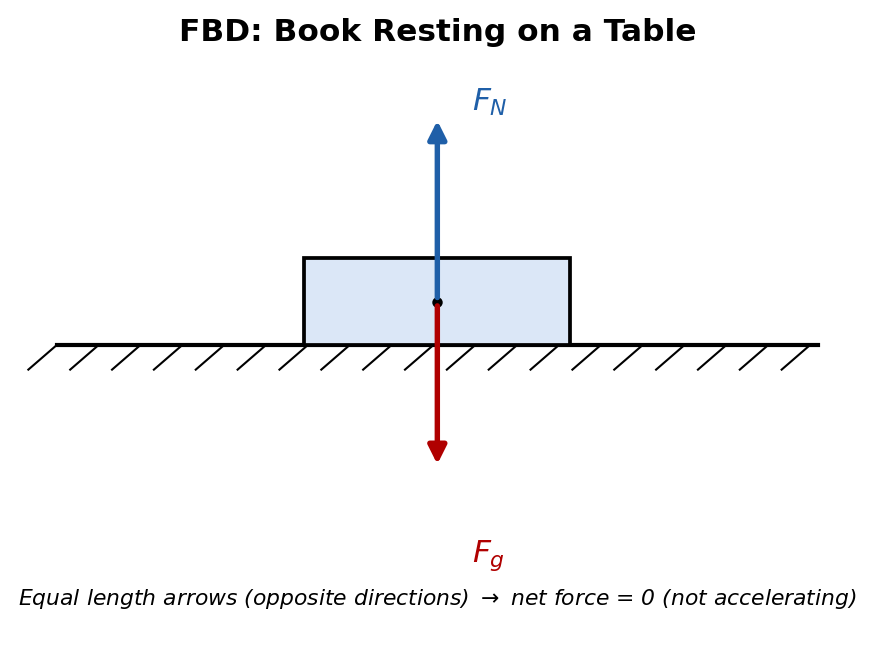
Worked Example: A book rests on a table. Gravity pulls the book down (Earth acting on the book) and the table pushes the book up (table acting on the book) — two different objects (Earth, table) each exerting one force on the book.
Free-Body Diagrams (FBDs)
- A simplified diagram showing ONE object as a single dot at its center of mass, with every external force on it drawn as a vector arrow starting from that dot
- Arrow length roughly shows relative magnitude; arrows are labeled by force type
- Two forces on the same object that happen to be equal and opposite are NOT automatically a "special pair" of any kind — they're just two forces that happen to balance
Worked Example: A box sits still on a table: FBD shows one dot, one arrow down labeled $F_g$, one arrow up labeled $F_N$, equal length (since the box isn't accelerating).
Choosing a Rotated Axis
- You can choose your coordinate axes in any orientation — nobody requires x to be horizontal and y to be vertical
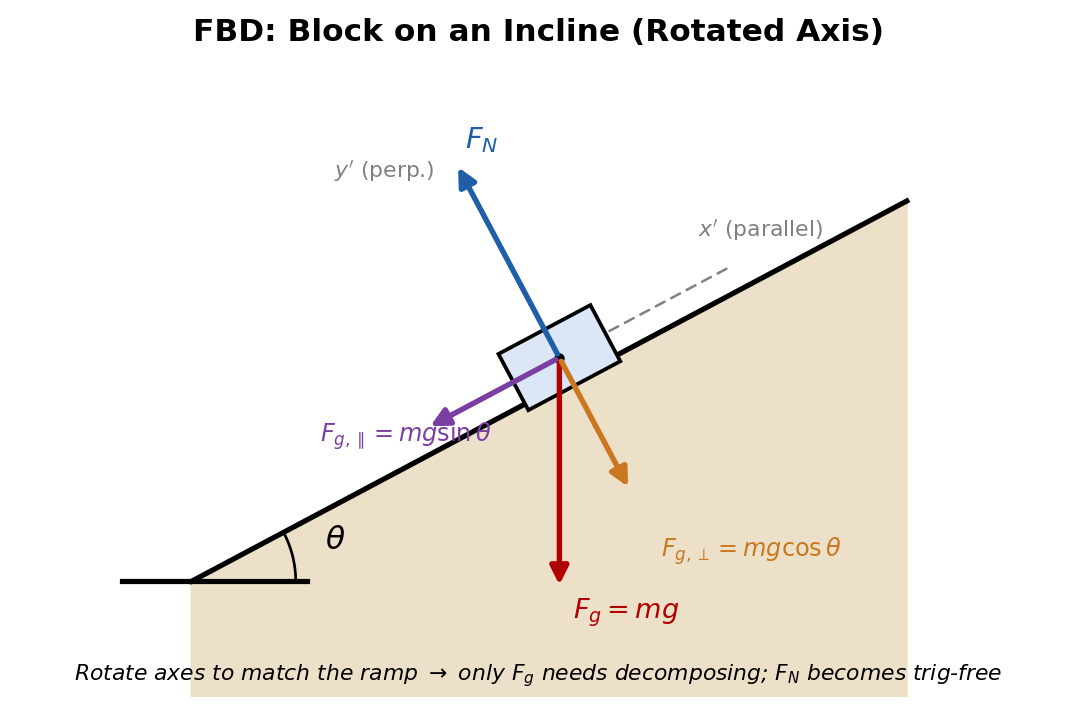
- Strategy: rotate the axis to align with the direction of acceleration whenever that simplifies the problem — most commonly, parallel/perpendicular to an incline surface
- Rotating the axis doesn't remove the need for trigonometry — it just moves which force needs decomposing (gravity, on an incline) and which force becomes trig-free (normal force, on an incline)
- On a FLAT surface, $F_g$ and $F_N$ are both already aligned with standard x-y axes (straight down/straight up) — neither needs decomposing. The incline's tilt is what misaligns one of them, and your axis choice decides which
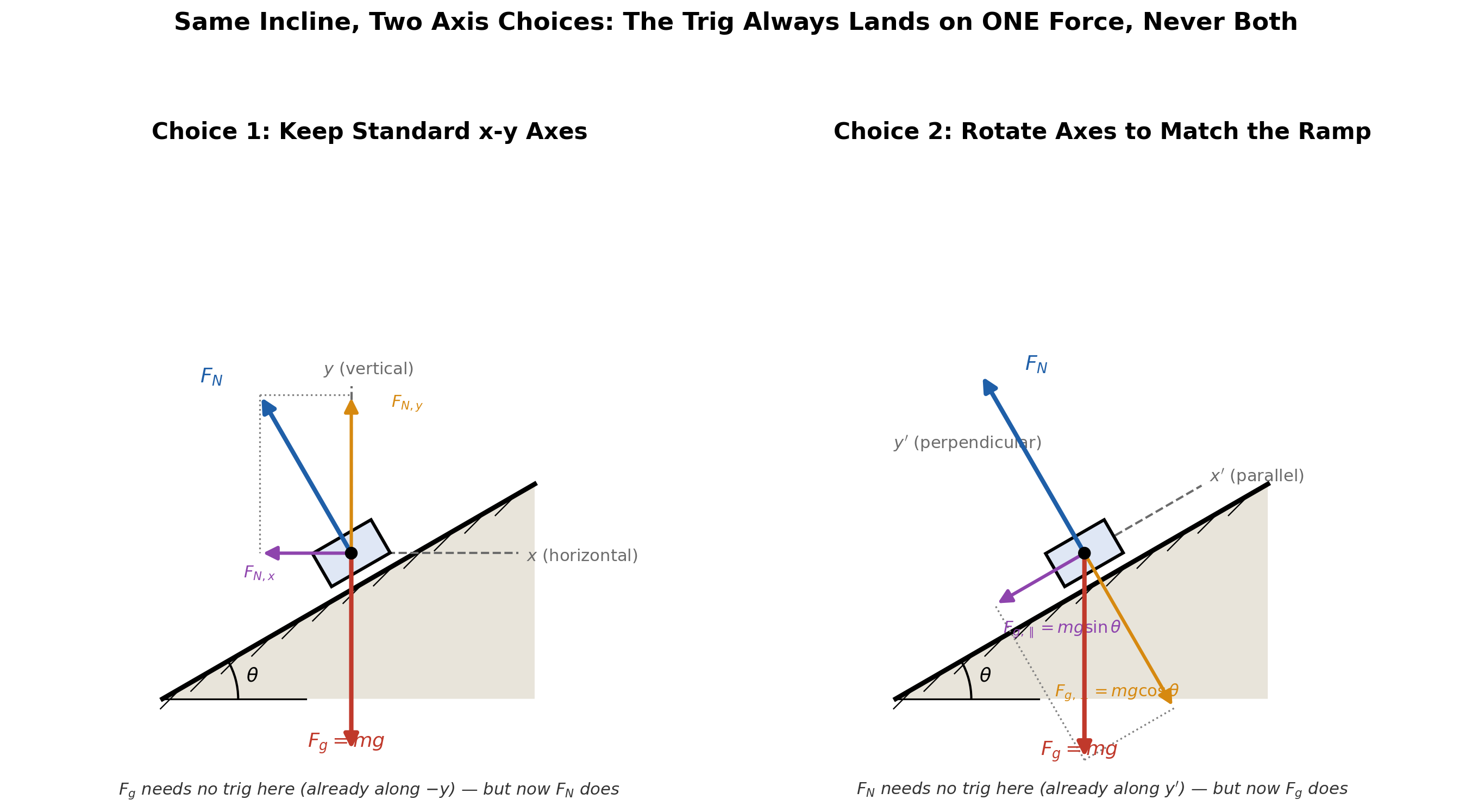
Worked Example: A block on a 30° incline: rotated axis gives $F_{g,\parallel} = mg\sin(30°)$ (component along the ramp, causing sliding) and $F_{g,\perp} = mg\cos(30°)$ (component into the ramp, balanced by the normal force).
Keep This Sheet!
These sheets build into your semester study guide. Keep them in order in a binder or folder — you'll want to flip back through them before quizzes, unit tests, and when AP exam review starts in the spring.