Topic 2.5: Newton's Second Law, Part 1 — Single-Object Systems
Name: _______________________________ Date: _______________
Before We Start: Yesterday's Recap
Yesterday, equilibrium meant $F_N = mg$ for someone standing still. What do you think has to change about that equation if the person is accelerating instead of standing still?
Today's New Concepts
AP CED Alignment: Unit 2, Topic 2.5 (Part 1 of 2)
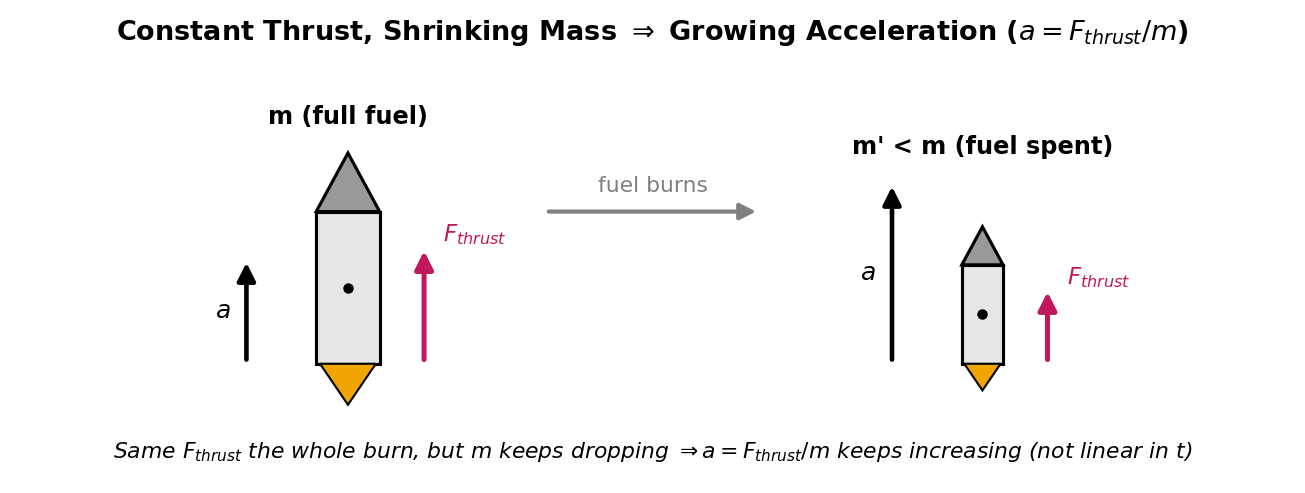
Newton's Second Law
- The net force on an object equals its mass times its acceleration
- Symbol: $F_{net} = ma$, or $a = \dfrac{F_{net}}{m}$
- Units: force in newtons (N), mass in kilograms (kg), acceleration in meters per second squared (m/s²)
- Equilibrium (Topic 2.4) is the special case where $a = 0$ — this is the same law, just the general case where $a$ can be anything
Worked Example: Standard process for any Newton's-second-law problem: draw the FBD, write $\Sigma F$ symbolically along the axis of interest with correct signs, set it equal to $ma$, solve symbolically for the unknown, THEN substitute numbers.
Elevator and Scale Problems
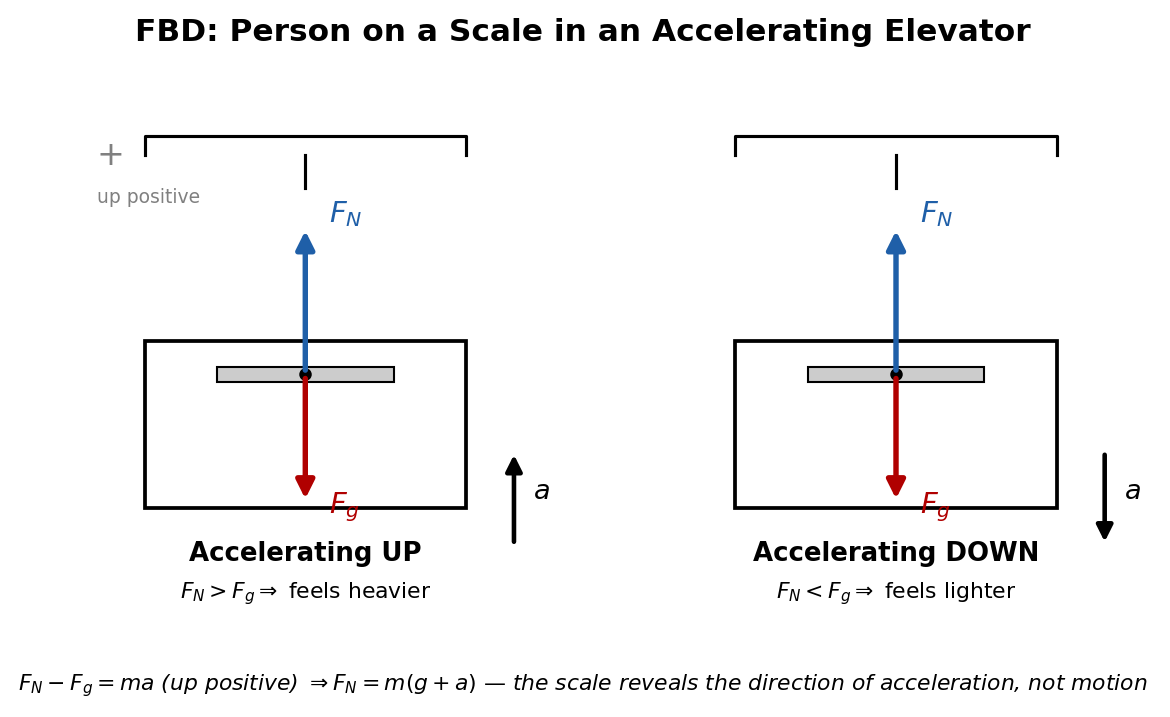
- Choosing up as positive: $F_N - mg = ma \implies F_N = m(g+a)$
- If accelerating upward ($a>0$): $F_N > mg$ (feels heavier)
- If accelerating downward ($a<0$): $F_N < mg$ (feels lighter)
- The scale reading tells you the direction of ACCELERATION, not necessarily the direction of motion — the object could be moving either way
Worked Example: A person's scale reads more than their normal weight — this means the elevator (and person) are accelerating upward, but they could be moving upward and speeding up, OR moving downward and slowing down.
Single-Object Incline Problems
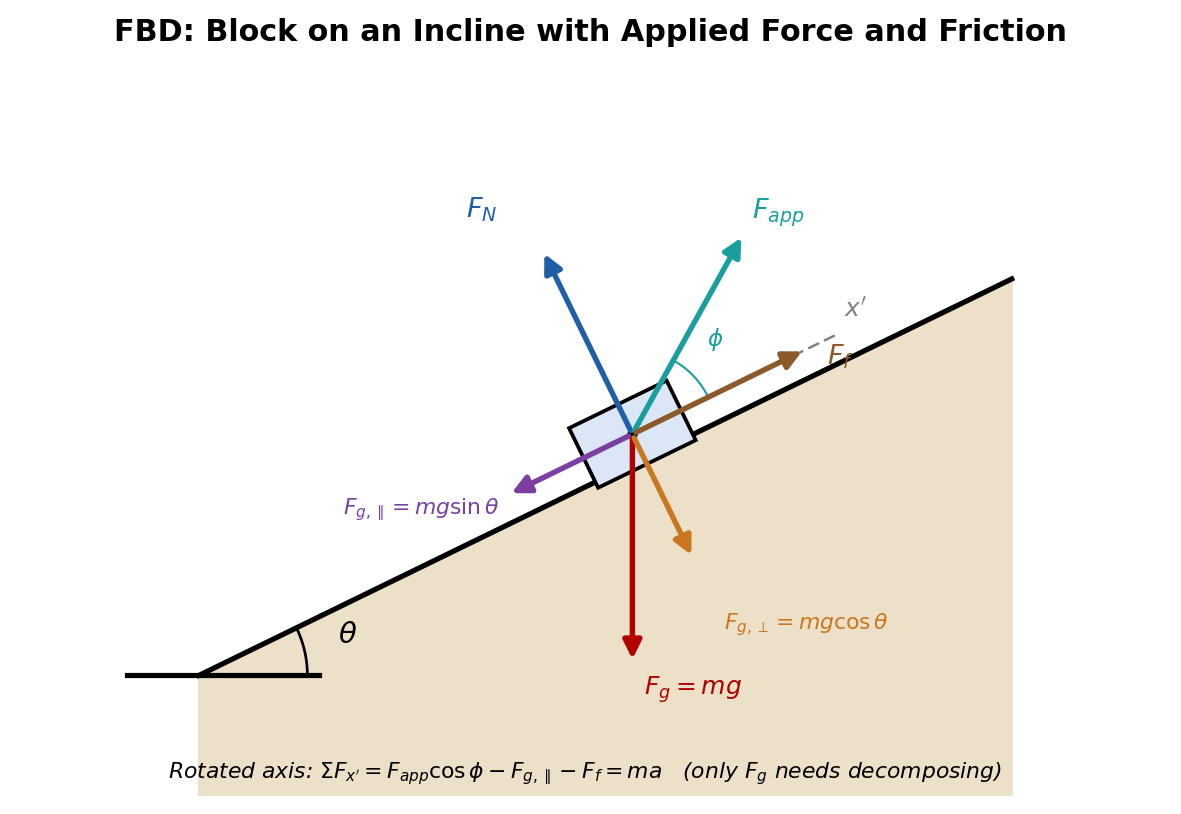
- Same rotated-axis strategy as Topic 2.2, now combined with Newton's second law: write $F_{net}$ along the ramp-parallel axis equal to $ma$
- On a frictionless incline, if gravity's parallel component is the only force along the ramp, $a = g\sin\theta$ — independent of mass, since mass cancels
Worked Example: A block pulled up a ramp by a rope at an angle, with friction opposing: $F_p\cos\theta_2 - F_f - mg\sin\theta_1 = ma$, solved symbolically for $a$ before any numbers are substituted.
Keep This Sheet!
These sheets build into your semester study guide. Keep them in order in a binder or folder — you'll want to flip back through them before quizzes, unit tests, and when AP exam review starts in the spring.