Topic 2.5: Newton's Second Law, Part 2 — Multi-Object Systems
Name: _______________________________ Date: _______________
Before We Start: Yesterday's Recap
Yesterday every problem had just one object. Today we connect two objects with a string, sharing one acceleration. Quick guess: is it easier to solve for that shared acceleration by looking at each object separately, or by treating the whole connected system as one bigger object?
Today's New Concepts
AP CED Alignment: Unit 2, Topic 2.5 (Part 2 of 2)
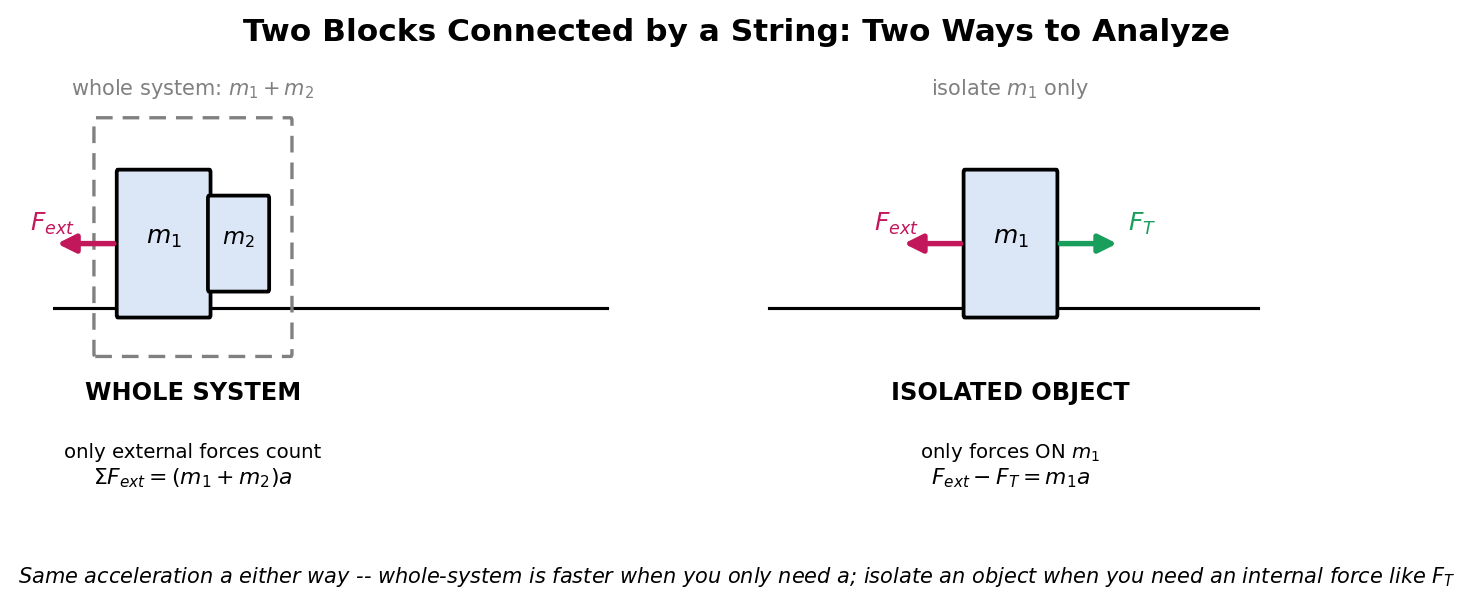
Two Ways to Solve a Connected System
- Method 1 — Whole system: combine both objects into one total mass, use ONLY external forces: $F_{net,ext} = m_{total},a$. Internal forces (like the string's tension) cancel out completely and never appear.
- Method 2 — Isolate one object: use only the forces on THAT object (including internal forces like tension), and its own mass: $F_{net,1} = m_1,a$
- Use Method 1 to find the shared acceleration quickly; use Method 2 (after finding $a$) to solve for an internal force like tension
Worked Example: Two blocks connected by a string, pulled by force $F$: whole system gives $a = \dfrac{F}{m_1+m_2}$; isolating the trailing block (only tension acts on it) gives $F_T = m_2 a = \dfrac{m_2 F}{m_1+m_2}$.
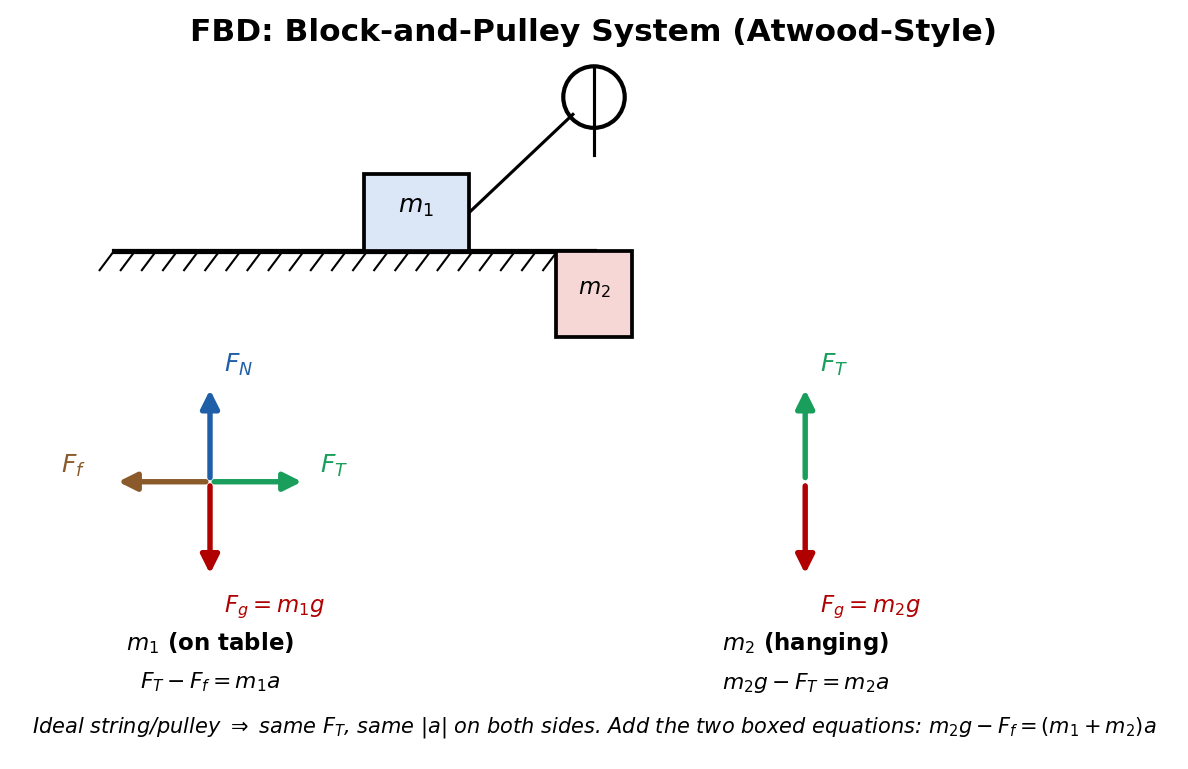
Worked Example: A block on a table connects over a pulley to a hanging mass. Isolating each object gives one equation apiece; adding them together eliminates tension and solves directly for the shared acceleration.
Center of Mass Acceleration Depends Only on External Force
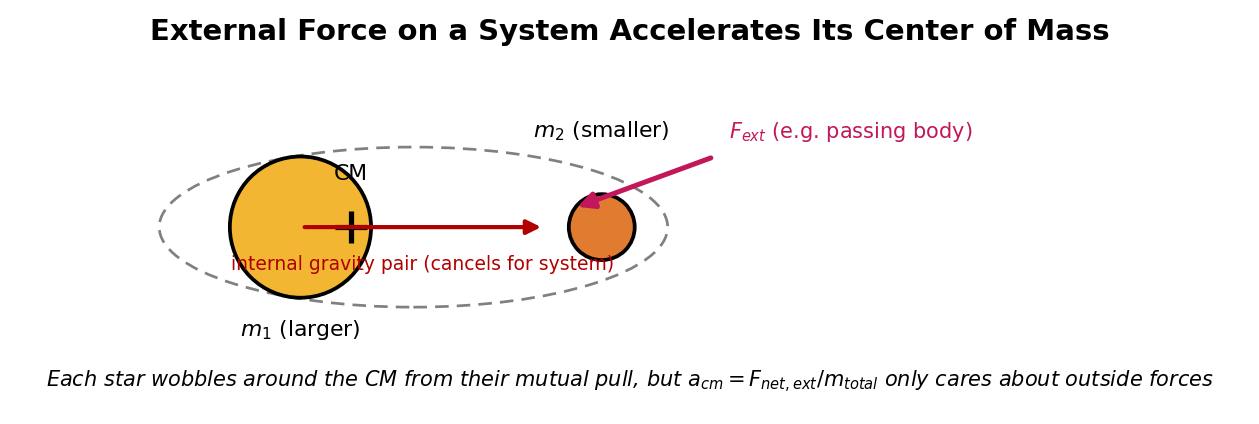
- $a_{cm} = \dfrac{F_{net,ext}}{m_{total}}$ — depends ONLY on the net force from OUTSIDE the system, never on internal interactions between the system's own parts
- Internal forces, no matter how complicated, can never change a system's own center-of-mass motion
Worked Example: Two stars orbit their shared center of mass, far from anything else. Each star individually moves in a circle (accelerating), but since there's no external force on the two-star system, the system's center of mass has zero acceleration.
The "String Breaks" Setup
- Before breaking: the connected objects share ONE acceleration — solve as a whole system
- After breaking: each object now has its OWN acceleration, from whatever forces still act on it alone — solve each object completely separately
- The center-of-mass equation still applies to the whole system throughout, using whatever total external force remains
Worked Example: Two crates connected by a string, one pulled by force $F$, both experiencing friction. After the string breaks, the trailing crate's acceleration is just $a_1 = f_1/m_1$ (friction alone), while the system's center-of-mass acceleration is still $a_{cm} = (F-f_1-f_2)/(m_1+m_2)$ — generally a different number.
Keep This Sheet!
These sheets build into your semester study guide. Keep them in order in a binder or folder — you'll want to flip back through them before quizzes, unit tests, and when AP exam review starts in the spring.