Unit 2 Test Review — Study Guide for Tonight
The Unit 2 test covers everything from Topics 2.1 through 2.9 — systems and center of mass, forces and free-body diagrams, all three of Newton's Laws, gravitational force, friction, spring forces, and circular motion. This post is a complete review of all nine topics, with worked practice problems (different numbers than anything on the actual test) so you can check your understanding before walking in. A few of these are the trickier "compare two related situations" problems we spent extra time on in class — those are worth reading slowly. You'll have a formula sheet on the test itself, so you don't need to memorize equations tonight — focus on knowing which equation to reach for and why.
Topic 2.1: Systems and Center of Mass
What to remember:
- Center of mass is a WEIGHTED average by position, not a simple average — heavier objects pull it toward them more.
- $x_{cm}=\dfrac{\sum m_ix_i}{\sum m_i}$
- The unweighted average of the positions is a classic wrong answer — don't fall for it.
Worked Example: Three objects sit on a line: $3.0\text{ kg}$ at $x=0\text{ m}$, $2.0\text{ kg}$ at $x=3.0\text{ m}$, $4.0\text{ kg}$ at $x=8.0\text{ m}$. Find the center of mass.
Solution: $x_{cm}=\dfrac{(3.0)(0)+(2.0)(3.0)+(4.0)(8.0)}{3.0+2.0+4.0}=\dfrac{0+6+32}{9}\approx4.22\text{ m}$.
Topic 2.2: Forces and Free-Body Diagrams
What to remember:
- On an incline, rotate your axis to run parallel/perpendicular to the surface — gravity splits into $mg\sin\theta$ (along the ramp) and $mg\cos\theta$ (into the ramp).
- The normal force balances the perpendicular component; nothing normally balances the parallel component unless something else (friction, a rope) is added.
Worked Example: An $8.0\text{ kg}$ block sits on a frictionless incline at $20°$. Find (a) the normal force, (b) the force needed (parallel to the incline) to hold the block motionless.
Solution: (a) $F_N=mg\cos\theta=(8.0)(9.8)\cos20°\approx73.7\text{ N}$. (b) $F_{hold}=mg\sin\theta=(8.0)(9.8)\sin20°\approx26.8\text{ N}$.
Topic 2.3: Newton's Third Law
What to remember:
- Newton's Third Law guarantees equal and opposite FORCES on two different objects — never equal accelerations.
- Since $a=F/m$, the lighter object always gets more acceleration from that same shared force.
Worked Example: Two skaters push off each other: Skater A ($45\text{ kg}$) and Skater B ($90\text{ kg}$). Skater A's acceleration during the push is $6.0\text{ m/s}^2$. Find Skater B's acceleration.
Solution: The push force is equal and opposite on both: $m_Aa_A=m_Ba_B \implies a_B=\dfrac{m_Aa_A}{m_B}=\dfrac{(45)(6.0)}{90}=3.0\text{ m/s}^2$ — half of Skater A's, since Skater B has twice the mass.
Topic 2.4: Newton's First Law
What to remember:
- Equilibrium means the net force is zero — not that no forces are acting.
- A two-cable problem needs BOTH the horizontal and vertical equations solved together — neither one alone is enough.
Worked Example: A $200\text{ N}$ sign hangs from two cables. Cable 1 makes a $30°$ angle with the ceiling; Cable 2 makes a $60°$ angle. Find both tensions.
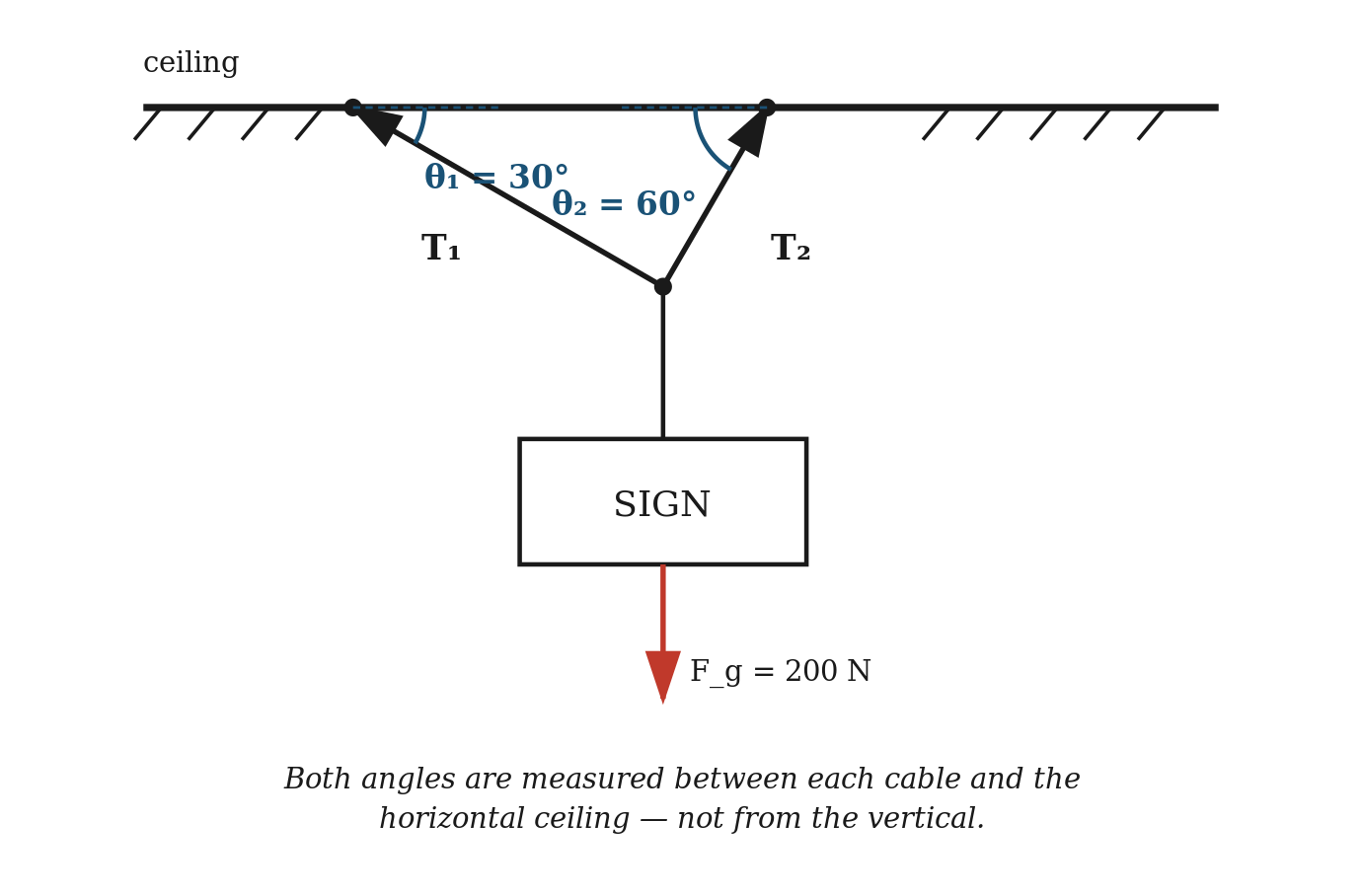 Both angles are measured off the ceiling itself (the horizontal), at the point where each cable is attached — not off the vertical. Cable 1's 30° is the shallower, more-horizontal cable; Cable 2's 60° is the steeper, more-vertical cable.
Solution: Horizontal: $T_1\cos30°=T_2\cos60°$. Vertical: $T_1\sin30°+T_2\sin60°=200$. Solving the pair together: $T_2\approx173\text{ N}$, $T_1=100\text{ N}$.
Topic 2.5: Newton's Second Law
What to remember:
- Treat a connected system as ONE object to find the shared acceleration — internal tension cancels out completely.
- Isolate ONE object only when you specifically need the internal force (tension) itself.
Worked Example (the "compare two setups" trap): Block A ($5.0\text{ kg}$) sits on a frictionless table, connected by a string over a pulley. Case 1: a hand pulls DOWN on the string with a constant force of $60\text{ N}$. Case 2: instead, an object whose WEIGHT is $60\text{ N}$ is hung from the string. Which case gives the larger acceleration? The larger tension?
Solution: Case 1: the tension IS the applied force — only Block A has mass in the system. $a_1=\dfrac{60}{5.0}=12\text{ m/s}^2$, $T_1=60\text{ N}$. Case 2: the hanging object has its own mass, $m_{hang}=\dfrac{60}{9.8}\approx6.12\text{ kg}$, and it has to accelerate too. $a_2=\dfrac{60}{5.0+6.12}\approx5.4\text{ m/s}^2$; $T_2=m_{hang}(g-a_2)\approx6.12(9.8-5.4)\approx27.0\text{ N}$. Case 1 wins on both — $a_1>a_2$ and $T_1>T_2$ — even though the force was $60\text{ N}$ either way. A hanging weight is not the same as a hand pulling with that same force, because the hanging object brings its own inertia into the system.
Topic 2.6: Gravitational Force
What to remember:
- $F_g=\dfrac{Gm_1m_2}{r^2}$ — inverse-square, so doubling distance quarters the force, not halves it.
- With three or more objects, whether forces ADD or CANCEL depends entirely on their directions — you have to think about geometry, not just plug into the formula once.
Worked Example (three bodies, not two): Three identical asteroids $X$, $Y$, $Z$ ($3.0\times10^{10}\text{ kg}$ each) lie in a straight line, with $Y$ exactly halfway between $X$ and $Z$, $4.0\times10^5\text{ m}$ between each adjacent pair. Find the net force on (a) $Y$, the middle asteroid, and (b) $X$, an end asteroid.
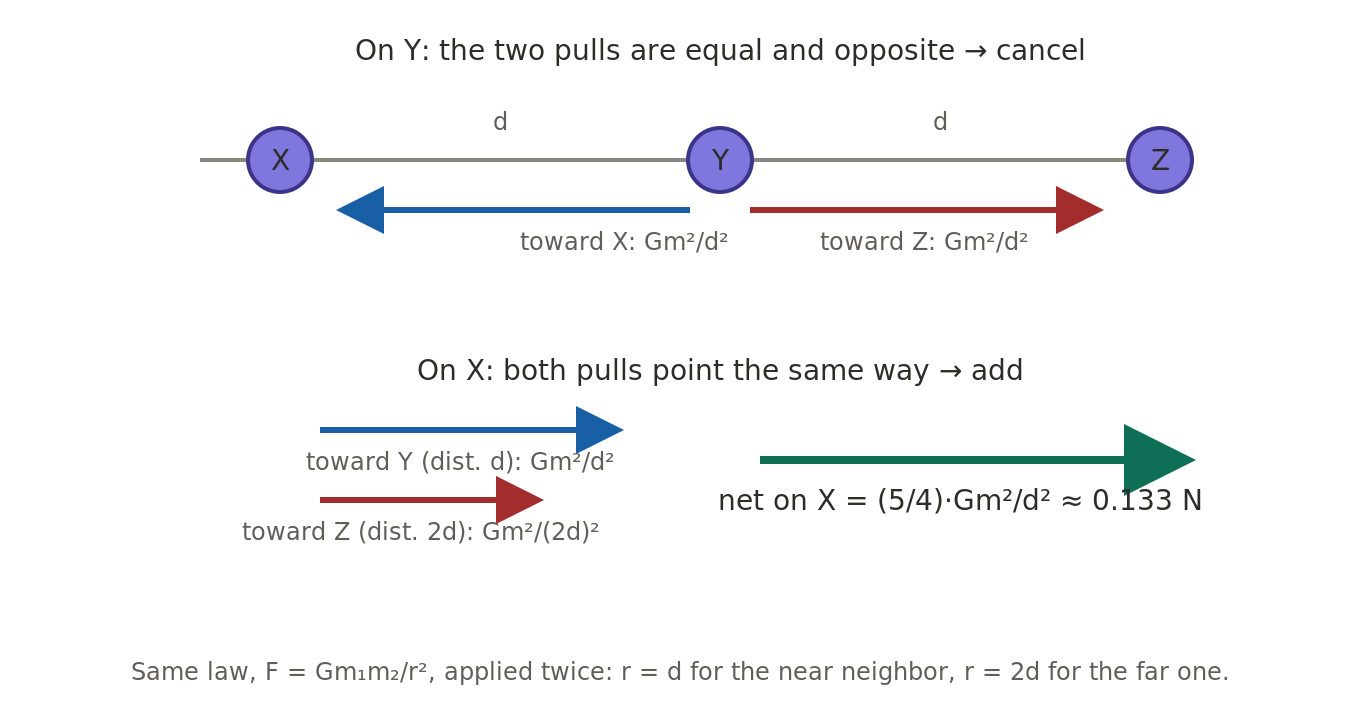 Y sits exactly between X and Z, so its two pulls are equal and opposite and cancel. X only has one neighbor on its near side, so both pulls on X point the same way and add.
Solution: (a) $Y$ feels equal pulls toward $X$ and toward $Z$ (same distance both ways) — but they point in OPPOSITE directions, so they cancel: $F_{Y,net}=0$. (b) $X$ feels a pull toward $Y$ (close) and toward $Z$ (farther, but same overall direction) — these ADD instead: $F_{X,net}=\dfrac{Gm^2}{d^2}+\dfrac{Gm^2}{(2d)^2}=\dfrac{5}{4}\cdot\dfrac{Gm^2}{d^2}\approx0.469\text{ N}$. The end asteroid feels a clearly bigger net pull than the middle one, even though every individual pair is identical.
Try this one yourself (answer at the bottom): Two satellites, each $500\text{ kg}$, orbit at the same distance from Earth's center, $r=7.0\times10^6\text{ m}$. If a third, identical satellite is moved to twice that distance ($1.4\times10^7\text{ m}$), how does the gravitational force Earth exerts on it compare to the force on the closer two?
Topic 2.7: Friction
What to remember:
- Static friction adjusts up to a maximum ($F_{f,s}\le\mu_sN$); kinetic friction is fixed once something is sliding ($F_{f,k}=\mu_kN$).
- "On the verge of slipping" means static friction is AT its maximum — that's the one moment you can set $F_{f,s}=\mu_sN$ exactly.
Worked Example: A $5.0\text{ kg}$ crate on an incline is exactly on the verge of slipping at $\theta=24°$. (a) Find $\mu_s$. (b) The incline is tilted further to $35°$ (now sliding, $\mu_k=0.28$). Find the crate's acceleration.
Solution: (a) At the verge of slipping: $\mu_s=\tan(24°)\approx0.445$. (b) Now sliding, switch to kinetic friction: $a=g\sin35°-\mu_kg\cos35°=(9.8)(0.574)-(0.28)(9.8)(0.819)\approx3.37\text{ m/s}^2$.
Topic 2.8: Spring Forces
What to remember:
- $F_s=k\Delta x$ — $k$ is a fixed property of the spring itself, never the mass hanging on it.
- Find $k$ from one trial, then reuse the SAME $k$ to predict a different trial.
Worked Example: A $0.50\text{ kg}$ mass hung from a vertical spring stretches it $0.090\text{ m}$. (a) Find $k$. (b) Predict the stretch for a $1.2\text{ kg}$ mass instead.
Solution: (a) $k=\dfrac{mg}{\Delta x}=\dfrac{(0.50)(9.8)}{0.090}\approx54.4\text{ N/m}$. (b) $\Delta x_{new}=\dfrac{(1.2)(9.8)}{54.4}\approx0.216\text{ m}$.
Topic 2.9: Circular Motion
What to remember:
- "Centripetal force" is never a new force on its own — it's whatever real force (tension, friction, gravity, normal force) happens to point toward the center.
- Friction can supply the ENTIRE centripetal force by itself — no string, no banking needed.
Worked Example (friction alone): A coin sits on a flat, horizontal, spinning platform at $r=0.40\text{ m}$ from the center. The coefficient of static friction is $\mu_s=0.42$, and friction is the only horizontal force on the coin. Find the maximum angular speed $\omega$ before the coin slides off.
Solution: At maximum speed, static friction is at its max and supplies the whole centripetal force: $\mu_smg=m\omega^2r \implies \omega_{max}=\sqrt{\dfrac{\mu_sg}{r}}=\sqrt{\dfrac{(0.42)(9.8)}{0.40}}\approx3.21\text{ rad/s}$ — mass cancels out completely, same as every other circular motion problem this unit.
Test-Day Reminders
- You'll get a formula sheet — you don't need equations memorized, but you DO need to know which one to use and why.
- Calculator is allowed the whole test, matching the real AP exam policy.
- Set up every equation symbolically first (with letters), then substitute numbers — it's much easier to catch a wrong equation choice before you've done any arithmetic.
- The three "compare two situations" problems in this unit (2.5, 2.6, and 2.9 above) show up on real AP exams constantly. If those three make sense to you, you're in great shape.
Missed a day this unit or want a deeper refresher on one topic? Rewatch the video linked in that day's lesson page — this review is meant to jog your memory, not replace what we covered in class.
Answer to the "try this yourself" problem: Gravitational force follows the inverse-square law, so doubling the distance means dividing the force by $2^2=4$. The farther satellite feels only one-fourth the gravitational force that each of the closer two feels — even though it's the exact same mass.