Topic 2.6: Gravitational Force: Why a Scale Doesn't Always Tell the Truth
Remember the Principia story from Newton's third law — the plague-years farm at Woolsthorpe, the apple, the twenty years of work before it all finally appeared in 1687? That same book didn't just hold his three laws of motion. It also held his law of universal gravitation: the idea that whatever pulls an apple down might reach all the way out to the Moon, with no difference between "earthly" falling and "celestial" orbiting. One force, one equation, everywhere. Johannes Kepler had already shown that planets sweep out predictable, patterned orbits — Newton's gravitation law is what finally explained why.
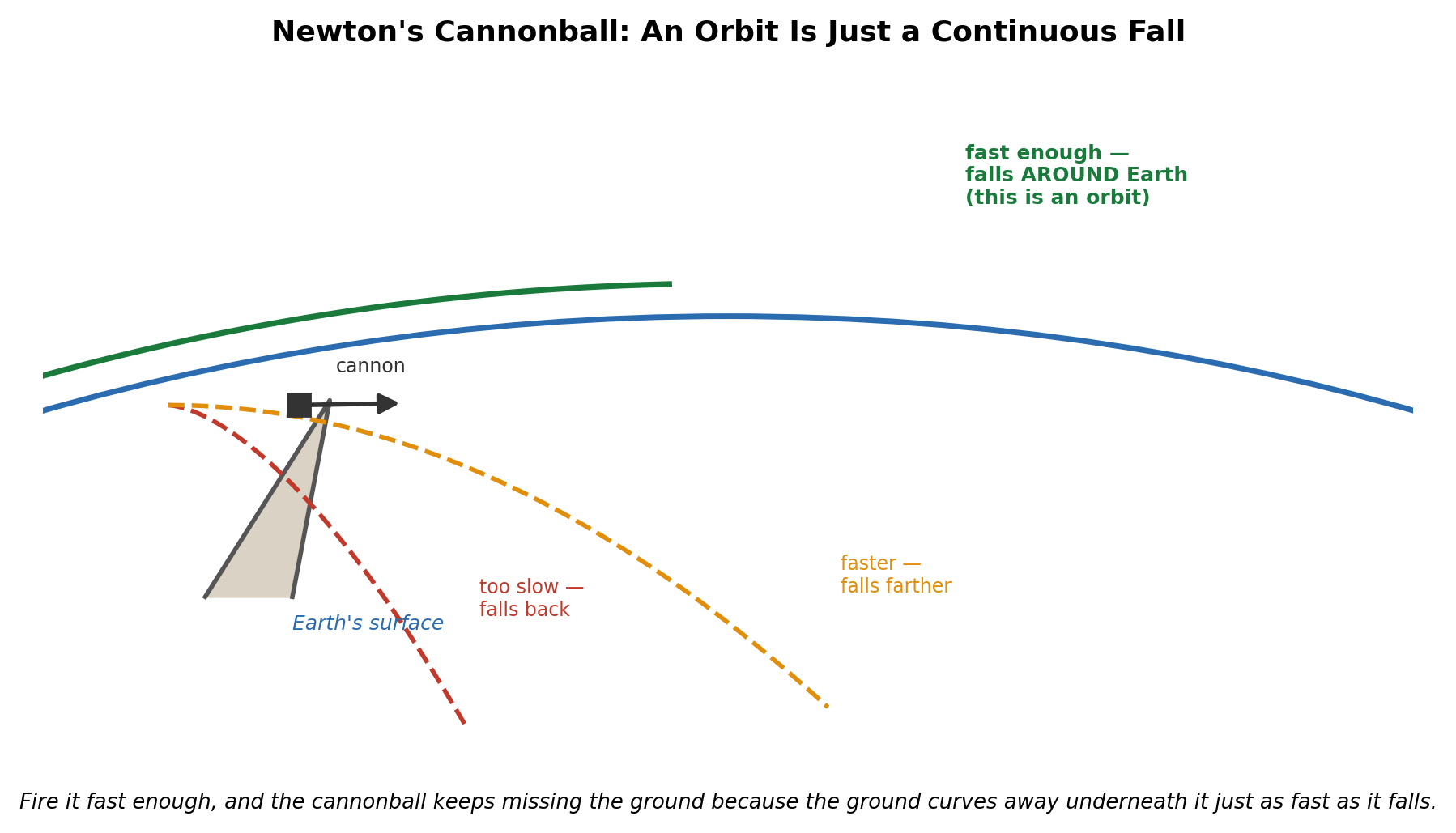
Newton's own illustration of the idea, updated: an orbit isn't the absence of gravity — it's a fall that never lands, because the ground keeps curving away.
It isn't just a historical curiosity, either. Every GPS, weather, and communications satellite in geostationary orbit sits at almost exactly 35,786 kilometers up, and that number is calculated using this exact equation — setting the gravitational force equal to what's needed to keep something moving in a circle, then solving for the distance where the orbital period comes out to 24 hours. Same idea Newton worked out on a farm during a plague, still running the satellites overhead right now.
Any two objects with mass pull on each other gravitationally — Newton's law of universal gravitation says the force is proportional to each mass and inversely proportional to the SQUARE of the distance between their centers of mass: $F_g = \dfrac{Gm_1m_2}{r^2}$, where $G = 6.67\times10^{-11}\ \text{N}\cdot\text{m}^2/\text{kg}^2$. It's always attractive, always along the line connecting the two centers of mass, and doubling the distance cuts the force to one-fourth — not one-half — because of that square.
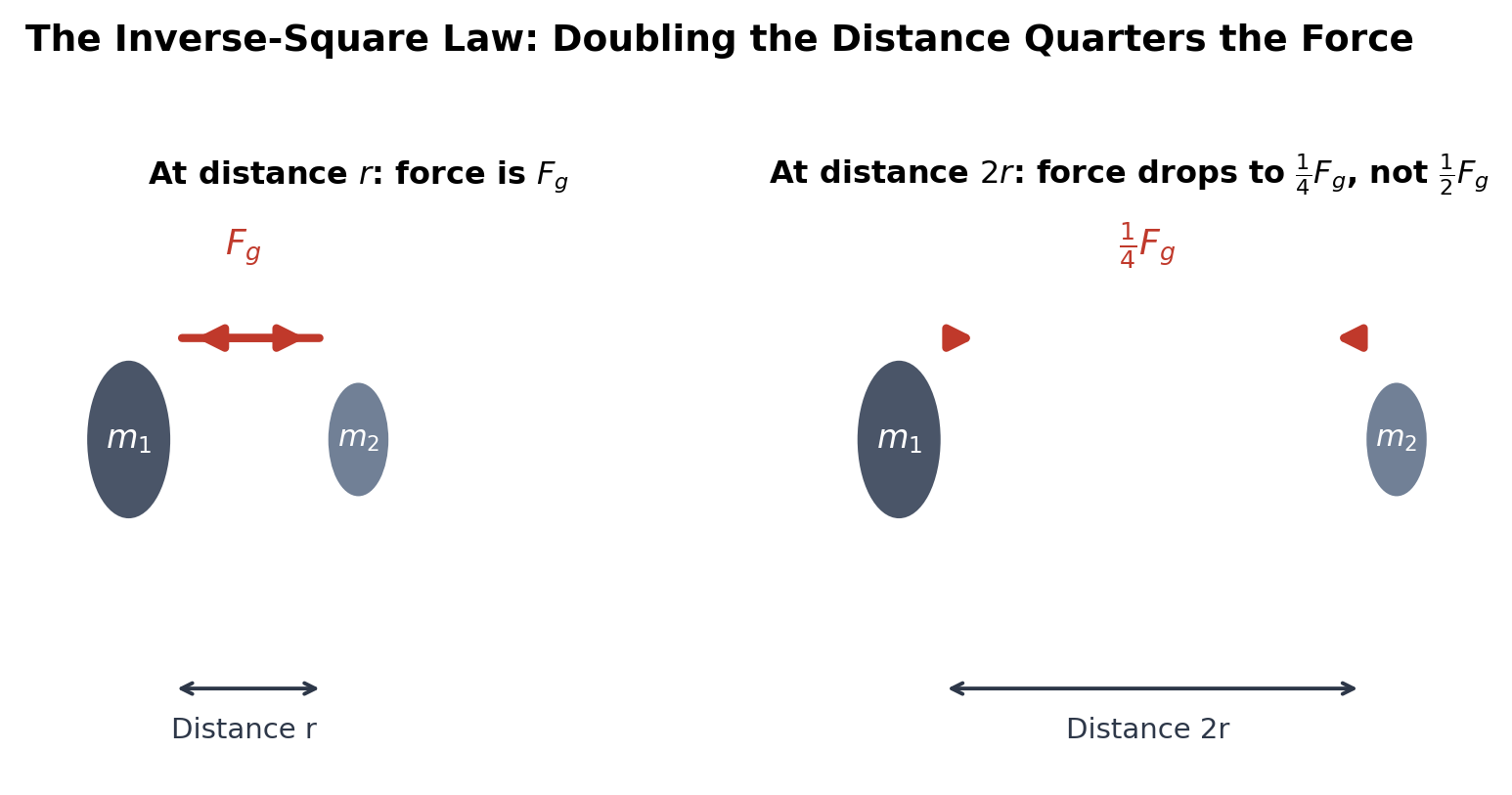 Double the distance, quarter the force — the square in the denominator means distance changes hit harder than mass changes.
Divide the force by a test object's own mass and the test object cancels out, leaving the gravitational field: $g = \dfrac{GM}{r^2}$, which depends only on the source mass and distance. Near Earth's surface this works out to $g\approx9.8\text{ m/s}^2$. Weight is just a name for the gravitational force acting on an object near a large body: $F_g = mg$ — same mass, different weight on a different world.
Here's the twist that connects straight back to the elevator lab: a scale doesn't measure gravity directly. It measures the normal force pushing back on you — your apparent weight. When you're not accelerating, apparent weight and true weight match, so nobody notices the difference. The moment you accelerate, they split apart, exactly like the elevator lab's $F_N = m(g\pm a)$. Push that to the extreme and you get true weightlessness: if gravity is the ONLY force acting on you — genuine free fall — the normal force is zero, so the scale reads zero. Not because gravity switched off, but because nothing is pushing back on you anymore. That's also why astronauts orbiting Earth float: they're in continuous free fall around the planet, so there's no floor pushing up on them, even though Earth's gravity out there is still almost full strength.
Try It: Planet Hopper
Compare weight, mass, and jump height on other worlds, and design a planet's gravity. Dynamics Dungeon: Planet Hopper
Try It: Moon Orbit
Find the speed, period, and gravity for a satellite in orbit, and the geostationary orbit. Dynamics Dungeon: Moon Orbit
Videos
- Introduction to the Force of Gravity and Gravitational Mass — Flipping Physics
Practice Problems
- Write Newton's law of universal gravitation. What does each symbol represent?
- Two objects are a fixed distance apart. If both of their masses are doubled, what happens to the gravitational force between them?
- Two objects are a distance $r$ apart, with gravitational force $F_g$ between them. If the distance is cut in half, find the new force in terms of $F_g$.
- A planet has 4 times Earth's mass and twice Earth's radius. An object weighs $W_E$ on Earth. Find the object's weight on this planet, in terms of $W_E$.
- A 50 kg person stands on a scale in an elevator accelerating downward at 1.5 m/s². Using $g=9.8\text{ m/s}^2$, find the scale's reading.
- A satellite orbits Earth at distance $r$ from Earth's center. a) Write a symbolic expression for the gravitational field $g$ at the satellite's location. b) If the satellite moves to an orbit at distance $2r$, is the field there more than, less than, or exactly one-fourth its original value?
- Explain, using forces, why an astronaut orbiting Earth experiences apparent weightlessness even though Earth's gravitational field at that altitude is still nearly as strong as at the surface.
- A person stands on a scale in an elevator that is moving downward while slowing down. Which correctly describes the scale's reading compared to the person's true weight $mg$? (A) Less than $mg$, because the elevator's acceleration is directed upward (B) Less than $mg$, because the elevator's acceleration is directed downward (C) More than $mg$, because the elevator's acceleration is directed upward (D) Exactly $mg$, because the elevator is still moving downward