Topic 2.9: Circular Motion: The Scientist Who Beat Newton to It
You already know Isaac Newton gets the historical credit for connecting force and circular motion. But someone else worked out the exact formula for the force needed to keep something moving in a circle — years before Newton published anything on the subject. Who, and why did history hand Newton the credit instead?
The answer is the Dutch scientist Christiaan Huygens. In 1659 — nearly three decades before Newton's Principia appeared in 1687 — Huygens had already derived what we now call centripetal force, using it to analyze pendulum clocks and spinning objects. But he didn't rush to publish the full derivation. It only appeared in print in 1703, after his death. By then, Newton's more complete framework had already taken over the scientific conversation, so Huygens rarely gets the credit in intro textbooks — even though he beat Newton to this exact piece of math by decades.
It's the same pattern as Robert Hooke and his spring-law anagram: a correct, important result from a scientist who published a little too cautiously, or a little too late, to keep the lasting credit.
Centripetal Acceleration and Force
An object moving in a circle at constant SPEED is still accelerating, because its velocity's direction is constantly changing. This acceleration always points toward the center of the circle:
$$a_c = \frac{v^2}{r}$$
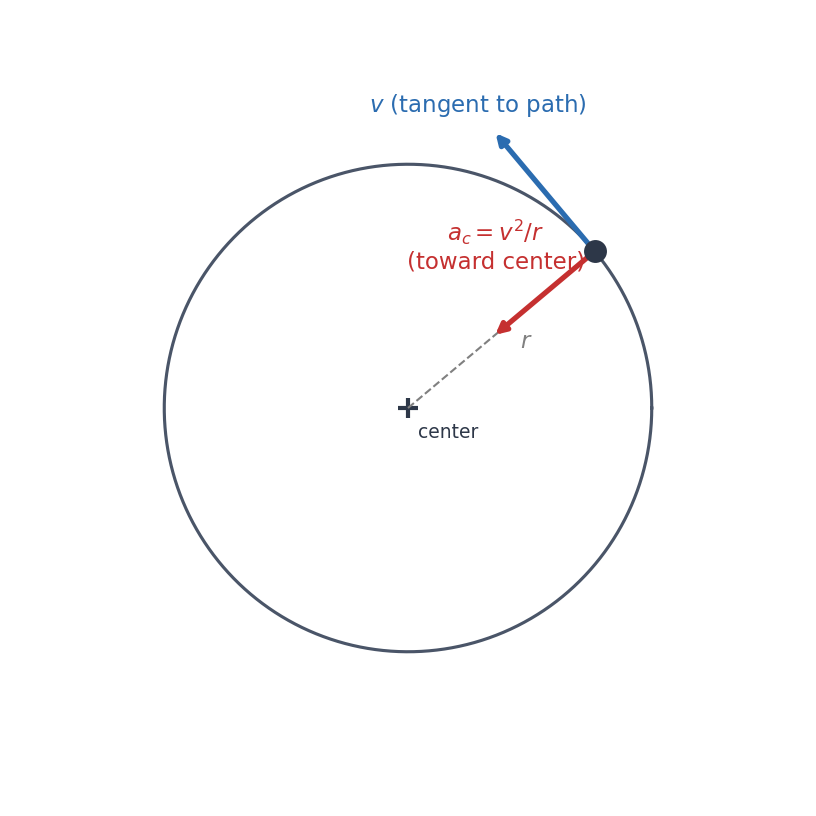
The velocity is always tangent to the circle; the centripetal acceleration always points toward the center — the two are always perpendicular.
Since there's an acceleration, Newton's Second Law says there must be a net inward force causing it. Importantly, "centripetal force" isn't a new, separate type of force — it's just a label for whatever real forces (tension, gravity, friction, normal force) happen to add up to a net inward force in a given situation:
$$F_{net} = \frac{mv^2}{r}$$
The Classic Vertical-Loop Problem
A roller coaster car crests the very top of a vertical loop. Two forces point toward the center there — gravity and the normal force from the track — both pulling the car down, toward the loop's center. The car's minimum safe speed at the top is the speed at which the normal force just reaches zero and gravity alone supplies the whole centripetal force: $mg = \dfrac{mv^2}{r} \implies v = \sqrt{gr}$. Notice the mass cancels out completely — a heavier coaster car needs exactly the same minimum speed as a lighter one to keep contact with the track.
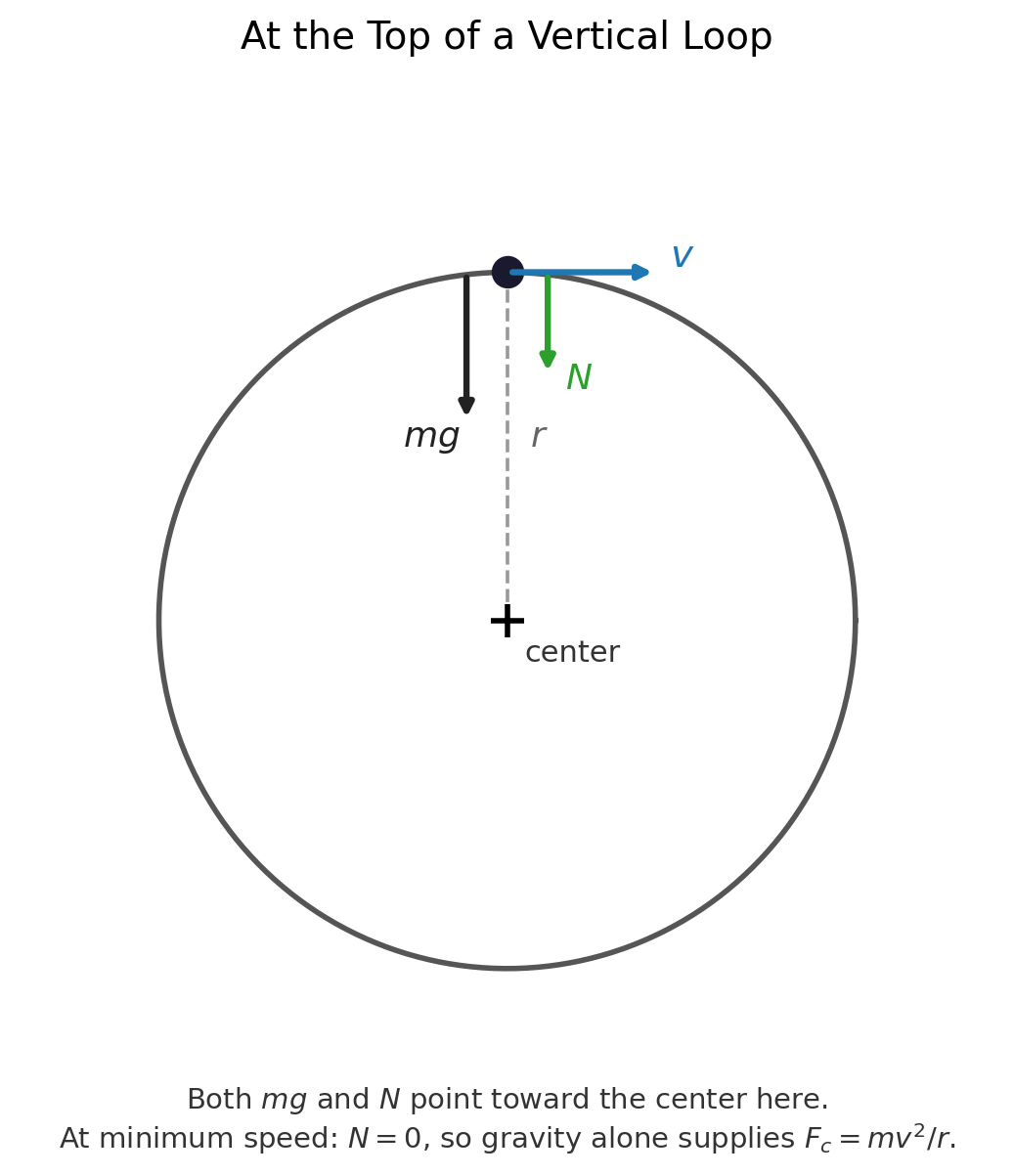 Both $mg$ and $N$ point toward the center at the top of the loop — at minimum speed, $N=0$ and gravity alone supplies the centripetal force.
Banked Curves Without Friction
Highway engineers lean on the same idea to design banked curves. On a frictionless banked curve, only gravity and the normal force act on the car — no friction needed at all. The tilted normal force splits into two pieces: its vertical component balances gravity, and its horizontal component supplies the centripetal force. Dividing those two equations to eliminate both $N$ and $m$ gives a clean result — $\tan\theta = \dfrac{v^2}{rg}$ — so a curve's banking angle alone, with no friction required, sets exactly one speed it's designed for.
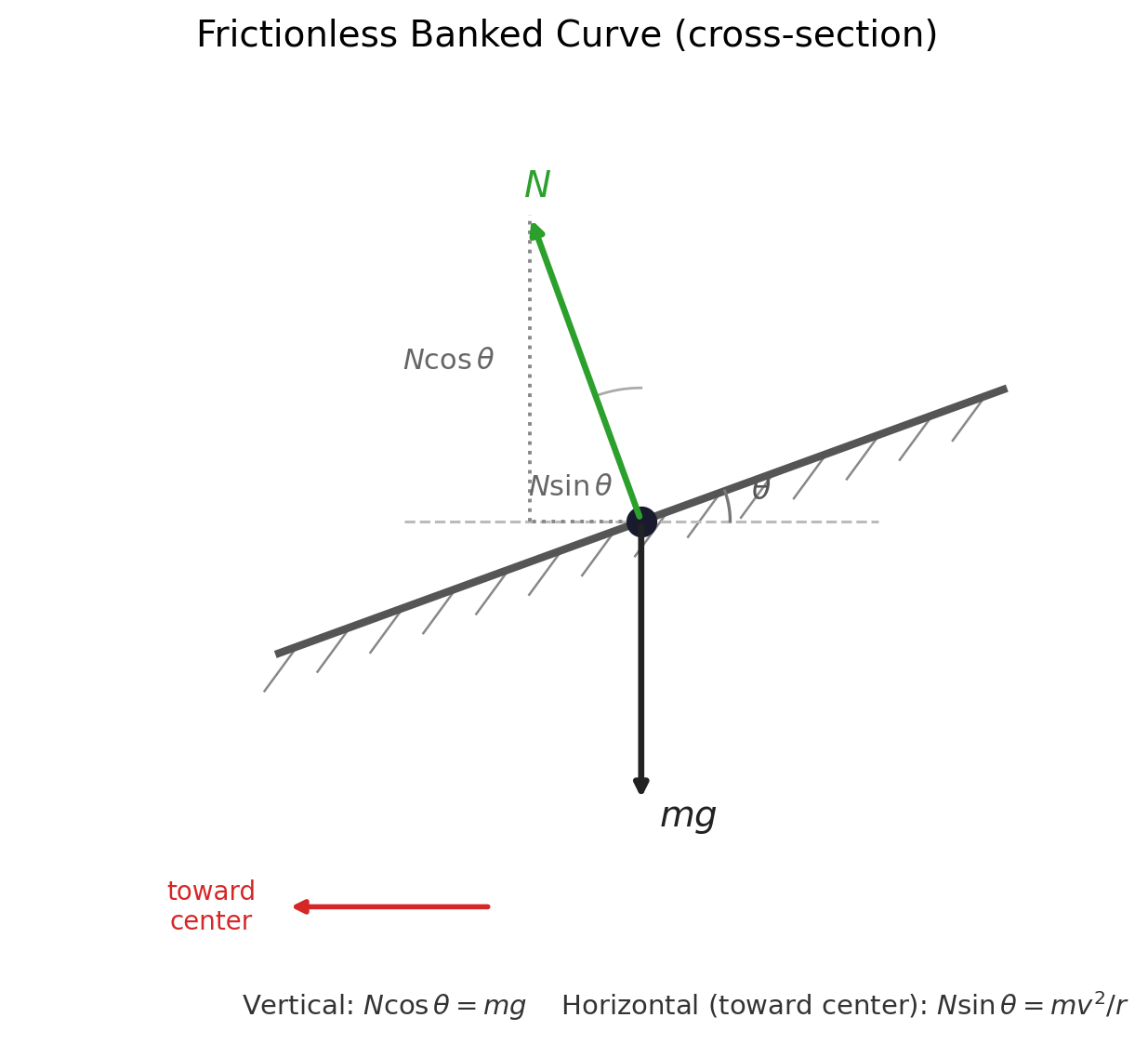 The normal force's horizontal component supplies the centripetal force; its vertical component balances gravity.
The Kepler Connection
Circular motion connects directly to something we previewed back in our gravitation lesson: Johannes Kepler's laws of planetary motion. Kepler found that for roughly circular orbits, the square of a planet's orbital period is proportional to the cube of its orbital radius — Kepler's Third Law, $T^2 \propto r^3$. That relationship falls directly out of setting gravitational force equal to the centripetal force needed to hold a planet in orbit — exactly the kind of reasoning Huygens was doing in 1659, just applied to the solar system instead of a pendulum.
Practice Problems
- A ball moves in a circle of radius $2.5\text{ m}$ at a constant speed of $6.0\text{ m/s}$. Find its centripetal acceleration.
- A $0.20\text{ kg}$ ball on a string moves in a horizontal circle of radius $0.80\text{ m}$ at $4.0\text{ m/s}$. Find the tension in the string.
- A frictionless banked curve has radius $80\text{ m}$ and is banked at $25°$. Find the speed at which a car can round it with no reliance on friction.
Try It: Loop the Loop
Find the speed a cart needs to stay on a vertical loop and the normal force on the rider. Dynamics Dungeon: Loop the Loop
Try It: Banked Curve
Find the ideal speed for a banked curve and the maximum speed on a flat curve. Dynamics Dungeon: Banked Curve
Further Reading
- Centripetal Acceleration Introduction (Flipping Physics, 6:20) (video)
- Centripetal Force Introduction and Demonstration (Flipping Physics, 5:25) (video)
- Introductory Centripetal Acceleration Problem - Cylindrical Space Station (Flipping Physics, 5:59) (video)
- Introductory Centripetal Force Problem - Car over a Hill (Flipping Physics, 7:31) (video)
- What is the Maximum Speed of a Car at the Top of a Hill? (Flipping Physics, 3:49) (video)
- Determining the Force Normal on a Toy Car moving up a Curved Hill (Flipping Physics, 5:06) (video)
- Mints on a Rotating Turntable - Determining the Static Coefficient of Friction (Flipping Physics, 6:47) (video)