Topic 3.1: Translational Kinetic Energy — The Argument That Split 17th-Century Physics
Suppose two objects collide. What quantity does nature actually keep constant? In the late 1600s, physicists had a real, heated argument over exactly this question — and it happened at almost the same moment Newton was writing his Principia.
Starting in 1686, the German mathematician Gottfried Leibniz — who co-invented calculus around the same time as Newton — published a direct challenge to the followers of René Descartes, who believed the conserved "quantity of motion" in a collision was simply mass times speed, $mv$. Leibniz used a clever thought experiment to argue that couldn't be the whole story, and that the true conserved quantity — he called it vis viva, Latin for "living force" — was proportional to mass times speed squared, $mv^2$. The dispute, now called the vis viva controversy, dragged on for decades and split European physicists into two camps.
Leibniz turned out to be onto something real: it took until the 1800s for physicists to add the missing factor of one-half and arrive at what we now call kinetic energy, $K=\tfrac12mv^2$. Descartes' original quantity, $mv$, wasn't wrong either — it just measures something different, which is exactly what momentum turns out to be, covered later this year in Unit 4.
What Kinetic Energy Actually Is
Kinetic energy is the energy an object has because it's moving: $K=\tfrac12mv^2$, measured in joules. Because mass is always positive and speed-squared is always positive (squaring erases any negative sign), kinetic energy can never be negative — the smallest it can ever be is exactly zero, when an object isn't moving at all.
Because kinetic energy depends on the square of speed, it behaves in a way that catches people off guard: doubling an object's speed doesn't double its kinetic energy — it quadruples it. Tripling the speed makes kinetic energy nine times larger. And because direction disappears once you square a velocity, kinetic energy only ever tracks speed, never which way something is moving.
The more surprising idea is that kinetic energy depends on who's doing the measuring. Speed itself is relative — it depends on the observer's own motion — so the same object, at the same instant, can have genuinely different kinetic energy values for two different observers.
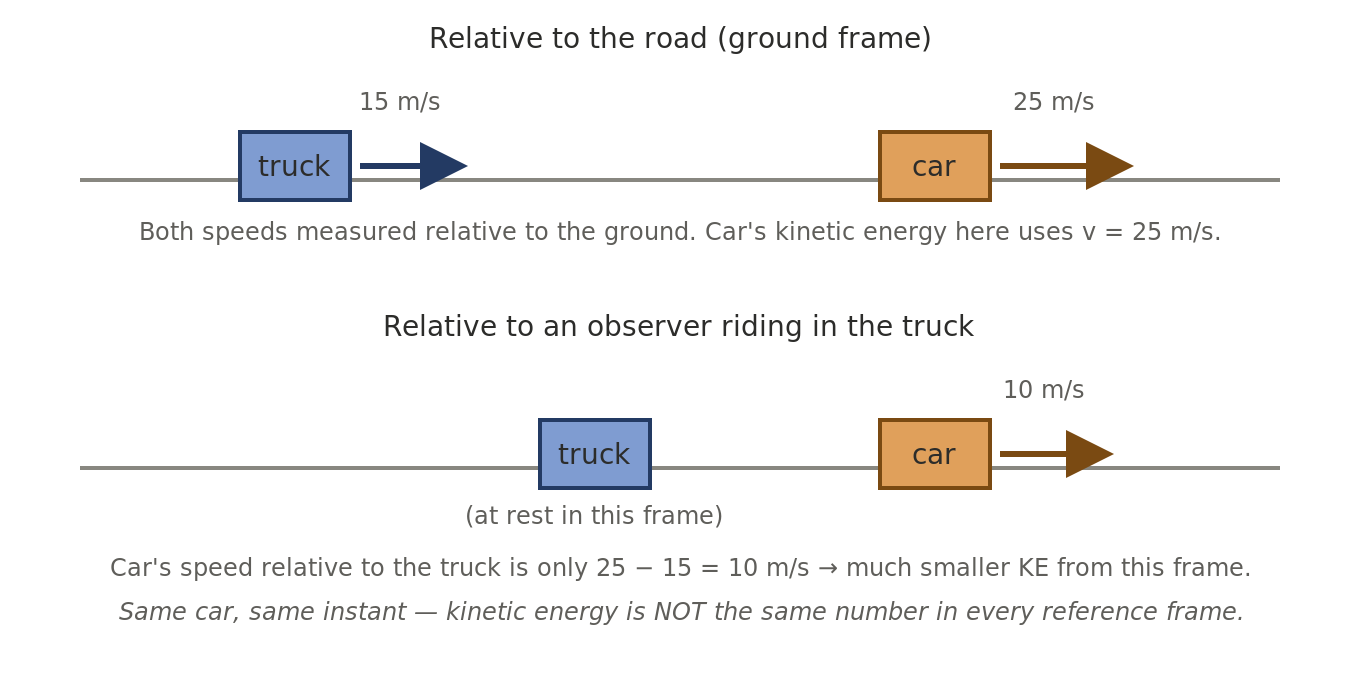 Same car, same instant — but the car's speed (and therefore its kinetic energy) is different depending on whether you measure it relative to the road or relative to the truck.
Picture a car traveling 25 m/s relative to the road, passing a truck moving 15 m/s in the same direction. Someone standing on the ground would calculate the car's kinetic energy using 25 m/s. But the person driving the truck would measure the car pulling ahead at only the difference between the two speeds — 10 m/s — and would calculate a much smaller kinetic energy for that same car, at that same instant. Neither observer is wrong; they're just measuring from different reference frames.
Try It: Stopping Distance
See how kinetic energy grows with the square of speed and sets the stopping distance. Energy Empire: Stopping Distance
Videos
- Introduction to Kinetic Energy with Example Problem — Flipping Physics
Practice Problems
- A 2.0 kg object moves at 3.0 m/s. Find its kinetic energy.
- A ball is thrown straight up. At the exact peak of its path, is the ball's kinetic energy positive, negative, or zero? Explain.
- A 0.20 kg object starts from rest and reaches a speed of 5.0 m/s. Find its final kinetic energy and its change in kinetic energy since it started from rest.
- The position of a 5 kg object moving in one dimension changes from $x=8\text{ m}$ at $t=4\text{ s}$ to $x=0\text{ m}$ at $t=5\text{ s}$. Find the object's kinetic energy at $t=5\text{ s}$.
- A projectile moves vertically upward with acceleration directed downward (gravity). Is the projectile's kinetic energy increasing, decreasing, or constant while it rises? Explain using the relationship between kinetic energy and speed.
- A car of mass 1300 kg travels on a highway at 25 m/s relative to the road. It passes a truck moving in the same direction at 15 m/s relative to the road. a) Find the car's kinetic energy relative to the road. b) Find the car's kinetic energy relative to an observer riding in the truck. c) Explain, in words, why these two answers are different even though they describe the same car at the same instant.
- A velocity-time graph shows an object of mass 0.20 kg with velocity increasing linearly from $0$ to $5\text{ m/s}$ over the first 2 seconds, then remaining constant at $5\text{ m/s}$ for the next 3 seconds. a) Find the object's change in kinetic energy over the full 5 seconds. b) Is the object's kinetic energy changing at all during the last 3 seconds? Explain.
- At time $t_1$, a car travels west with speed $v$. At time $t_2$, the same car travels east with speed $v$ (same speed, opposite direction). Which of the following correctly describes the change in kinetic energy $\Delta K$ of the car between $t_1$ and $t_2$? (A) $\Delta K = 0$, because the mass and speed of the car are the same at both times (B) $\Delta K = 0$, because the car's kinetic energy is negative at $t_1$ and positive at $t_2$, which cancels (C) $\Delta K > 0$, because the car's velocity changed direction (D) $\Delta K > 0$, because kinetic energy is always increasing over time