Topic 3.5: Power — Horses, Steam Engines, and the Rate of Energy
In the late 1700s, James Watt was building better steam engines and trying to sell them to mine owners who were pumping water out of mines with horses. The owner's obvious question: how many horses' worth of work will your engine do? There was no unit for that, so Watt measured. He estimated how much work a strong horse could do in a given time and defined horsepower — about 33,000 foot-pounds of work per minute, roughly 746 watts in modern units. Now an owner could compare an engine to the horses it replaced and calculate his savings.
Notice what Watt measured: not how much work, but how fast it gets done. A horse and an engine can both lift a load, but a more powerful engine gets it there sooner. That rate is power, and the SI unit, the watt, is named for him.
Average Power
Power is the rate at which energy is transferred:
$$P_{avg} = \frac{\Delta E}{\Delta t} = \frac{W}{\Delta t} = \frac{Fd}{\Delta t}$$
with units of watts, $1\text{ W} = 1\text{ J/s}$ (the last form assumes the force is parallel to the displacement). Do the same work in half the time and you've delivered twice the power. That's exactly what a classic AP question asks: two crates get the same force over the same distance, but the second in half the time — the average powers differ by a factor of two.
Instantaneous Power: $P = Fv$
At a single instant, for a force parallel to the velocity, $P = Fv$ — more force and more speed means more power right now. A motor pulling a block up a frictionless ramp at constant speed must supply $F = mg\sin\theta$ to balance gravity's component along the ramp, so $P = mg\sin\theta, v$. On a steeper ramp at the same speed, more force is needed, so more power is delivered. And if a constant force accelerates an object from rest, $P = Fv$ grows as the object speeds up — the final power is twice the average.
Power From Kinematics
For a box that starts at rest and accelerates uniformly through distance $d$ in time $t$: $a = 2d/t^2$, so $W = mad = 2md^2/t^2$ and the average power is
$$P_{avg} = \frac{2md^2}{t^3}$$
Or use the energy route: $P_{avg} = \Delta K/\Delta t = mv^2/(2t)$.
Power-vs-Time Graphs
On a power-vs-time graph, the area under the curve is the energy transferred — the same "area under the graph" tool from Topic 3.2. Two very different graphs can transfer the same energy.
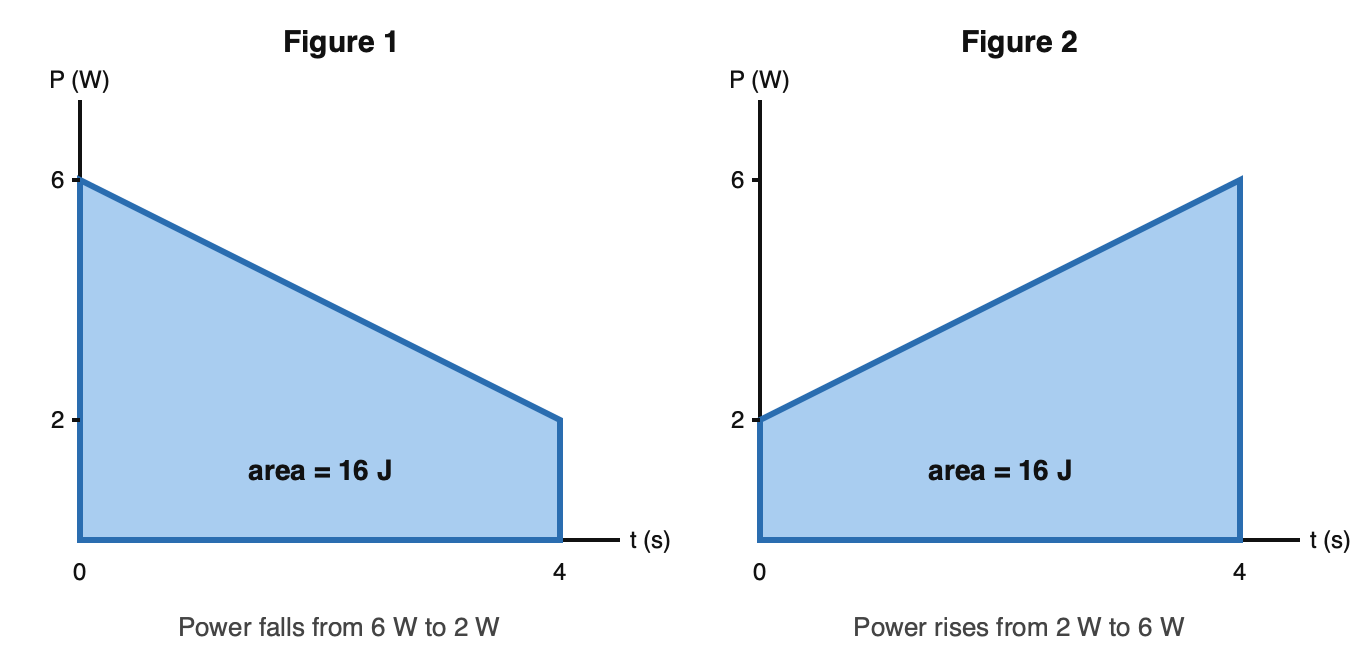 Different graph shapes, same area: both transfer 16 J in 4 s, so both have the same average power (4 W).
Try It: Power Race
Lift crates with motors: power, energy, and time. Energy Empire: Power Race
Videos
- Introduction to Power — Flipping Physics
- Average and Instantaneous Power Example — Flipping Physics
- Graphing Instantaneous Power — Flipping Physics
Practice Problems
-
A $50\text{ kg}$ student climbs $3.0\text{ m}$ of stairs in $5.0\text{ s}$. Find the average power.
-
A motor lifts a $100\text{ kg}$ crate at a constant speed of $0.50\text{ m/s}$. Find the power the motor delivers.
-
An engine delivers $150\text{ kW}$. Convert this to horsepower ($1\text{ hp}=746\text{ W}$).
-
A rower performs four trials, recording the average force on the boat, the distance traveled, and the time. Find the average power for each trial and state which is greatest.
Trial $F_{avg}$ $d$ $\Delta t$ A $180\text{ N}$ $50\text{ m}$ $45\text{ s}$ B $240\text{ N}$ $30\text{ m}$ $30\text{ s}$ C $210\text{ N}$ $45\text{ m}$ $35\text{ s}$ D $260\text{ N}$ $35\text{ m}$ $40\text{ s}$ -
A $2.0\text{ kg}$ block is pulled at a constant $2.0\text{ m/s}$ up a frictionless $30°$ ramp, and an identical block up a frictionless $60°$ ramp at the same speed. Find the power delivered to each.
-
A $2.0\text{ kg}$ box starts at rest and is pulled with constant acceleration, traveling $9.0\text{ m}$ in $3.0\text{ s}$. Find the average power. Then show it matches $\dfrac{2md^2}{t^3}$.
-
Two crates rest on a flat surface. A student applies the same constant force $F$ over the same distance $d$ to each; the first takes time $t$ and the second takes $t/2$. Find the ratio of the average powers $P_2:P_1$.
-
A $3.0\text{ kg}$ block starts from rest and accelerates at a constant rate; after $2.0\text{ s}$ its speed is $4.0\text{ m/s}$. a) Find the average power over the 2.0 s. b) Find the instantaneous power at $t=2.0\text{ s}$. c) Explain, using $P=Fv$, why the final power is larger than the average.
-
At time $t_1$ a train on a level track has speed $v$ and acceleration $a$. At $t_2$ it has speed $2v$ and acceleration $a$. Compare the instantaneous power $P_2$ to $P_1$ and justify.
-
Figure 1 shows power delivered to an object falling linearly from $6\text{ W}$ to $2\text{ W}$ over $4\text{ s}$ (energy change $\Delta E_1$). Figure 2 shows power rising linearly from $2\text{ W}$ to $6\text{ W}$ over the same 4 s (energy change $\Delta E_2$). Which correctly compares $\Delta E_1$ and $\Delta E_2$ with a valid justification? (A) $\Delta E_1<\Delta E_2$, because the final power in Figure 1 is smaller. (B) $\Delta E_1<\Delta E_2$, because the slope is negative in Figure 1 and positive in Figure 2. (C) $\Delta E_1=\Delta E_2$, because the area under each graph is the same. (D) $\Delta E_1=\Delta E_2$, because the magnitude of the slope is the same in both graphs.
-
A box of mass $m$ starts at rest and is pulled to the right a distance $d$ in time $t$ with constant acceleration. Which is the average power delivered to the box? (A) $\dfrac{2md^2}{t^2}$ (B) $\dfrac{2md^2}{t^3}$ (C) $\dfrac{md^2}{2t^2}$ (D) $\dfrac{md^2}{2t^3}$