Systems and Center of Mass: Why the Answer Is Never Just the Midpoint
Is there a way to lift something far heavier than you are — not with a machine, just a stick and a rock to rest it on? Archimedes of Syracuse, around 250 BC, is said to have claimed: "Give me a place to stand, and I will move the Earth." The quote itself likely wasn't recorded until centuries later (by Pappus of Alexandria, roughly 600 years after Archimedes lived), so it's probably embellished legend — but the physics behind the boast is real. Archimedes was the first person to rigorously prove how a lever works, and along the way became the first mathematician to define and calculate the center of gravity: the one point where an entire object's weight balances, no matter how oddly shaped it is. He showed a lever balances not at the midpoint between two weights, but wherever the torque from each side matches — heavier things count for more. That's the exact mass-weighted idea behind today's topic, under a more modern name.
Welcome to Unit 2! Unit 1 was about describing motion — now we start asking why motion happens, which means forces. But before forces make sense, we need a clean way to talk about groups of objects together, and that's today's idea: the system.
A system is just whatever collection of objects you choose to study together, with a boundary you define. The powerful part: if you don't care what's happening inside the system, you can treat the whole thing as a single object sitting at one point — its center of mass. That's why a gymnast's wildly spinning body during a backflip still traces a smooth, predictable arc through the air, exactly like a thrown ball — the flailing arms and legs are just mass rearranging itself around that one steady point.
Finding the center of mass has two tools. The easy one is symmetry: if an object's mass is spread evenly on both sides of a line, the center of mass sits right on that line — no math needed for a plain meter stick, a basketball, or a bowling pin. The other tool is a mass-weighted average, needed whenever an object or system isn't symmetric:
$$x_{cm} = \dfrac{\sum m_ix_i}{\sum m_i}$$
Here's the single most important warning about this formula: it is not the same as averaging the positions. A 1 kg block at 0 m and a 4 kg block at 10 m does NOT have its center of mass at the halfway point, 5 m — the heavier block pulls it much closer to itself, to 8 m. If a center-of-mass answer ever comes out sitting exactly at the midpoint between two clearly different masses, that's a sign of a very common mistake: forgetting to weight by mass. Always sanity-check by asking, "is my answer closer to the heavier object?"
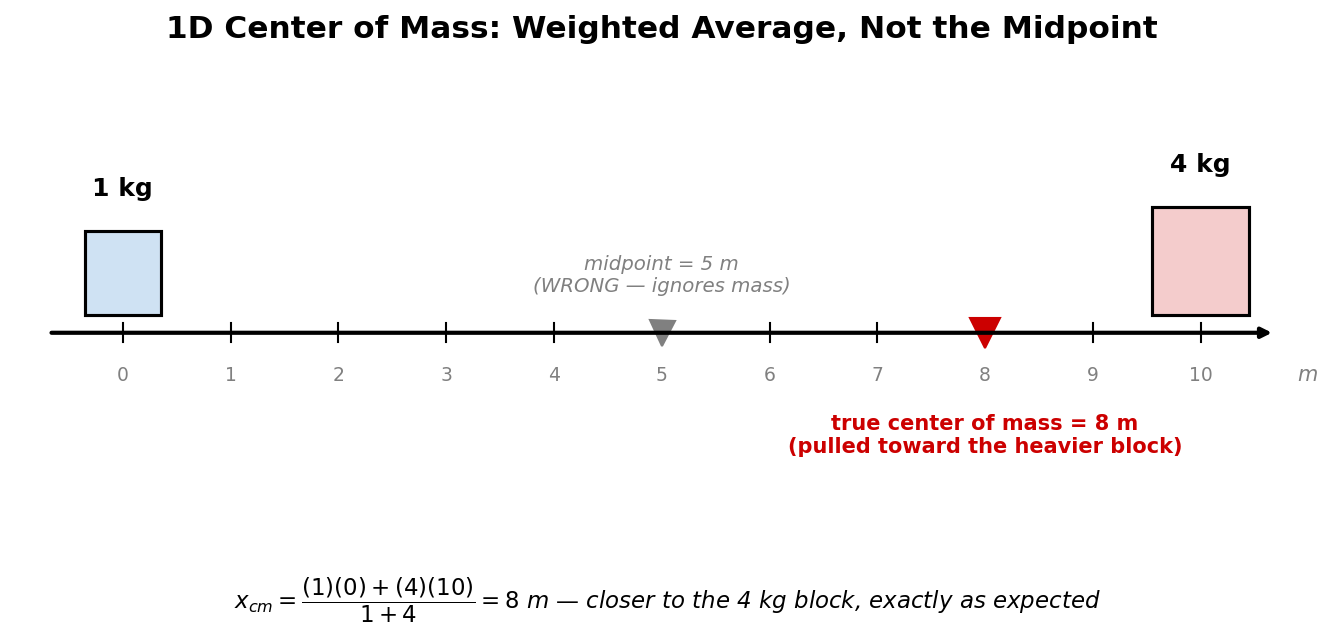 The center of mass at 8 m is pulled toward the 4 kg block — nowhere near the naive midpoint of 5 m.
Try It: Balance Beam
Place masses and the pivot to find the balance point. Dynamics Dungeon: Balance Beam
Videos
- Center of Mass — Flipping Physics
Practice Problems
- A plain wooden meter stick, uniform all the way through, is 100 cm long. Where is its center of mass, and how do you know without calculating anything?
- A 2 kg block sits at 0 m and a 2 kg block sits at 8 m. Without calculating, where is the center of mass? Explain why the "don't just average" warning doesn't matter here.
- A 1 kg ball is at the 0 cm mark on a track. A 3 kg ball is at the 20 cm mark. Find the center of mass of the two-ball system.
- A bowling pin has uniform density. Based on its symmetry, describe (in words, no diagram needed) where its center of mass must be located along its height.
- Two blocks, 4 kg and 2 kg, sit on a track 12 m apart, with the 4 kg block at the 0 m mark. A student calculates the center of mass and gets 6 m. Explain what mistake this student made, and find the correct answer.
- Three drones hover in a line above a field. Drone A (mass 2 kg) is at the 5 m mark, Drone B (mass 3 kg) is at the 15 m mark, and Drone C (mass 5 kg) is at the 35 m mark. a) Find the center of mass of the three-drone system. b) A classmate says "the center of mass should be close to 18 m, since that's roughly the middle of the three positions." Explain why this reasoning is wrong, and state what the classmate forgot to do.
- A 10 kg sphere and a 2 kg sphere are separated by 3.0 m. a) Without calculating, is the center of mass closer to the 10 kg sphere or the 2 kg sphere? Explain why. b) Now calculate the exact distance from the 10 kg sphere's center to the system's center of mass.
- A 40 g block is at the 0 cm mark and a 20 g block is at the 60 cm mark on a track. Which of the following is the center of mass of the two-block system? (A) 20 cm (B) 30 cm (C) 40 cm (D) 60 cm