Center of Mass on a Plane: Same Formula, Twice
Archimedes' balance-point idea from last lesson worked along one line. Does it still hold up if the weights are scattered across a whole flat surface instead of lined up? Same idea, it turns out — just run twice, once each direction.
Yesterday's center-of-mass formula assumed everything sat along one line. Most real systems don't — three drones hovering at different spots, three moons at different points around a planet. Describing a location like that takes two numbers, an x-position and a y-position, but the good news is the math doesn't get harder. You just apply the same mass-weighted average formula twice — once for x, once for y:
$$x_{cm} = \dfrac{\sum m_ix_i}{\sum m_i} \qquad\qquad y_{cm} = \dfrac{\sum m_iy_i}{\sum m_i}$$
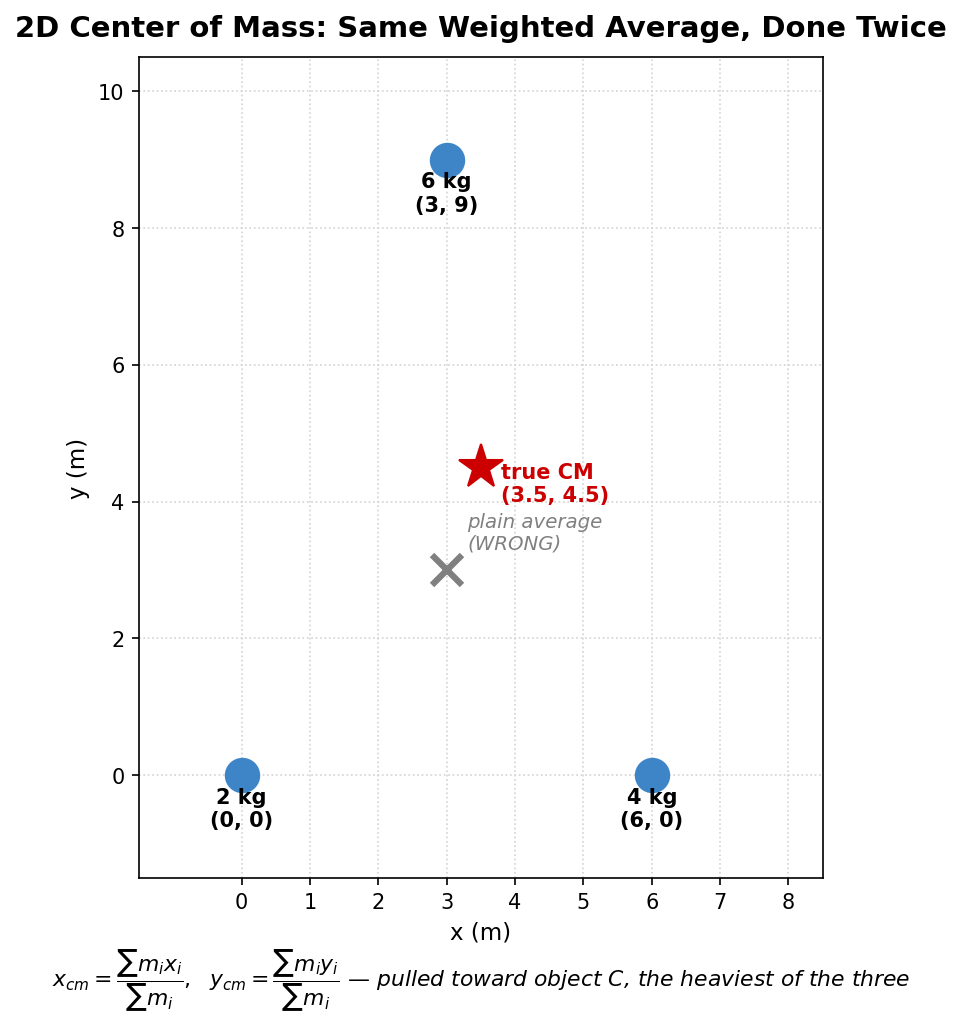 Same warning as 1D, just in both directions at once — the true center of mass is pulled toward the heaviest object, not sitting at the plain average of the three positions.
Symmetry gets more powerful in two dimensions, too. If a flat object has two different lines of symmetry, the center of mass has to sit on both at once — which means it's exactly where those two lines cross. A plain square plate, uniform all the way through, has its center of mass dead center, where its vertical and horizontal symmetry lines intersect. A system arranged with point symmetry (every object has an identical mirror partner directly across one central point) has its center of mass exactly at that point — no calculation needed, just matching the pattern.
The last idea is pure reasoning, no formula at all: a system's center of mass always lies somewhere between the centers of mass of its individual parts — it can never end up outside that range. Picture a board with its own center of mass fixed in place, and a small weight attached near one end. If that weight slides toward the board's center, the system's center of mass has to shift the same direction too — but by less than the weight itself moved, since the board's own center never budged and anchors part of the average in place. That's exactly the kind of "which way, and how far" reasoning that shows up constantly on real physics assessments.
Try It: Balance Beam
Predict the center of mass of several masses on a beam. Dynamics Dungeon: Balance Beam
Videos
- Center of Mass — Flipping Physics
Practice Problems
- A 3 kg ball sits at (2 m, 4 m) and another 3 kg ball sits at (8 m, 4 m). Find the center of mass of the two-ball system.
- A uniform, flat square metal plate has two lines of symmetry (vertical through the middle, horizontal through the middle). Where is its center of mass, and why doesn't a calculation need to be done?
- Three objects sit on a plane: a 2 kg object at (0 m, 0 m), a 4 kg object at (6 m, 0 m), and a 6 kg object at (3 m, 9 m). Find the (x, y) location of the center of mass.
- A board's center of mass is fixed at the 80 cm mark. A small block starts at the 10 cm mark and is slid all the way to the 80 cm mark. Which way does the system's center of mass shift, and why must the shift be less than 70 cm?
- System 1: two identical 2 kg balls are placed at (−3 m, 0 m) and (3 m, 0 m). System 2: two identical 2 kg balls are placed at (0 m, −3 m) and (0 m, 3 m). Without calculating, explain why both systems have their center of mass at the exact same location, and state that location.
- Three drones hover at a single instant: Drone A (2 kg) at (0 m, 0 m), Drone B (3 kg) at (10 m, 0 m), Drone C (5 kg) at (5 m, 20 m). a) Find the center of mass of the three-drone system. b) A classmate estimates the center of mass by eye and guesses (5 m, 6.7 m) — the plain average of the three positions. Explain exactly what the classmate forgot to do, and why the real answer is different.
- Two spheres sit on the x-axis: a 4 kg sphere at x = 0 m and a 12 kg sphere at x = 10 m. Each sphere is then moved 2 m toward the other, so the 4 kg sphere ends at x = 2 m and the 12 kg sphere ends at x = 8 m. a) Without calculating, does the system's center of mass move left or right? Explain your reasoning. b) Calculate the center of mass before the move and after the move, and confirm that your answer to part a) was correct.
- A 3 kg object is at (0 m, 2 m) and a 9 kg object is at (8 m, 6 m). Which of the following is the center of mass of the two-object system? (A) (4 m, 4 m) (B) (6 m, 5 m) (C) (8 m, 6 m) (D) (2 m, 2 m)