Topic 2.2: Free-Body Diagrams: One Dot, Every Force, Your Choice of Axis
Can you actually see a force? Not its effect — the force itself. Sit with that for a second, because the honest answer is no. Forces are invisible; you only ever see what they do. That's a genuinely tricky problem for physics: how do you reason carefully about something you can never directly observe? The answer physicists landed on is exactly what today's post is about — a standardized diagram, stripped of everything except arrows for every force acting on one object. It's not a real picture of anything, the same way a circuit diagram doesn't look like a real circuit. Once forces are drawn this way, invisible or not, they can be measured, combined, and predicted with total precision.
A force is always an interaction between two different objects — a system can never exert a net force on itself. That single rule is the most important thing to get right before drawing a single diagram. A free-body diagram (FBD) makes this concrete: it shows one object as a single dot at its center of mass, with every external force on it drawn as an arrow starting from that dot — gravity ($F_g$), normal force ($F_N$), tension ($F_T$), friction ($F_f$), or an applied push/pull ($F_{app}$). Arrow length shows relative size, and it's worth saying directly: two forces on the same object that happen to be equal and opposite are NOT automatically some special pair — they're just two forces that happen to balance out.
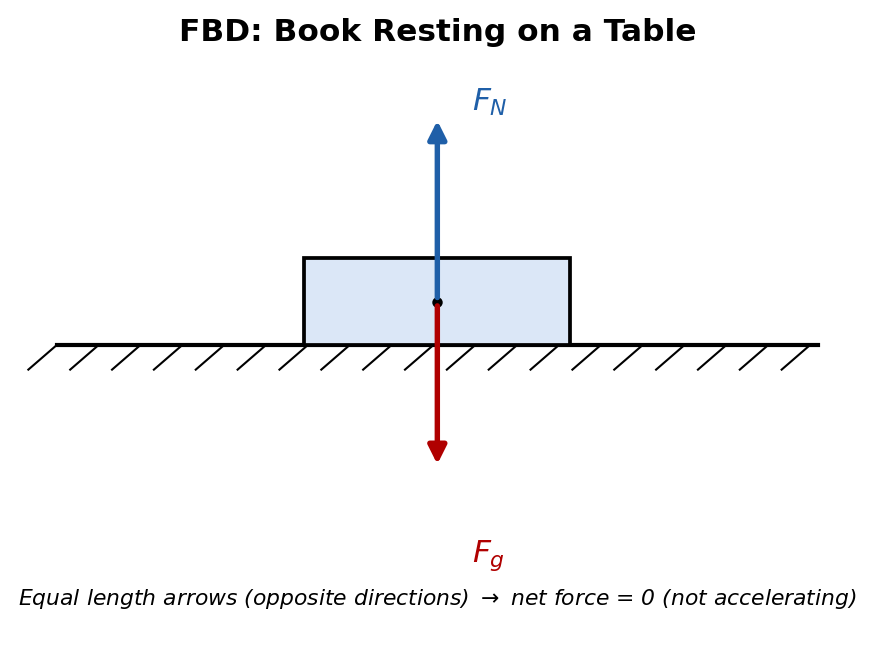 The simplest possible FBD: one dot, two arrows, equal and opposite because the book isn't accelerating.
The other big idea today: you get to choose your coordinate axes. Nothing says x has to be horizontal. On an incline, rotating the axis to run parallel/perpendicular to the ramp's surface — rather than the usual horizontal/vertical — means the object's acceleration (which runs along the ramp) shows up in only one direction instead of split awkwardly across two. Rotating the axis doesn't remove the trig, though — it just moves which force needs decomposing. Before rotating, gravity was simple and normal force needed components; after rotating to match the incline, it flips: normal force becomes trig-free, and gravity needs $mg\sin\theta$ (along the ramp) and $mg\cos\theta$ (into the ramp).
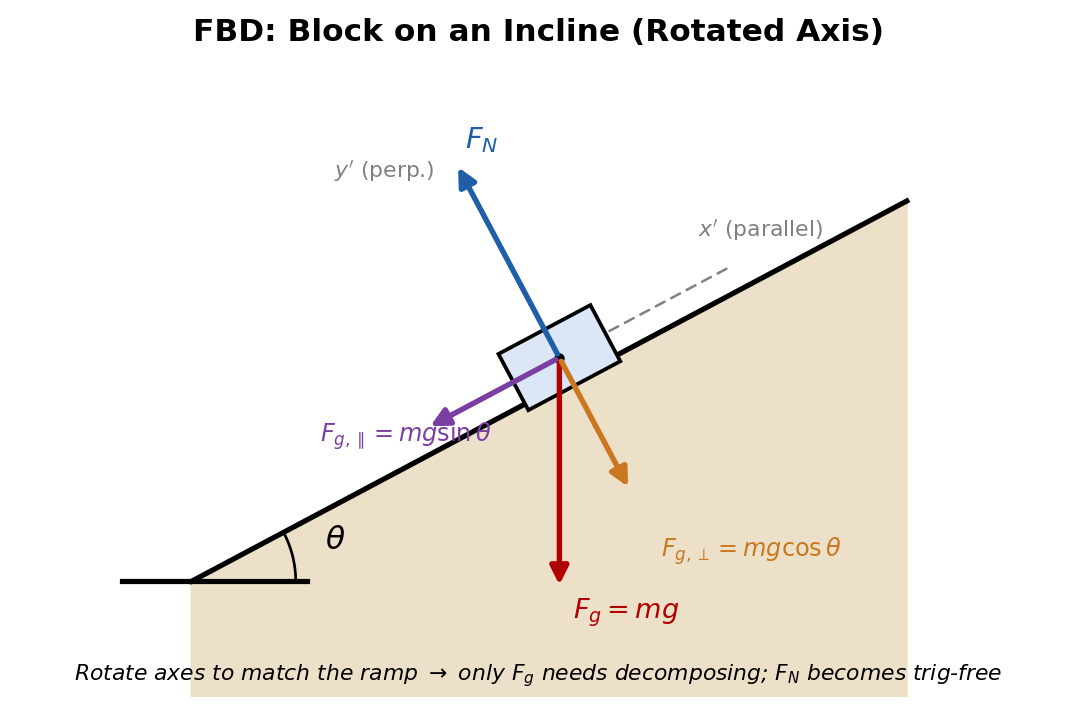 Rotate the axis to match the ramp, and gravity — not the normal force — becomes the one that needs decomposing.
Try It: FBD Builder
Practice drawing free-body diagrams: pick each force, drag its arrow, and get it checked. Dynamics Dungeon: FBD Builder
Videos
- Free Body Diagrams — Flipping Physics
Practice Problems
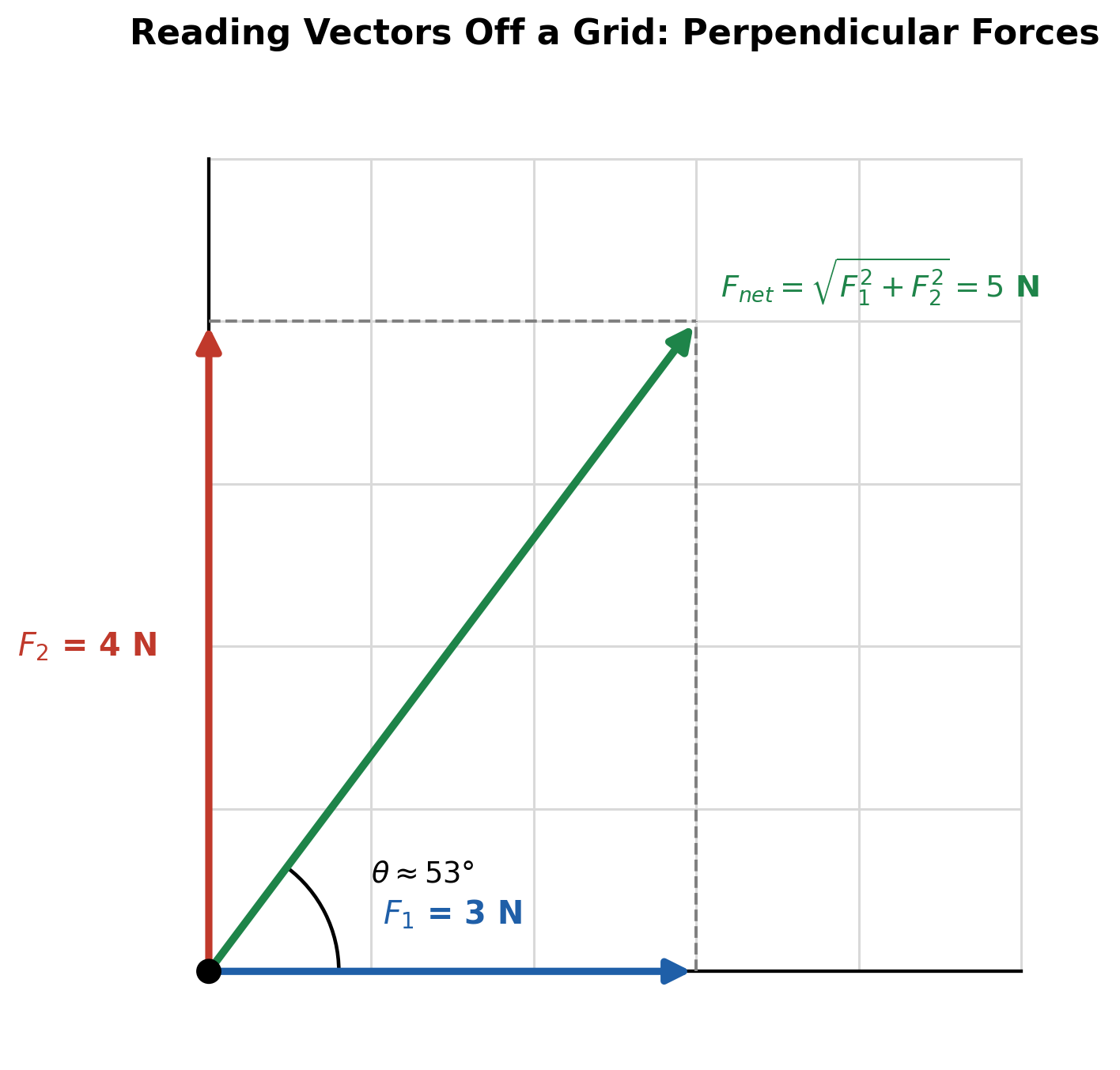 Two perpendicular forces always combine the same way — square, add, square-root.
-
Two forces act on an object: 6 N to the right and 8 N straight up. Find the magnitude of the net force.
-
Draw a simple FBD (dot + labeled arrows only, no numbers needed) for a book resting motionless on a table.
-
Two forces act on an object: 5 N to the right and 12 N straight up. Find the magnitude and direction (angle above horizontal) of the net force.
-
A block sits on a frictionless incline at 25° to the horizontal. Write the expression (do not calculate a number) for the component of gravity acting along the incline's surface.
-
A classmate says: "Tension in a rope holding up a motionless sign and the sign's weight are equal and opposite, so they must be a Newton's-third-law pair." Is this reasoning valid? Explain why or why not.
-
A crate sits motionless on a ramp inclined at 20°, held in place by friction only (no rope). a) Sketch the FBD, labeling all forces (gravity, normal, friction). b) Write the expression for the component of gravity along the ramp's surface, and explain in words why the friction force must have the same magnitude as that component.
-
A sign hangs motionless from a single vertical rope. Partway through the day, the rope is cut. a) Before the rope is cut, is the net force on the sign zero? Justify your answer using the sign's FBD. b) The instant after the rope is cut, is the net force on the sign zero? Explain what changes on the FBD and why.
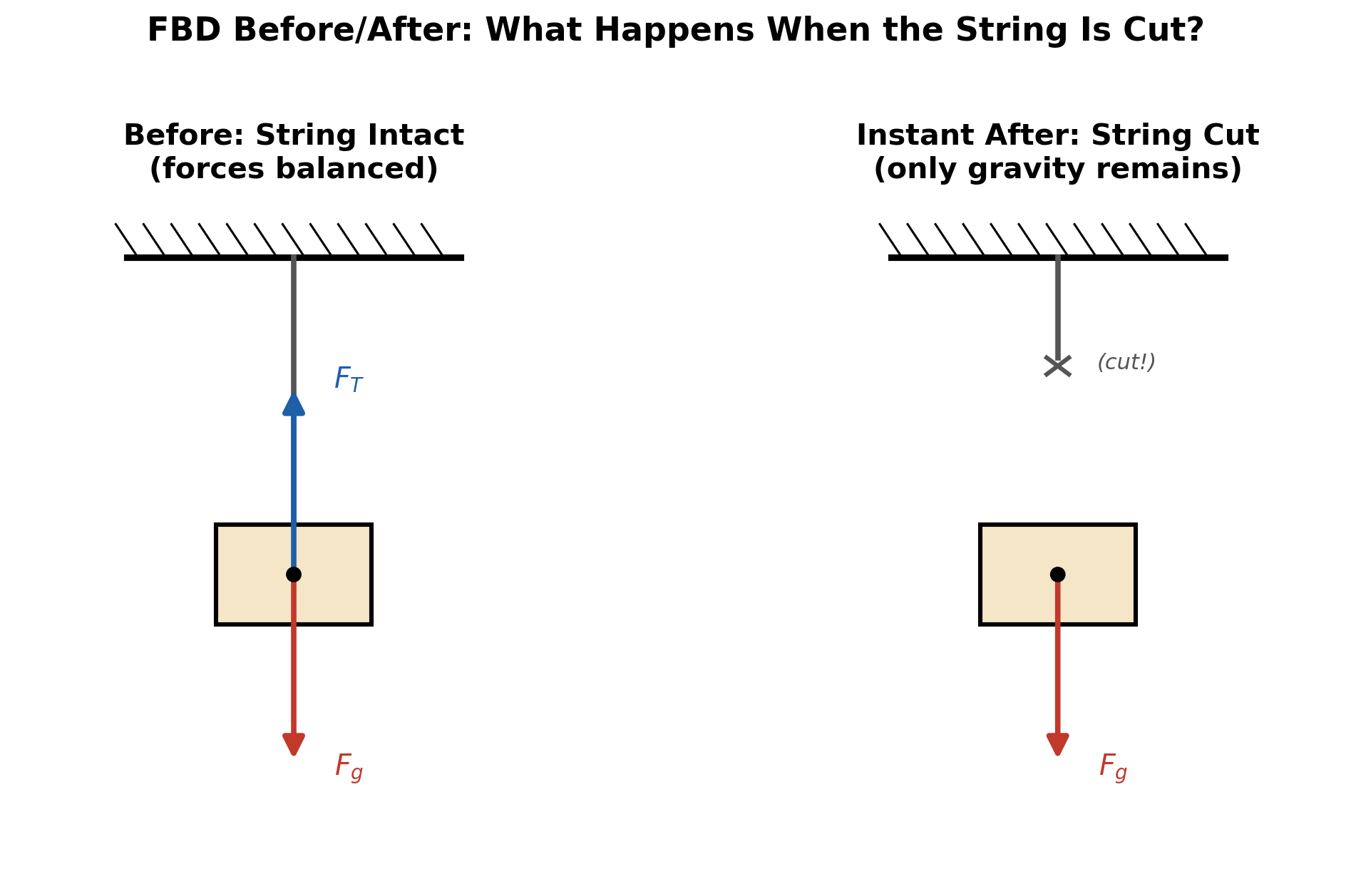 Cutting the rope doesn't just weaken the tension — it removes that force from the FBD entirely.
 -
Two forces act on an object on a grid: 9 N to the right and 12 N straight up. Which of the following is the magnitude of the net force? (A) 21 N (B) 15 N (C) 3 N (D) 10.5 N