Topic 2.2 Supplement: Why We Rotate the Axis
Nobody says x has to be horizontal and y has to be vertical. Coordinate axes are a tool you choose, not a law of physics — and the one rule worth following is to pick an axis parallel to the direction of acceleration whenever you can. On flat ground, acceleration is horizontal, so standard axes already line up perfectly. On an incline, acceleration points along the ramp's surface instead — so rotating the axis to run parallel and perpendicular to that surface puts the entire acceleration on ONE axis instead of splitting it awkwardly across two.
Here's the part that trips people up: on a flat surface, gravity ($F_g$, straight down) and the normal force ($F_N$, straight up) are BOTH already aligned with standard axes — neither needs decomposing. Tilt the surface, and exactly one of those two forces ends up misaligned. You can't avoid that. The only thing you actually get to choose is which force pays the trig tax. Keep standard axes and gravity stays simple, but $F_N$ now needs components — and so does the acceleration itself, since it's still pointed along the tilted ramp. Rotate to match the ramp instead, and $F_N$ becomes trig-free, but gravity now splits into $F_{g,\parallel}=mg\sin\theta$ (along the ramp) and $F_{g,\perp}=mg\cos\theta$ (into the ramp).
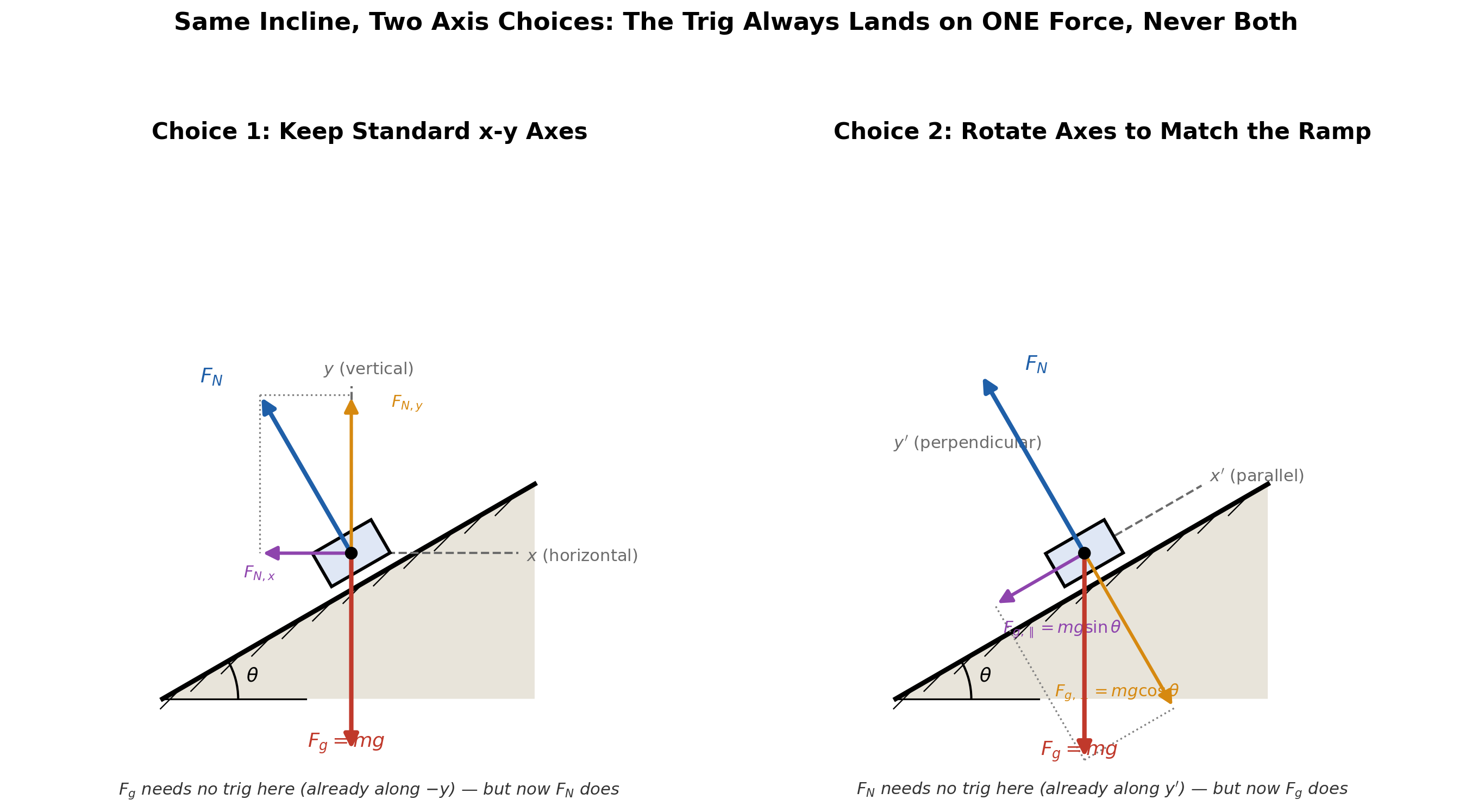 The trig never disappears — rotating the axis only changes which force carries it.
Same Problem, Solved Two Ways
Take a 10 kg block on a frictionless 30° incline. Solve it with standard axes, and gravity stays easy, but the normal force and the acceleration both end up split across x and y — two equations, both mixing the unknowns $N$ and $a$ together, solved by substitution. Solve it with rotated axes instead, and each equation isolates one unknown immediately:
$$F_{g,\parallel}=ma ;\Rightarrow; mg\sin\theta=ma ;\Rightarrow; a=g\sin\theta \qquad\qquad F_N = mg\cos\theta$$
Both methods land on the exact same numbers: $a = 4.9\text{ m/s}^2$ and $F_N \approx 84.87\text{ N}$.
| Standard axes | Rotated axes | |
|---|---|---|
| Force needing decomposition | $F_N$ | $F_g$ |
| Acceleration direction | Split across both axes | Entirely along one axis |
| Solving method | Substitution required | Direct, one unknown per equation |
| Final $a$ | 4.9 m/s² | 4.9 m/s² |
| Final $F_N$ | 84.87 N | 84.87 N |
Same physics, same final answer — the only thing that changes is how much algebra it takes to get there. That's the entire case for rotating the axis: it's a simplification strategy, not a different result.
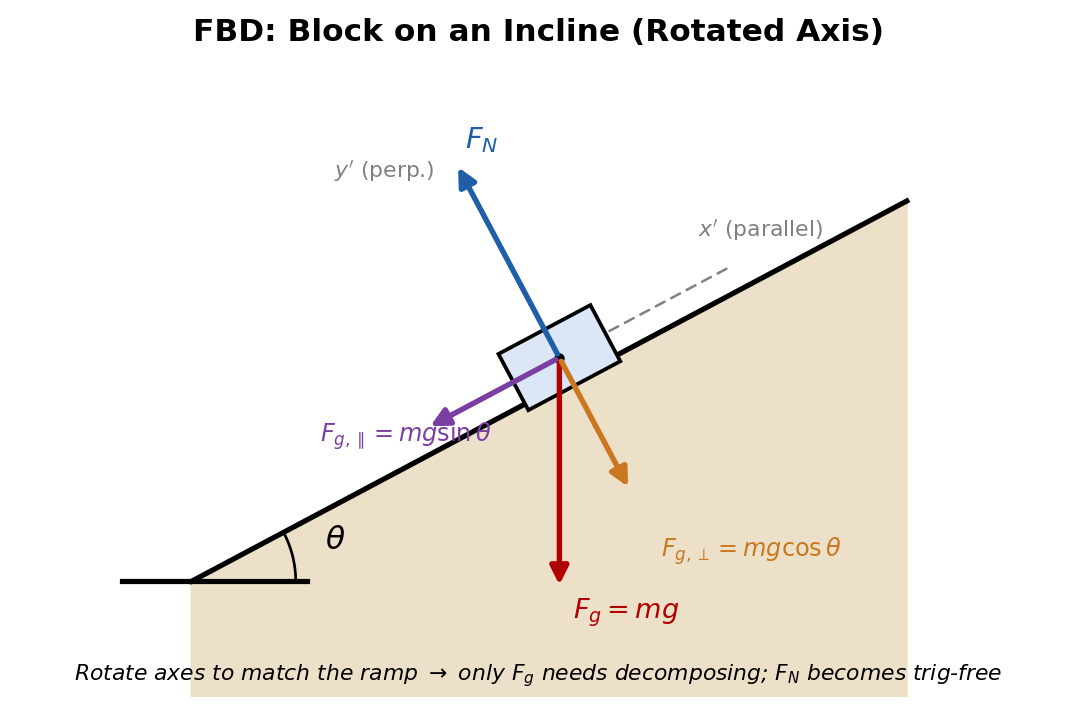 Gravity decomposed along the rotated axis — the normal force needs no decomposition at all in this frame.
Check Your Understanding
- A block sits on a frictionless incline at 40°. If you rotate your axis to match the ramp, which force needs to be broken into components — gravity or the normal force? Why?
- True or false: rotating your axis on an incline problem removes the need for trigonometry entirely. Explain your answer.
- A classmate keeps standard horizontal/vertical axes instead of rotating on an incline problem. Is their approach wrong? What trade-off are they actually making?