Topic 2.3: Newton's Third Law: Always Two Objects, Always Equal
Picture floating in the middle of empty space, completely stationary — no rope, no jetpack, nothing within reach. Is there anything at all you could do to start moving? It turns out yes, as long as you have literally anything to throw. A shoe, a wrench — throw it one way, and you drift the other way, with nothing to push off but the object itself. No friction, no ground, just two objects trading a force. That's Newton's third law in its purest form.
That idea — for every push, an equal push back — is one-third of the single most influential physics book ever published: Isaac Newton's Principia, 1687. Newton packed all three of his laws of motion into that one book, plus his law of gravitation (more on that in a few weeks). The backstory starts twenty years earlier: in 1665, Cambridge shut down because of the plague, and a 23-year-old Newton went home to his family's farm at Woolsthorpe for almost two years. Isolated there, he did some of the most productive scientific thinking in history — inventing calculus, working out the beginnings of his laws of motion, and, in the famous (and probably embellished) story, watching an apple fall and wondering if the same force reached all the way to the Moon. He didn't publish any of it right away; it took another twenty years before the Principia finally appeared. Today's law is the third of the three he put in that book.
The Law
Newton's third law: for every force one object exerts on a second object, the second object exerts an equal-magnitude, opposite-direction force back on the first. The key word is "second" — a genuine third-law pair is always between two different objects, never the same object twice. And it's always exactly equal, regardless of the two objects' relative mass, motion, or acceleration. Push twice as hard on a wall, and the wall pushes back exactly twice as hard too — there's no lag and no cap tied to some earlier value.
Where the Confusion Comes From
This is exactly where most confusion creeps in: picture a box sliding at constant speed, with gravity and normal force on it happening to be equal in size. That is NOT a third-law pair — both forces act on the same box. A genuine pair would be the box pushing down on the floor and the floor pushing up on the box. Gravity's actual third-law partner is the box pulling up on the Earth with equal force — real, but far too small relative to Earth's mass to ever notice.
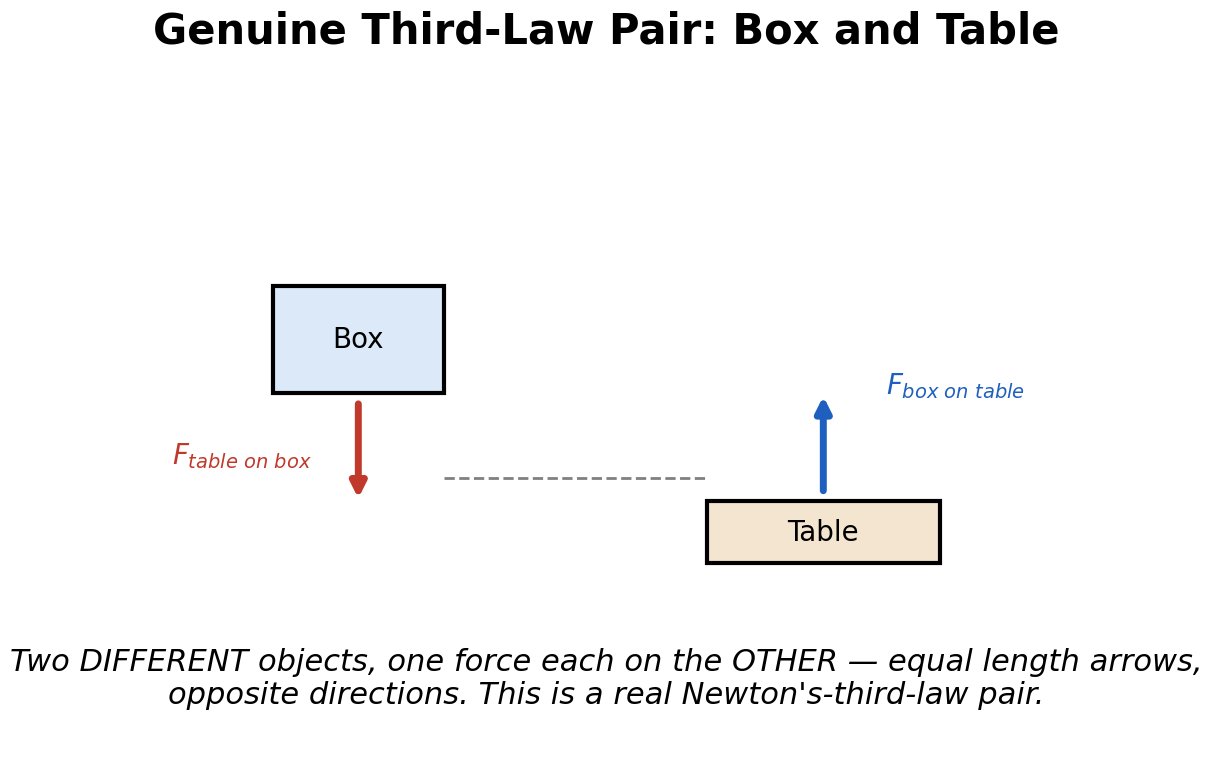 A real third-law pair is always drawn as two different objects, each with one arrow pointing at the other.
Strings and Tension
One more idea: ideal (massless) strings carry the same tension throughout their length, but a real, heavy rope does not. At any point along a heavy rope, the tension supports the weight of everything still hanging below that point — so tension is highest at the top (supporting the whole rope) and decreases as you move down.
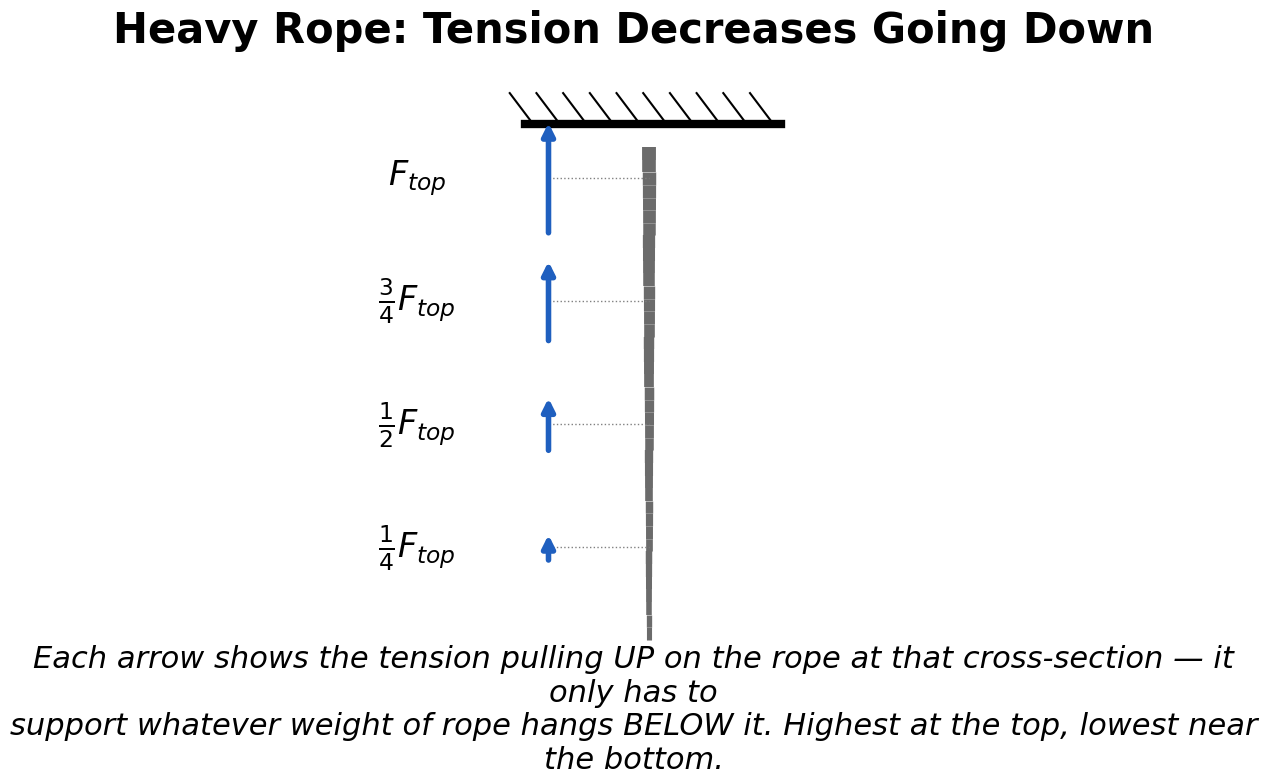 Only an ideal, massless string has the same tension everywhere — a real rope's own weight changes the tension along its length.
Try It: Newton's Arena. Test the third law with skaters pushing apart (World 3), plus the first two laws. Dynamics Dungeon: Newton's Arena
Practice Problems
-
A person leans against a wall. Is the force the person exerts on the wall equal in magnitude to the force the wall exerts on the person? Explain using Newton's third law.
-
A book rests on a table. Gravity and the normal force on the book are equal in magnitude. Is this a Newton's-third-law pair? Explain why or why not.
-
A student pushes a filing cabinet with force $F$. The cabinet pushes back on the student with force $F$ as well. The student then pushes three times as hard, applying $3F$. What force does the cabinet now exert on the student?
-
A heavy, uniform chain hangs from the ceiling, not touching the floor. The tension at the very top is $F_{top}$. Find an expression for the tension exactly one-third of the way down from the top, in terms of $F_{top}$.
-
Two ice skaters of very different mass stand facing each other and push off. Are the push forces they exert on each other equal in magnitude? If one skater ends up moving much faster than the other, does that contradict your answer? Explain.
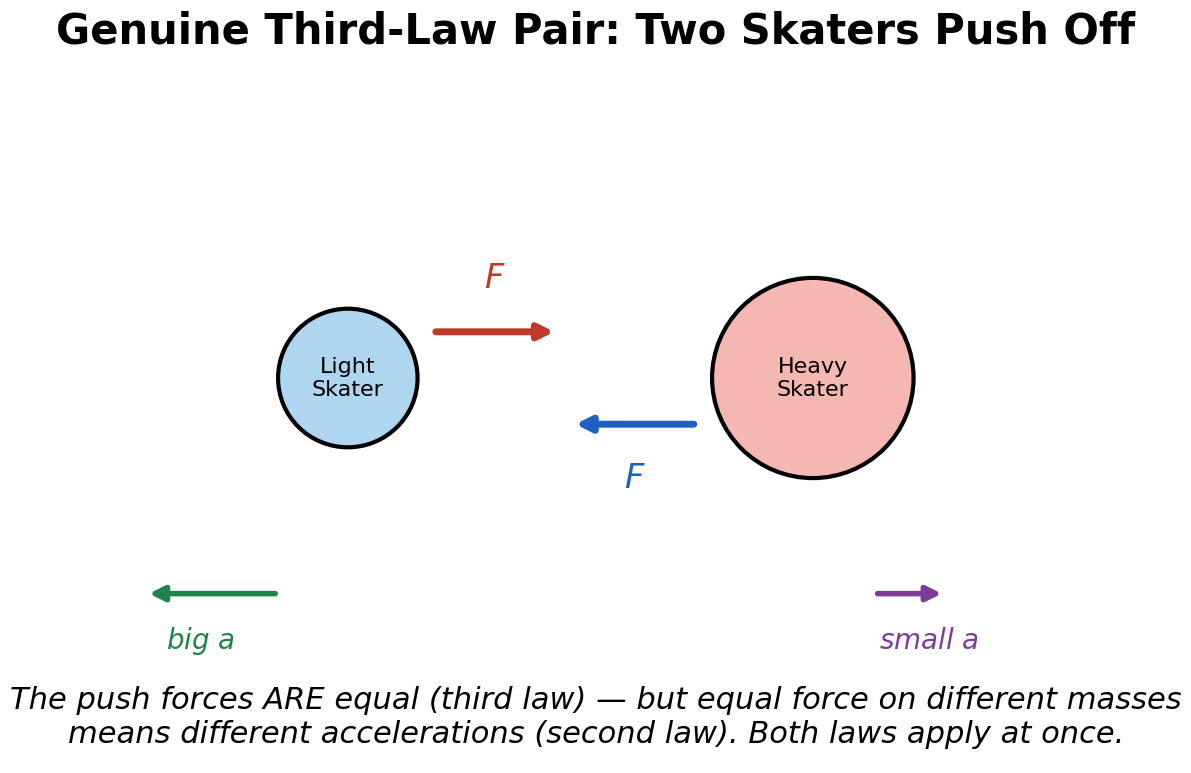 The push forces are exactly equal — third law. The accelerations are not — that's second law acting on two different masses.
 -
A rope pulls a block of mass $3m$ to the right, which is in contact with and pushing a second block of mass $m$ ahead of it, both accelerating together across a frictionless floor. a) Is the force the $3m$ block exerts on the $m$ block equal in magnitude to the force the $m$ block exerts on the $3m$ block? Justify using Newton's third law. b) A classmate claims the $3m$ block must push harder on the $m$ block "because it's heavier and pushing it." Explain what's wrong with this reasoning.
-
Two boxes of unequal mass are connected by an ideal (massless) string and pulled straight upward at constant speed by a second string above them. a) Explain why the tension in the connecting string between the two boxes is the same at both the point where it attaches to the upper box and the point where it attaches to the lower box. b) Would your answer to part a) change if the connecting string had significant mass of its own? Explain why or why not.
-
A box is pulled to the right at constant speed across a rough floor. Four forces act on the box: tension (forward), friction (backward), gravity (down), and normal force (up). Which pair of these four forces represents a genuine Newton's-third-law interaction pair? (A) Tension and friction (B) Gravity and normal force (C) None of these four forces form a Newton's-third-law pair, because all four act on the same object (D) All four forces form third-law pairs with each other
Further Reading
- Newton's Third Law — The Physics Classroom (video)
- Interaction Force Pairs — The Physics Classroom (video)
- Newton's Third Law — FuseSchool (video)
- What is Newton's Third Law? — Michel van Biezen (video)
- Newton's Third Law — Two-Cart Force-Probe Demo — The Physics Classroom (video)
- Force Pairs (Newton's Laws) — Allen Tsao The STEM Coach (video)
- Understanding the Tension Force — Flipping Physics (video)
- High School Physics - Newton's 3rd Law — Dan Fullerton (video)