Topic 2.4: Newton's First Law: Equilibrium Means Balanced, Not Absent
Newton called this his FIRST law — but was it actually the first idea he personally came up with? Not even close. The core of it — an object left alone just keeps doing whatever it was already doing, no push required to continue — traces back to Galileo, the same person behind the inclined-plane experiment from Unit 1. Galileo argued that a ball rolling on a perfectly smooth, frictionless, level surface would roll forever, never slowing on its own; it's friction and other real forces that make motion look like it needs a constant push. Newton took that idea, sharpened it, and made it the opening law of the same 1687 Principia that held his Third Law — placed first on purpose, as the foundation the other two laws build on.
Newton's first law: an object in equilibrium — net force exactly zero — moves at constant velocity, including the special case of constant velocity equal to zero (at rest). The trap to avoid: equilibrium does NOT mean "no forces are acting." It means the forces that are acting sum to zero. Throw a ball straight up, and at the very peak its vertical velocity is momentarily zero — but gravity never stopped pulling down on it. The ball isn't in equilibrium at the peak, because nothing is balancing gravity there. Being momentarily at rest and being in equilibrium are two different things.
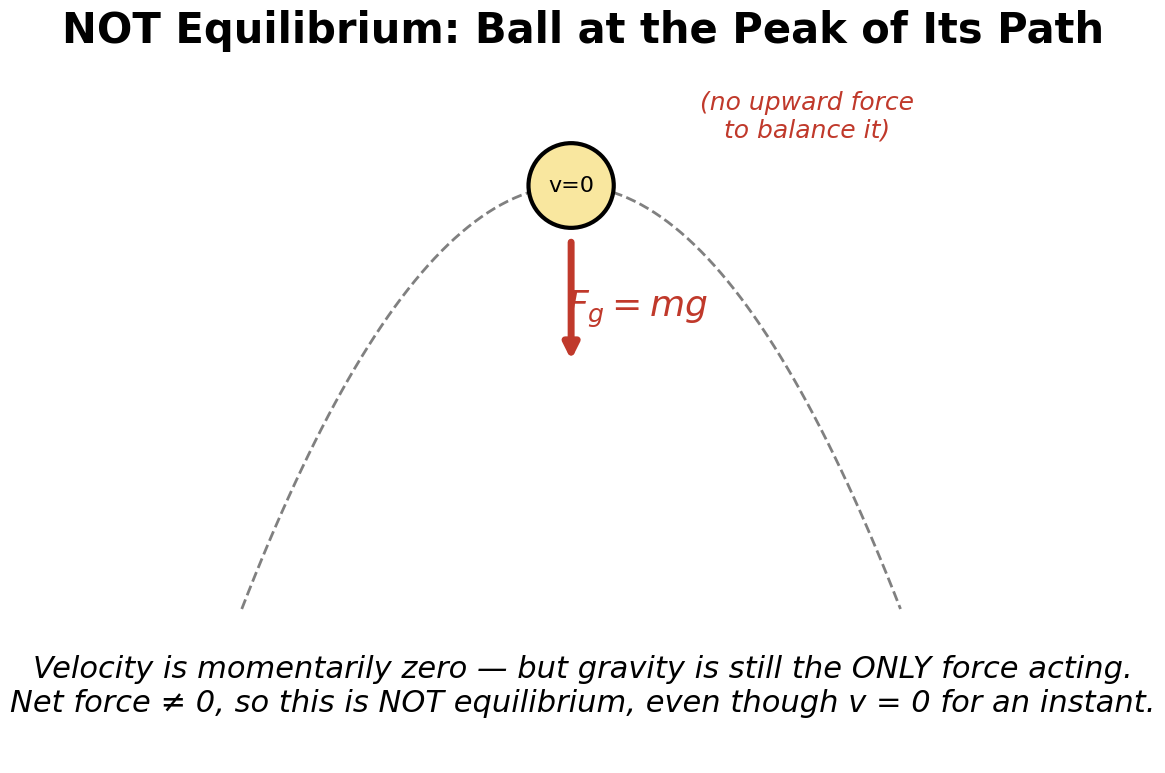 Zero velocity for an instant does not mean zero net force — gravity never takes a break.
When multiple forces act at angles, equilibrium has to be checked axis by axis: $\Sigma F_x = 0$ AND $\Sigma F_y = 0$, independently. Changing one force's component on just one axis can break equilibrium in that direction while the other axis stays perfectly balanced — the two directions don't interfere with each other. Every calculation follows the same order: write the equilibrium equation in symbols first, including every force term with its correct sign, THEN solve algebraically for the unknown, and only THEN substitute numbers. Some problems — like finding a skydiver's terminal velocity from $Av_T^2 = mg$ — never involve numbers at all; the whole answer stays symbolic, exactly like a real AP FRQ.
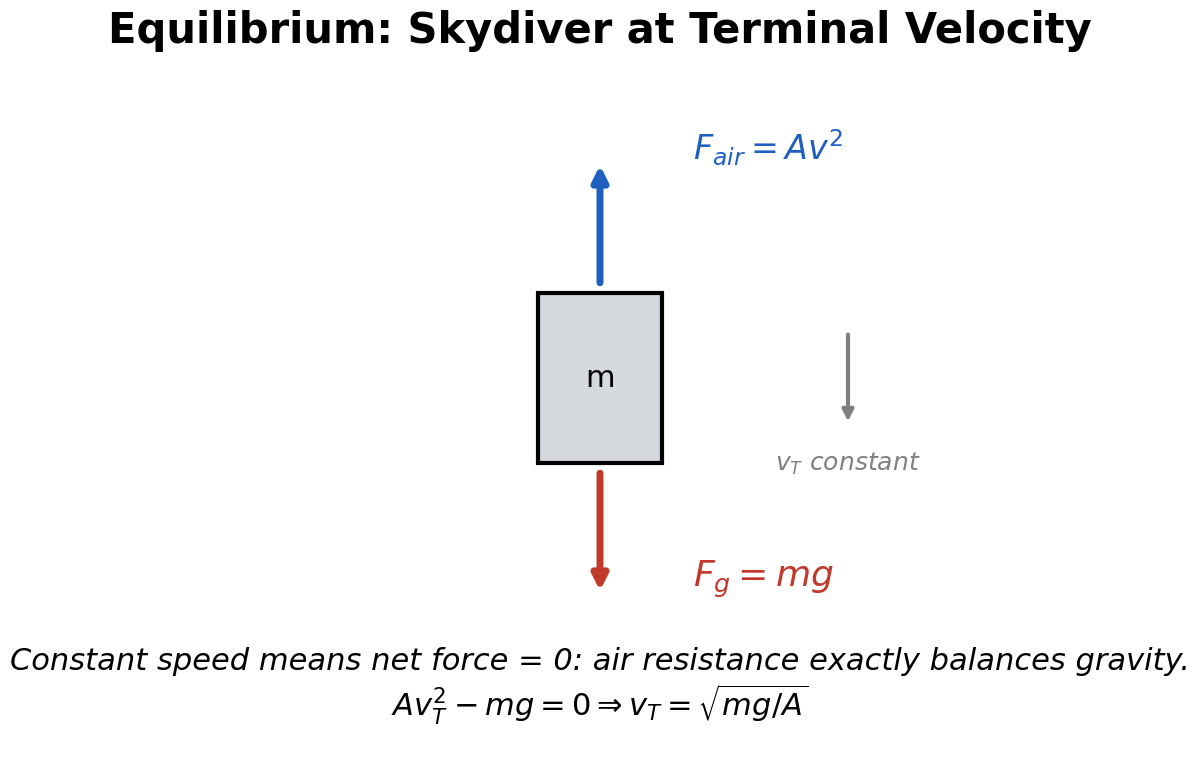 A whole FRQ can stay entirely symbolic — set air resistance equal to gravity and solve for $v_T$ without ever plugging in a number.
Try It: Newton's Arena
Slide a puck with balanced and unbalanced forces (World 1). Dynamics Dungeon: Newton's Arena
Videos
- Newton's First Law — Flipping Physics
Practice Problems
-
A ball is thrown straight up. At the exact peak of its path, is the ball in equilibrium? Explain why or why not.
-
A box hangs motionless from a single vertical string. The box's weight is 12 N. What is the tension in the string? Write the equilibrium equation first.
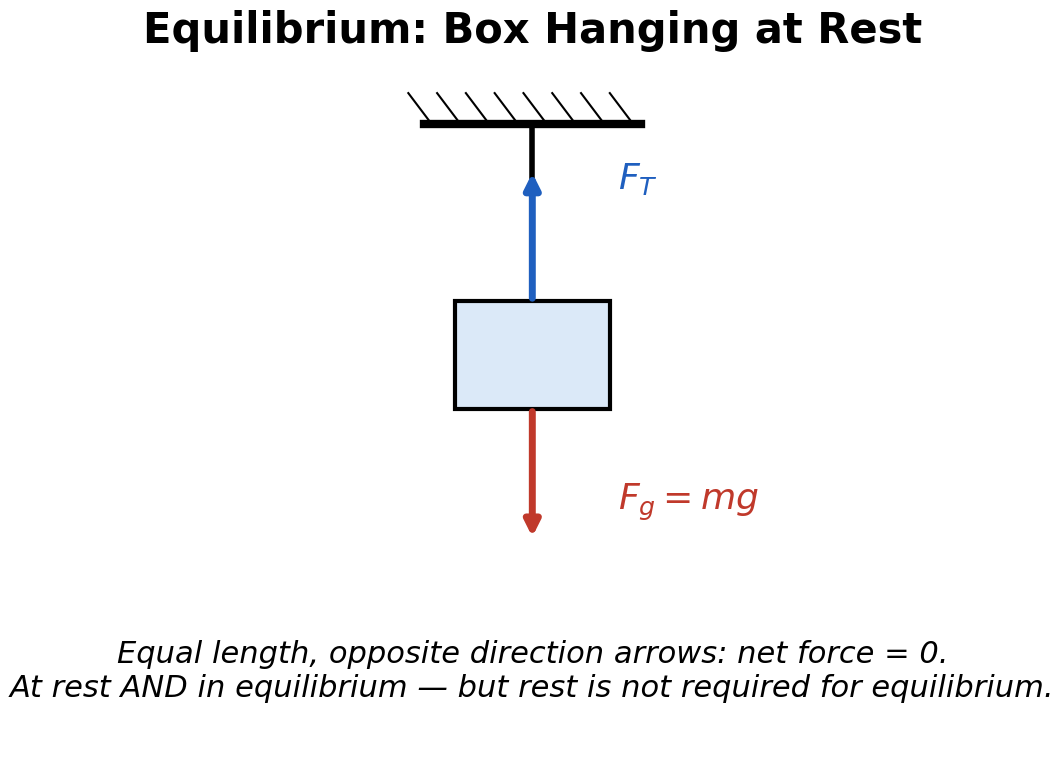 Equal-length, opposite-direction arrows: the visual signature of equilibrium.
 -
A box hangs at rest, suspended by a string above and resting on a scale below. The scale reads a normal force $F_N$ of 4 N, and the box's weight is 10 N. Find the tension in the string above (write $\Sigma F_y = 0$ symbolically first, then substitute).
-
A hockey puck slides across frictionless ice at a constant nonzero speed. Is the puck in equilibrium? Are there forces acting on it? Explain both answers.
-
Two forces act on a box moving at constant velocity across a frictionless floor: $F_1$ at angle $\theta_1$ above horizontal, $F_2$ at angle $\theta_2$ above horizontal, on opposite sides. Using only the horizontal balance, find an expression for $F_1$ in terms of $F_2$, $\theta_1$, and $\theta_2$.
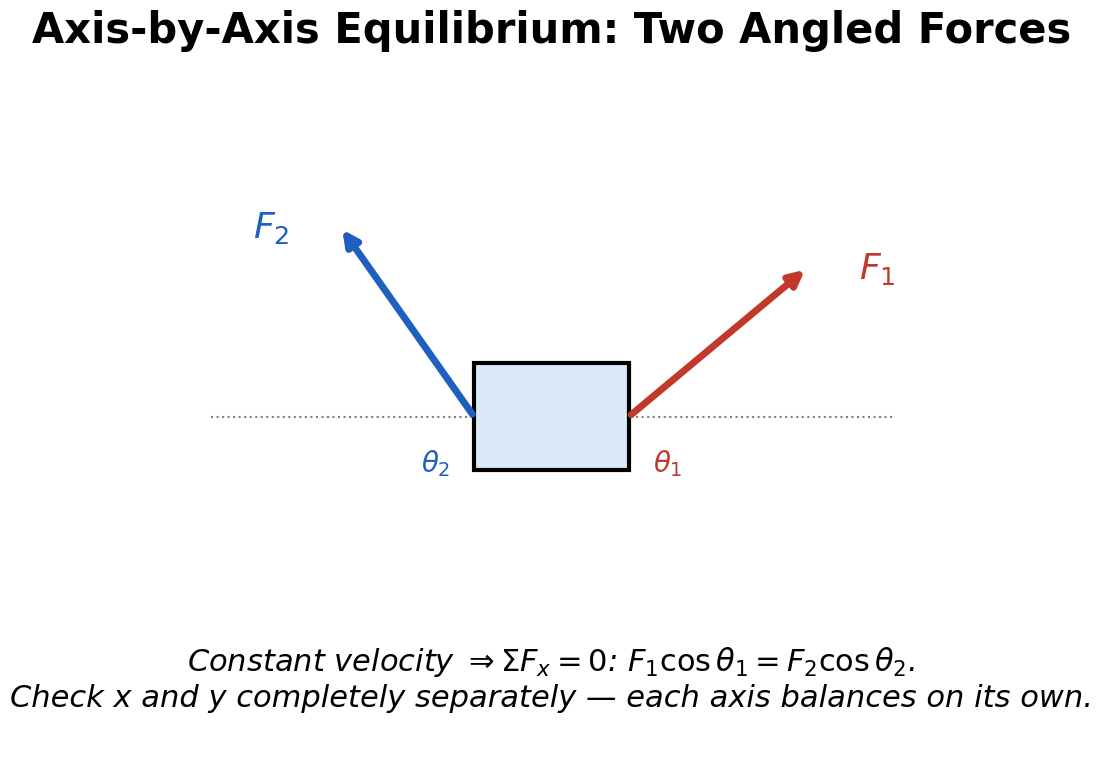 Each axis balances on its own — don't let the angles on one side change how you check the other.
 -
A box moves at constant velocity to the right across a frictionless floor. Two applied forces act on it: one at a fixed angle above the horizontal on the right, and one that starts purely horizontal on the left, with both magnitudes constant. The angle of the right-side force is slowly decreased toward zero. a) Write the horizontal equilibrium equation symbolically for the original setup. b) Explain what happens to the box's motion as the angle decreases, and why.
-
A skydiver-parachute system of mass $m$ falls and reaches a constant terminal speed $v_T$, where air resistance follows $F_{air} = Av^2$. a) Write the equilibrium equation for the system at terminal speed. b) Solve symbolically for $v_T$ in terms of $m$, $g$, and $A$ — do not substitute any numbers.
-
A person of mass $m$ stands on a scale inside an elevator, motionless relative to the scale. The scale reads a normal force $F_N$ that is LESS than the person's weight $mg$. Which of the following is a valid claim about the elevator's motion? (A) The elevator must be moving downward (B) The elevator could possibly be moving downward and speeding up, or moving upward and slowing down (C) The elevator must be at rest (D) The elevator must be moving upward