Topic 2.5: Newton's Second Law: Same Setup as Equilibrium, One New Term
Is the equation you're about to learn today exactly what Newton wrote in the Principia, word for word, symbol for symbol? Not quite. Newton never actually wrote "F = ma." In the same 1687 Principia that held his third law, his second law was stated in terms of momentum — something closer to "the change in an object's motion is proportional to the force impressed on it" — because the clean mathematical notation for acceleration didn't fully exist in his time. The tidy algebraic form used in every problem in this unit, $F=ma$, wasn't formalized until decades later, by the mathematician Leonhard Euler in the 1700s. Same idea Newton had, cleaner notation — and Euler's version is the one taught today.
Newton's second law: the net force on an object equals its mass times its acceleration, $F_{net} = ma$. This isn't a brand-new process — it's the same FBD-first, symbols-first approach from Topic 2.4's equilibrium work, just without setting the right side to zero. Draw the FBD, write $\Sigma F$ along the axis of interest symbolically, set it equal to $ma$, solve symbolically for the unknown, and only then substitute numbers.
The most common real-exam scenario is a person on a scale in an accelerating elevator. Taking up as positive: $F_N - mg = ma$, so $F_N = m(g+a)$. Accelerating upward makes the scale read more than actual weight (feels heavier); accelerating downward makes it read less (feels lighter). Here's the catch worth remembering: the scale reading only tells you the direction of acceleration, not the direction of motion — a scale reading more than your weight is equally consistent with speeding up while moving up, or slowing down while moving down.
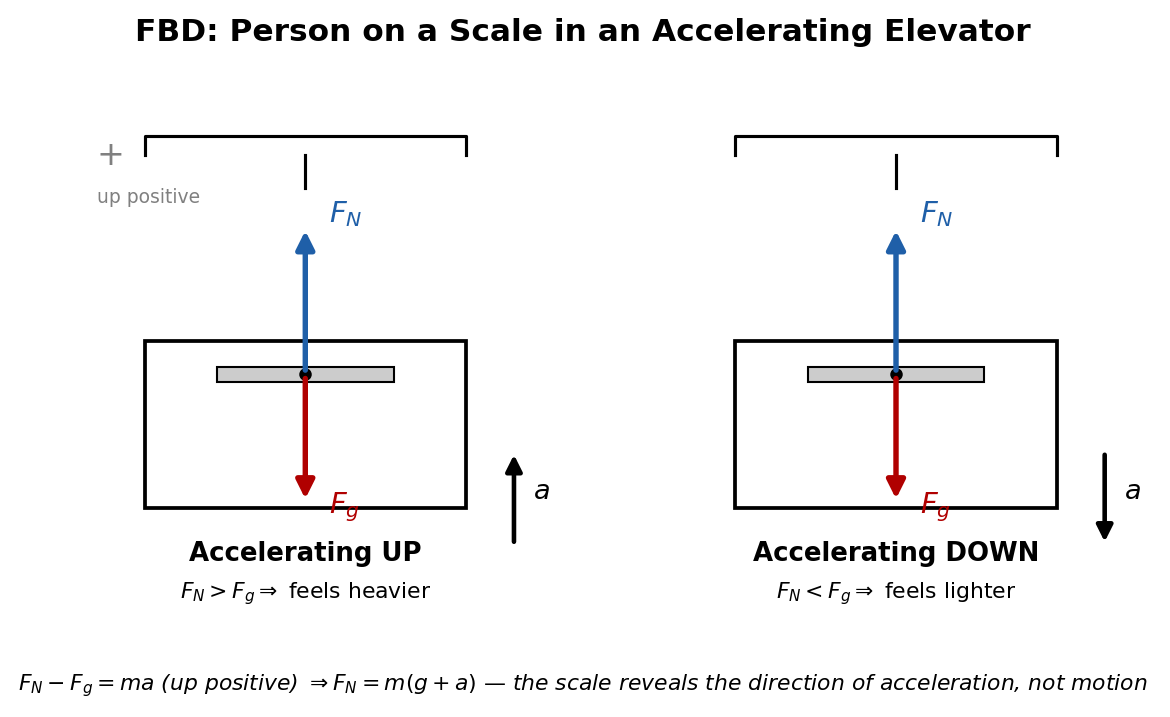 Same equation both times, $F_N - F_g = ma$ — only the sign and size of $a$ change.
The same rotated-axis strategy from Forces and FBDs (Topic 2.2) carries over directly: on an incline, write $F_{net}$ along the ramp-parallel axis equal to $ma$. On a frictionless incline with nothing but gravity acting along the ramp, the result is $a = g\sin\theta$ — notice mass cancels out completely, so a heavier block and a lighter block slide down the same frictionless ramp with identical acceleration.
Try It: Elevator Ride
See how acceleration changes the reading on a scale in an elevator. Dynamics Dungeon: Elevator Ride
Try It: Newton's Arena
Predict acceleration from force and mass (World 2). Dynamics Dungeon: Newton's Arena
Videos
- Introduction to Newton's Second Law of Motion with Example Problem — Flipping Physics
- A "Show All Your Work!" Example — Flipping Physics
Practice Problems
-
A 50 kg person stands on a scale in an elevator accelerating upward at 1 m/s². Find the scale's reading (the normal force).
-
A block slides down a frictionless incline at 20° to the horizontal. Write the expression for its acceleration down the ramp (do not calculate a number).
-
A 70 kg person stands on a scale in an elevator accelerating downward at 3 m/s². Find the scale's reading.
-
A car's brakes are applied, and its acceleration magnitude increases linearly with time as $a = Ct$, where $C$ is a positive constant and the car's mass $m$ stays constant. Write an expression for the net force on the car as a function of time, and describe the shape of its graph.
-
A block of mass $m$ is pushed up a frictionless ramp (angle $\theta$ to horizontal) by a horizontal force $F_p$ (not along the ramp's surface). Write the expression for the block's acceleration along the ramp, in terms of $F_p$, $m$, $\theta$, and $g$.
-
A 60 kg person rides in an elevator. At time $t_1$, the elevator accelerates downward with magnitude 3 m/s². At time $t_2$, it accelerates upward with magnitude 1 m/s². a) Find the scale reading (normal force) at $t_1$ and at $t_2$. b) Find the ratio of the normal force at $t_1$ to the normal force at $t_2$.
-
A spacecraft in deep space fires a thruster that exerts a constant force on it. The spacecraft's total mass decreases at a constant rate as fuel burns. a) Using $a = F_{net}/m$, explain whether the spacecraft's acceleration increases, decreases, or stays the same over time. b) Explain why the relationship between acceleration and mass here is not a linear one, even though the force is constant.
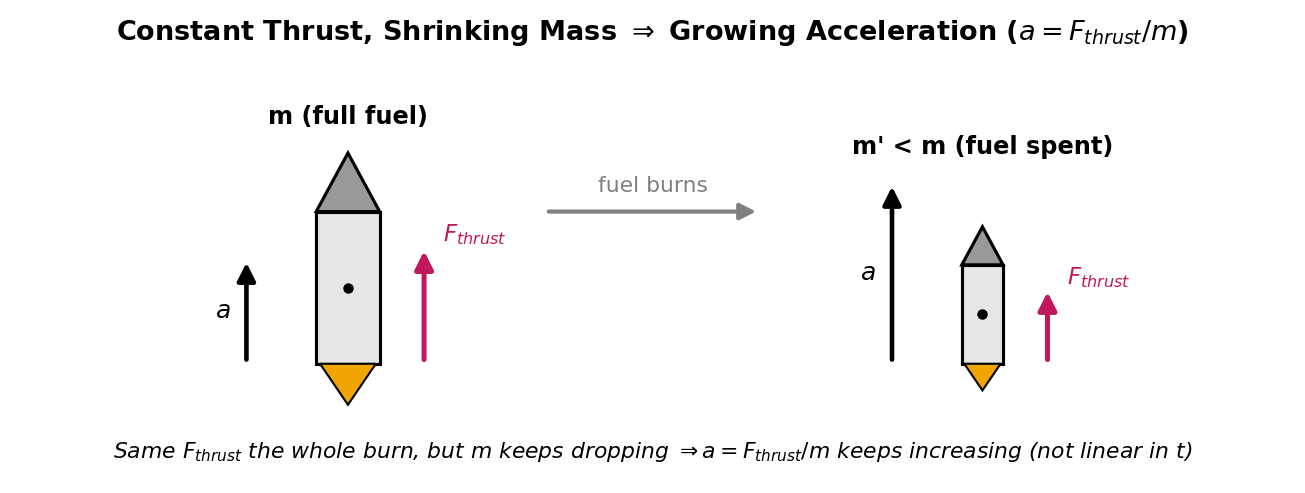 Same $F_{thrust}$ the whole time — acceleration climbs only because mass is shrinking.
 -
A 90 kg person stands on a scale in an elevator. The scale reads 1100 N. (Use $g = 10\text{ m/s}^2$, so the person's weight is 900 N.) Which of the following is a valid claim about the elevator's motion? (A) The elevator must be moving upward (B) The elevator must be moving downward and slowing down (C) The elevator could possibly be moving upward and speeding up, or moving downward and slowing down (D) The elevator must be at rest