Topic 2.5: Connected Systems: Whole-System vs. Isolate-One-Object
Picture two stars, far from anything else in the universe, orbiting their shared center of mass — each one individually tracing out a circle. Does the system's center of mass, the single point introduced back in the center-of-mass lesson, trace out a circle too? Hold that question — the answer is below.
When two objects are connected and forced to move together, they share exactly one acceleration — which gives two different, equally valid ways to write Newton's second law. Treat both objects as ONE combined mass and use only external forces ($F_{net,ext} = m_{total},a$) — any force internal to the system, like a connecting string's tension, cancels out completely and never appears. Or isolate a single object and use only the forces touching that one object, including internal forces. The whole-system method is fastest for finding the shared acceleration; isolating one object is required if the question actually asks for an internal force like tension.
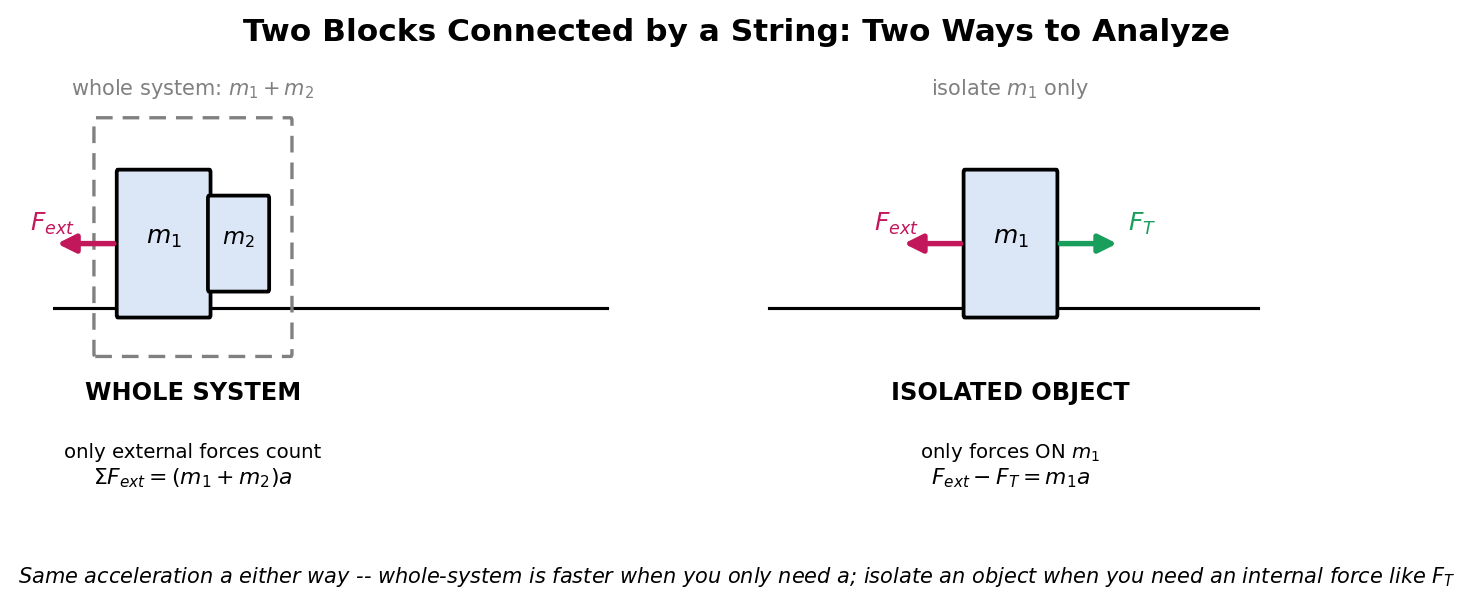 Same acceleration either way — whole-system is faster when you only need $a$; isolate an object when you need an internal force like tension.
This connects straight back to center of mass: a system's center-of-mass acceleration depends only on the net force from OUTSIDE the system — never on internal interactions between its own parts. Two stars far from anything else, orbiting their shared center of mass in circles, are each very much accelerating individually — but since nothing external is pushing on the two-star system, its center of mass has exactly zero acceleration. Internal forces, no matter how complicated, cannot move a system's own center of mass.
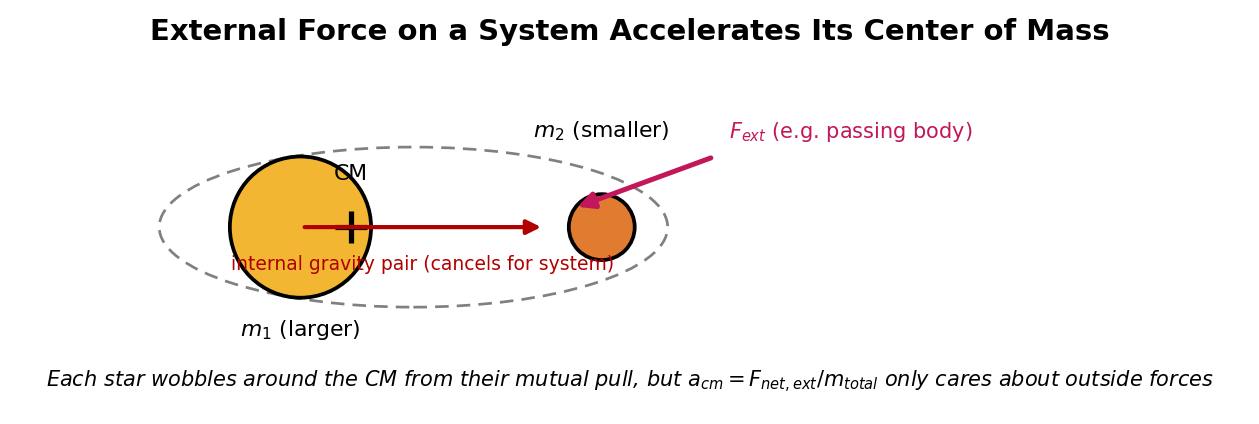 Each star individually accelerates from their mutual pull, but with no external force, the system's own center of mass doesn't move at all.
The classic AP setup combining both ideas: two connected crates, pulled by an external force, then the connecting string breaks. Before the break, solve as one system, sharing one acceleration. After the break, each crate has its OWN acceleration from whatever forces remain on it alone — they're no longer forced to move together, and typically end up with different accelerations from that instant on, even though the system's center-of-mass equation still applies throughout.
Try It: Ramp Racer
Predict the acceleration of a crate on a ramp with and without friction. Dynamics Dungeon: Ramp Racer
Try It: Atwood Machine
Predict the acceleration and tension of two masses over a pulley. Dynamics Dungeon: Atwood Machine
Try It: Tug of Two Blocks
Predict the acceleration and string tension for two connected blocks. Dynamics Dungeon: Tug of Two Blocks
Videos
- Introduction to Newton's Second Law of Motion with Example Problem — Flipping Physics
Practice Problems
-
Two blocks, masses 3 kg and 5 kg, are connected by a string on a frictionless floor. An external force of 16 N pulls the 3 kg block forward, with the 5 kg block trailing behind. Find the system's shared acceleration.
-
Using your answer to problem 1, isolate the trailing (5 kg) block to find the tension in the connecting string.
-
Two objects, far from any other objects in space, orbit their shared center of mass in circles at constant speed. Is the center of mass of the two-object system accelerating? Explain using the concept of external force.
-
Two blocks (masses $m_1$ and $m_2$) are connected by a string over a frictionless pulley, with $m_1$ resting on a horizontal frictionless table and $m_2$ hanging off the edge. Write the whole-system equation for the shared acceleration $a$, in terms of $m_1$, $m_2$, and $g$.
-
Using your answer to problem 4, isolate $m_1$ (on the table) to write an expression for the tension in the string.
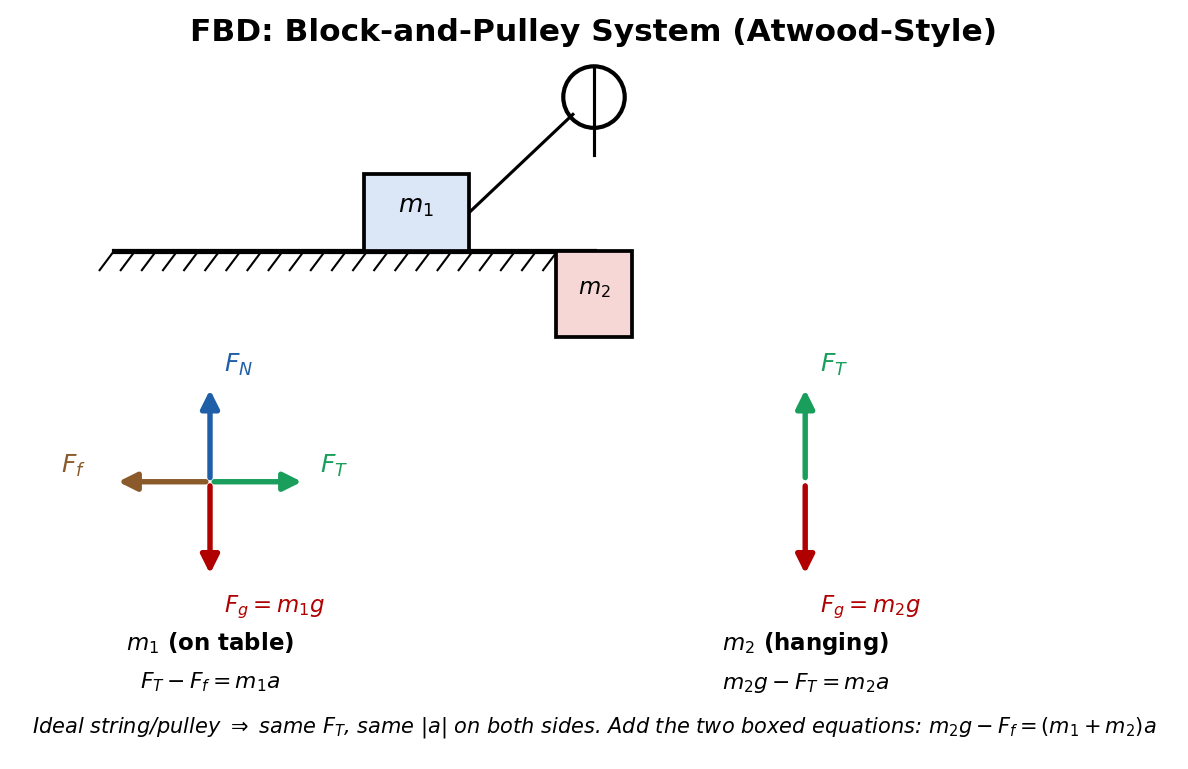 An ideal string and pulley mean the same tension and the same acceleration magnitude on both sides — add the two boxed equations together to eliminate friction's odd-one-out placement.
 -
Crate 1 (mass $2m$) and Crate 2 (mass $m$) are connected by a string on a rough floor. Crate 1 is pulled to the right by a constant force $F$. Crate 1 experiences friction $f_1$ and Crate 2 experiences friction $f_2$, both less than $F$. The string then breaks, and $F$ continues to act on Crate 1. a) Find an expression for Crate 2's acceleration right after the string breaks. b) Find an expression for the acceleration of the two-crate system's center of mass right after the string breaks, and explain why it may differ from Crate 2's individual acceleration.
-
A system consists of two identical blocks connected by a rigid rod. At a certain instant, the system's center of mass has zero velocity but a nonzero acceleration to the right. a) Is the net force on the system zero at that instant? Explain your reasoning. b) Explain why "the center of mass is momentarily at rest" does not imply "the system is in equilibrium."
-
Crate 1 (mass $m_1$) and Crate 2 (mass $m_2$) are connected by a string and pulled together by external force $F$ across a frictionless floor, sharing acceleration $a$. Which of the following correctly gives the tension in the connecting string if Crate 1 is the one being directly pulled by $F$, and Crate 2 trails behind? (A) $F_T = F$ (B) $F_T = m_1 a$ (C) $F_T = m_2 a$ (D) $F_T = (m_1+m_2)a$