Topic 2.8: Spring Forces: The Anagram That Locked In a Discovery
Imagine figuring out something important in science, but you're not ready to publish it yet — and you're worried someone else might beat you to the credit. There was no patent office for scientific ideas in the 1600s. So what would you do?
The English scientist Robert Hooke had been testing springs since 1660. In 1676, still not ready to reveal his full result, he tacked a strange string of letters onto the end of an unrelated lecture: "ceiiinosssttuv." Complete nonsense — on purpose. It was a coded placeholder, proof he'd already worked something out, without telling anyone what.
Two years later, in 1678, he finally published the solution: "Ut tensio, sic vis" — Latin for "as the extension, so the force." Stretch a spring further, and it pulls back harder, in direct proportion. Scientists guarded credit fiercely in this era — recall Newton and Leibniz's fight over who invented calculus first — and Hooke's anagram was one clever workaround.
That single relationship — now called Hooke's Law — is the entire principle behind an old-fashioned spring scale, the balance wheel inside a mechanical watch, and the suspension system in every car you've ridden in.
Hooke's Law
For an ideal spring, the force it exerts is directly proportional to how far it's stretched or compressed from its relaxed (equilibrium) length:
$$F_s = -k\Delta x$$
Here $k$ is the spring constant (in N/m) — a measure of stiffness specific to that spring — and $\Delta x$ is the displacement away from the relaxed length, not an absolute position. A large $k$ means a stiff spring that resists stretching; a small $k$ means a loose, floppy spring.
Always a Restoring Force
The negative sign in Hooke's Law captures something important: the spring force always points back toward the spring's relaxed position, no matter which way you've deformed it. Stretch it, and it pulls back. Compress it, and it pushes back out. That's why it's called a restoring force — it's always trying to restore the spring to where it started.
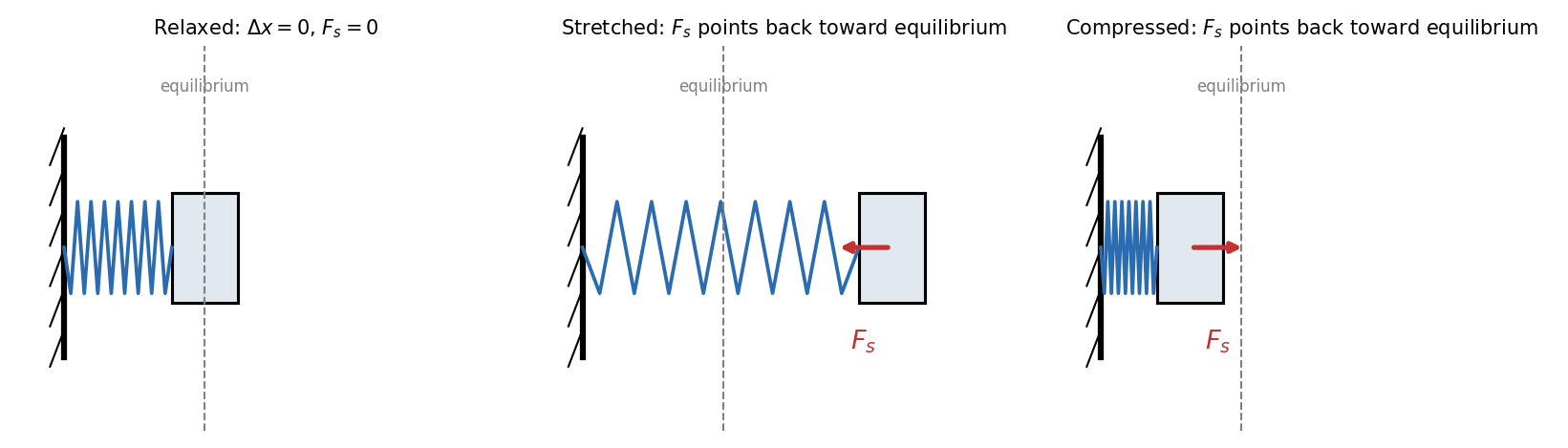
Whether stretched or compressed, the spring force always points back toward the relaxed, equilibrium position.
If you plot the force applied to a spring against how far it stretches, you get a straight line through the origin, and the slope of that line is exactly the spring constant $k$ — the standard way to measure $k$ in a real lab.
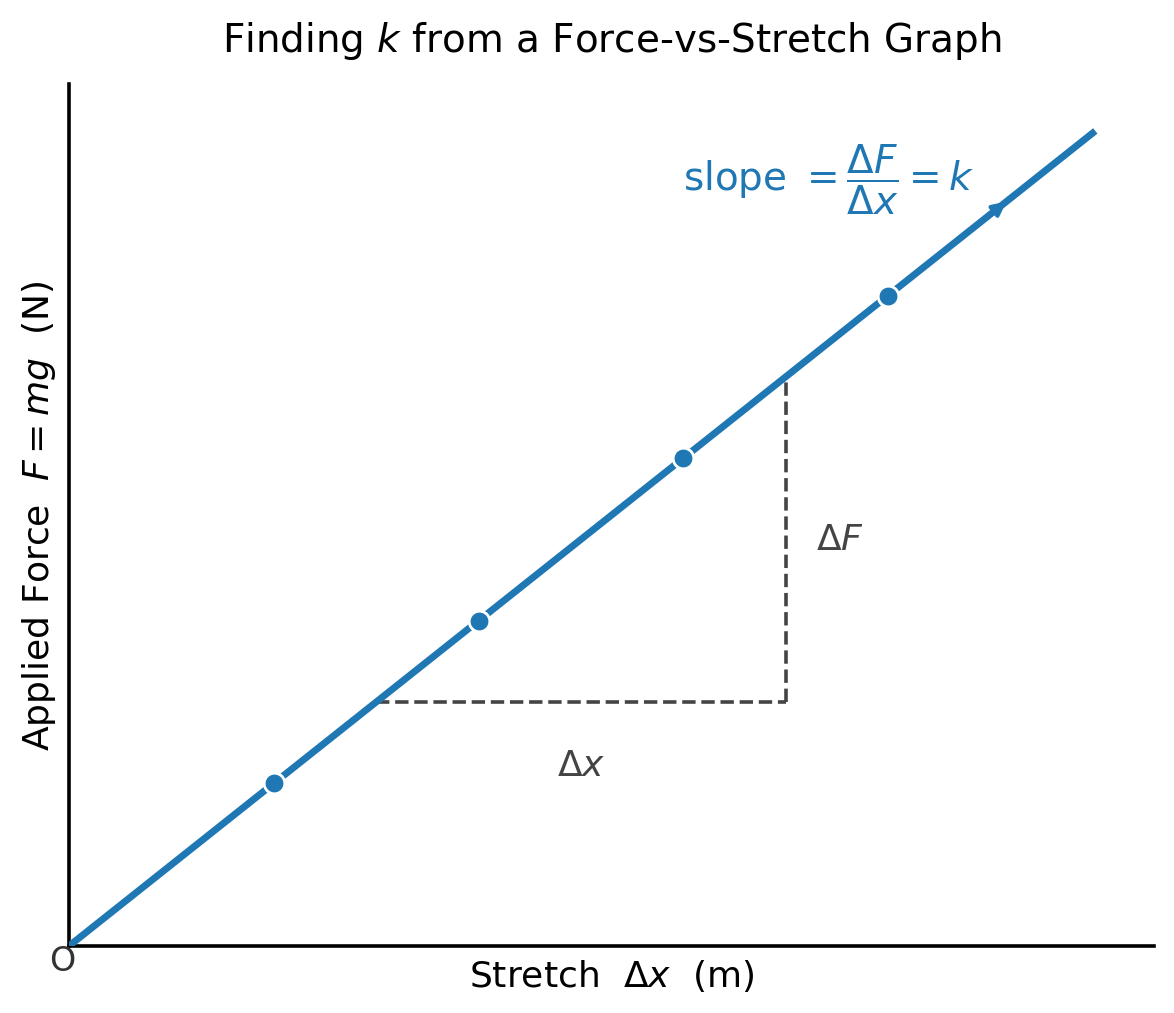 A straight line through the origin — its slope IS the spring constant $k$.
That's exactly how a real physics lab finds a spring constant in practice: hang a series of known masses from a spring, measure how far it stretches under each one, and plot the applied force against the stretch. But push a real spring far enough, and the graph stops behaving — past a point called the elastic limit, the line curves away from straight, and the spring is no longer well-described by Hooke's Law at all.
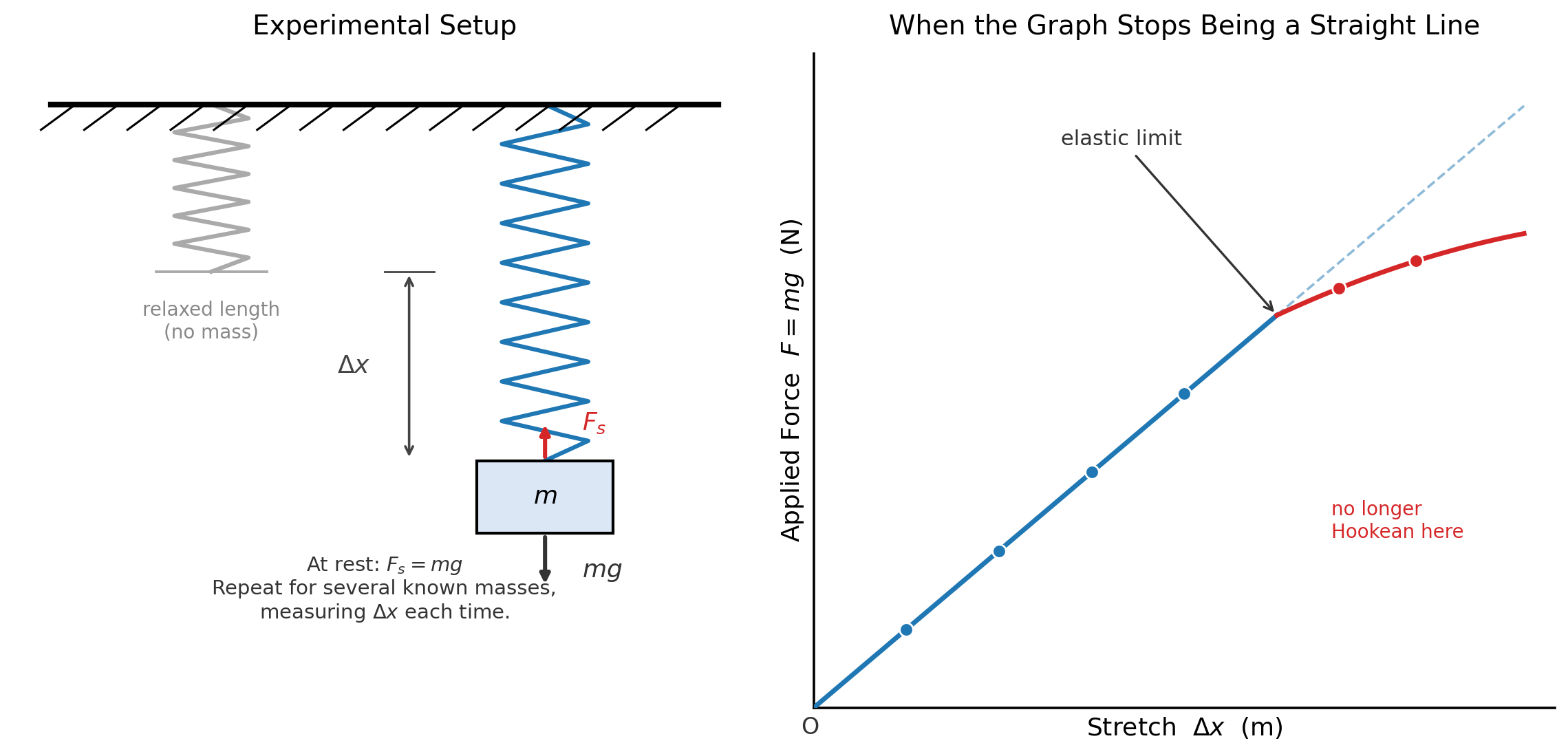 Past the elastic limit, the graph curves away — the spring is no longer Hookean there.
Practice Problems
- A spring has a spring constant of $k = 400\text{ N/m}$. Find the force it exerts when compressed $0.05\text{ m}$ from its relaxed length.
- A spring stretches $0.15\text{ m}$ when a $3.0\text{ kg}$ mass hangs from it at rest. Find the spring constant $k$.
- A different spring has $k = 180\text{ N/m}$. What mass, hung at rest, would stretch it $0.10\text{ m}$?
Try It: Spring Scale
Hang masses from a spring and predict the stretch, then try springs in series and parallel. Dynamics Dungeon: Spring Scale