Topic 2.8: Multi-Spring Systems: Load-Sharing, Buoyancy, and the Direction of Acceleration
Everything from last time still applies — $F_s=-k\Delta x$ for every spring, every time. What changes today is what happens when more than one spring is involved at once.
Multiple Springs, One Object
When more than one spring acts on the same object, treat it exactly like any other force-summing free-body diagram: find each spring's force separately using Hooke's Law, then add them together.
$$\Sigma F = F_{s1} + F_{s2} + (\text{any other forces})$$
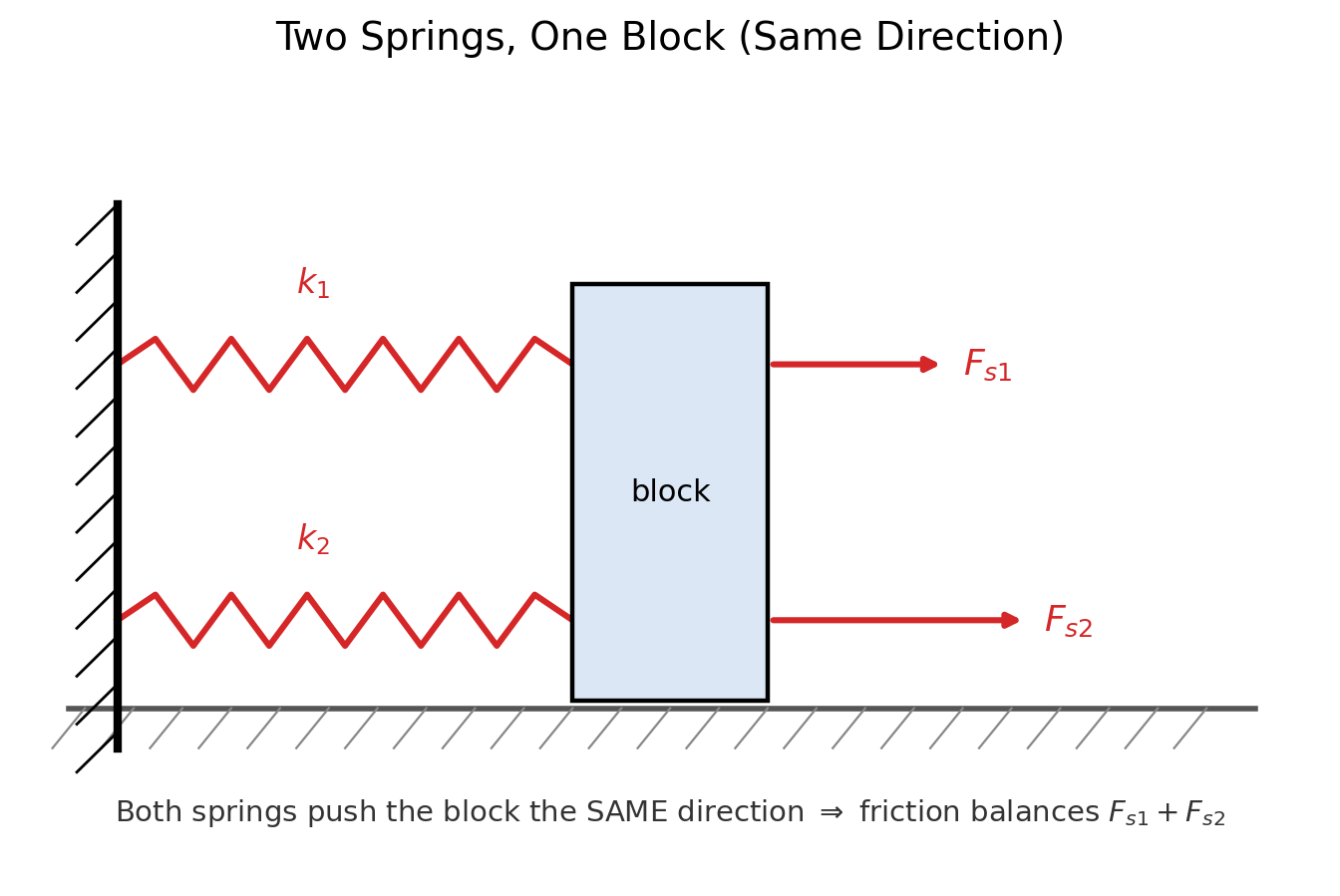 Sum each spring's force separately with Hooke's Law, then add — exactly like any other free-body diagram.
Sharing a Load
If several identical springs share a hanging load equally, each spring only supports its fraction of the total weight — not the whole thing:
$$\Delta x = \frac{Mg}{Nk}$$
for $N$ identical springs sharing weight $Mg$. Double the load AND double the number of springs sharing it, and the stretch per spring doesn't change at all.
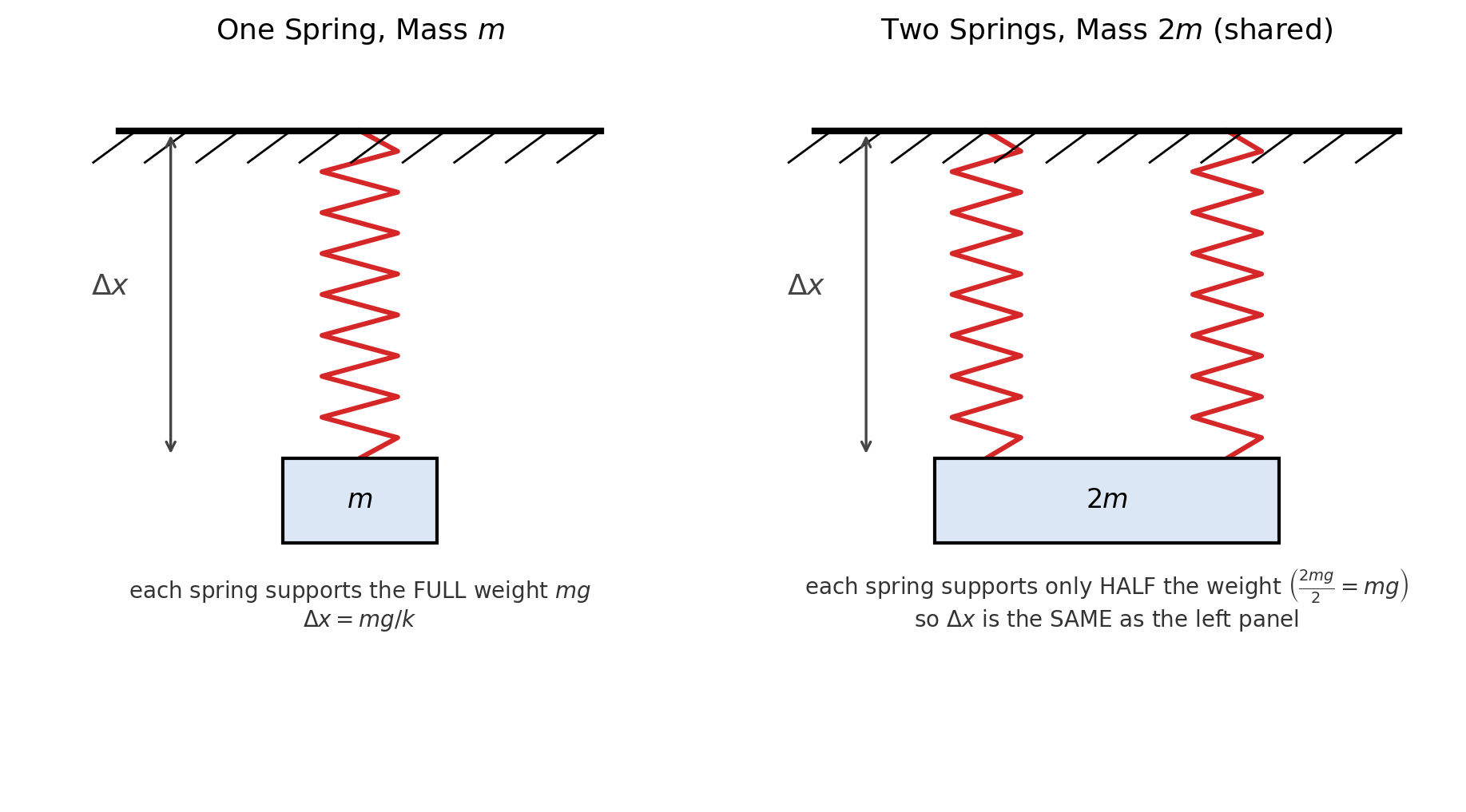 Double the mass and double the number of springs sharing it, and the stretch per spring comes out exactly the same.
A Change in Stretch Doesn't Always Mean a Change in $k$
Here's a classic AP Classroom trap: a spring's stretch changes, so it's tempting to conclude the spring constant $k$ must have changed too. But $k$ is a fixed property of the physical spring — it never changes just because the surrounding situation changed. If the same spring's stretch is different, look for a NEW force that entered or left the picture instead. A block hanging from a spring in air, then fully submerged in water, stretches the spring less — not because $k$ changed, but because buoyancy is now helping support the block's weight.
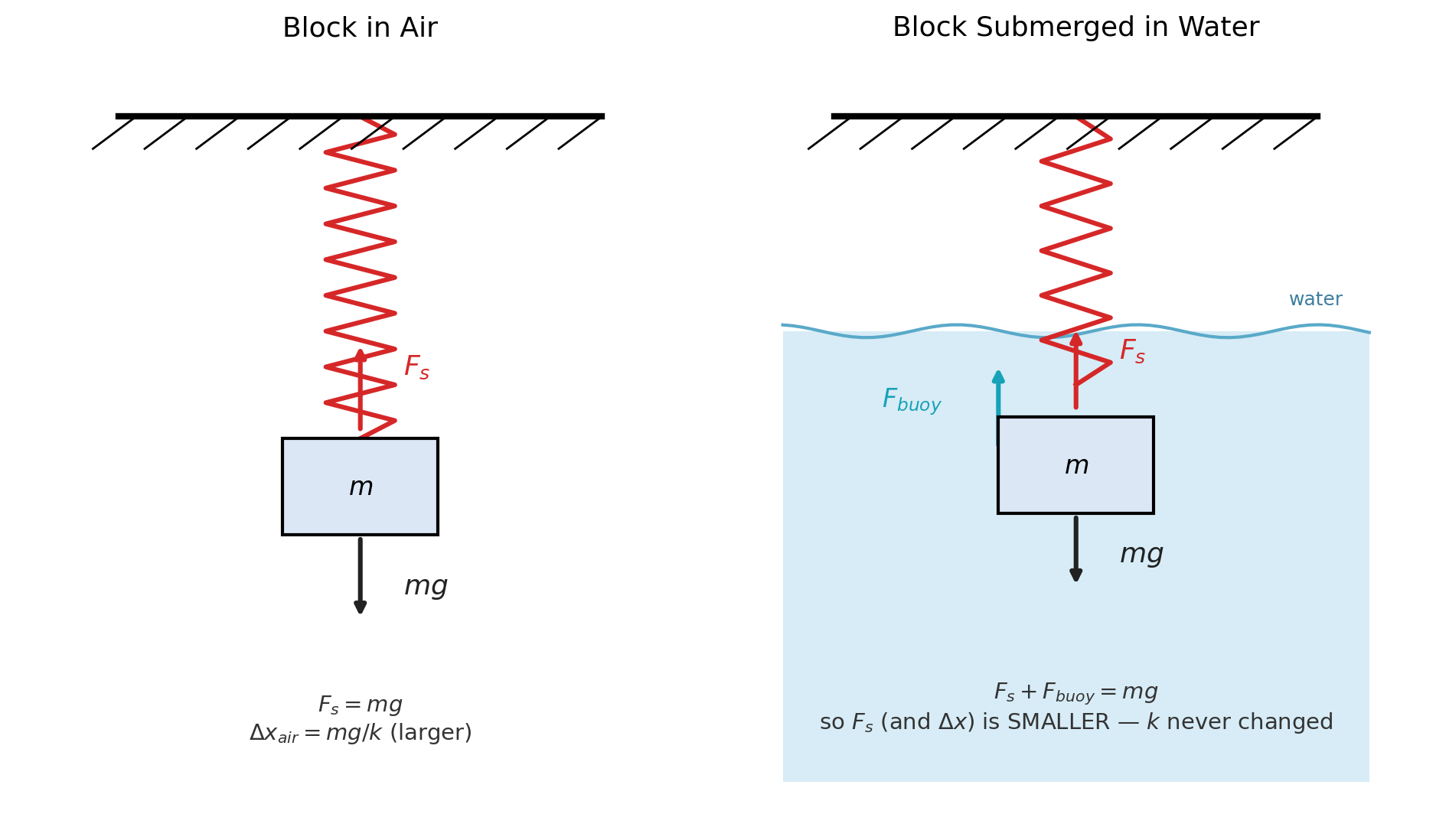 The spring is shorter underwater not because $k$ changed, but because buoyancy now shares the job of supporting the block's weight.
A Preview of Oscillation
One more connection: since the spring force always points toward equilibrium (last session's restoring-force idea), and $F_{net}=ma$, the acceleration of a spring-mass system also always points toward equilibrium — based only on where the object currently IS, never on which way it's currently moving. An object can be moving away from equilibrium and still have an acceleration pointing back toward it; that's not a contradiction, it just means the object is slowing down, about to reverse direction.
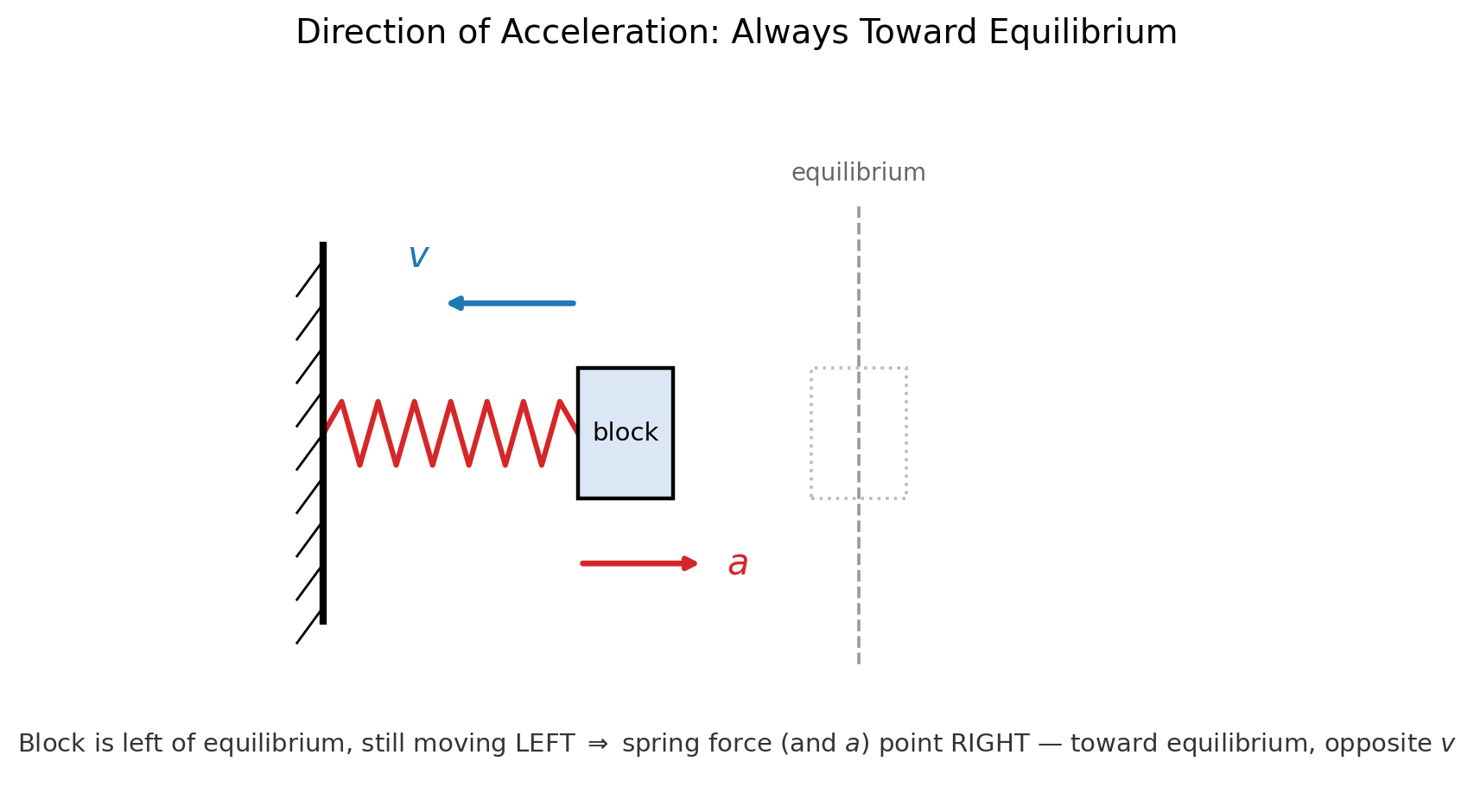 Acceleration always points back toward equilibrium, based on where the block IS — even while it's still moving further away.
Try It: Spring Scale
Compare springs in series and in parallel. Dynamics Dungeon: Spring Scale
Videos
- Hooke's Law Introduction - Force of a Spring (9:35) — Flipping Physics
Practice Problems
- A block on a horizontal surface is pushed by two horizontal springs, both anchored to the same wall and both compressed, so both push the block in the same direction. Spring 1 ($k_1=170\text{ N/m}$) is compressed $0.12\text{ m}$; Spring 2 ($k_2=210\text{ N/m}$) is also compressed $0.12\text{ m}$. The block stays at rest, held by friction. Find the friction force needed.
- A single spring ($k=180\text{ N/m}$) holds a $5.0\text{ kg}$ mass at rest. In a second setup, TWO identical springs (each $k=180\text{ N/m}$) share a $10.0\text{ kg}$ mass equally. Find the stretch in each case, and explain whether they're equal.
- A $3.0\text{ kg}$ block hangs at rest from a vertical spring ($k=120\text{ N/m}$) in air. The block is then fully submerged in water and comes to rest again, with the spring now stretched only $0.10\text{ m}$. Find (a) the original stretch in air, (b) the spring force while submerged, (c) the buoyant force from the water.
- A block attached to a horizontal spring oscillates back and forth on a frictionless surface. At the instant the block is to the RIGHT of equilibrium and moving further right (away from equilibrium), which direction does its acceleration point? Explain.