Topic 3.3: Gravitational Potential Energy — Energy That Isn't Moving
A boulder sits motionless at the edge of a cliff. Its kinetic energy is zero — so does it have energy anyway? In 1853 the Scottish engineer William Rankine gave physics a word for exactly this: potential energy, energy an object has because of where it is or how it's arranged, waiting to be turned into motion. (He called the energy of motion "actual" energy; his contemporary Lord Kelvin's word, kinetic, is the one that stuck.)
Rankine's word hides one subtle point that AP Classroom loves: the potential energy isn't really in the boulder. It belongs to the boulder and the Earth together. Take the Earth away and there is no gravitational potential energy at all. So we always speak of the gravitational potential energy of the object–Earth system.
Near Earth's Surface: $\Delta U_g = mg\Delta y$
Near the surface, the change in gravitational potential energy is
$$\Delta U_g = mg,\Delta y$$
where $\Delta y$ is the change in height of the object's center of mass. Two details matter. First, the center of mass is what counts — two equal-mass spheres lowered from ceiling to floor lose different amounts of energy if their radii differ, because the smaller sphere's center falls farther. Second, the zero line is a free choice: it changes the value of $U_g$ you write down but can never change $\Delta U_g$.
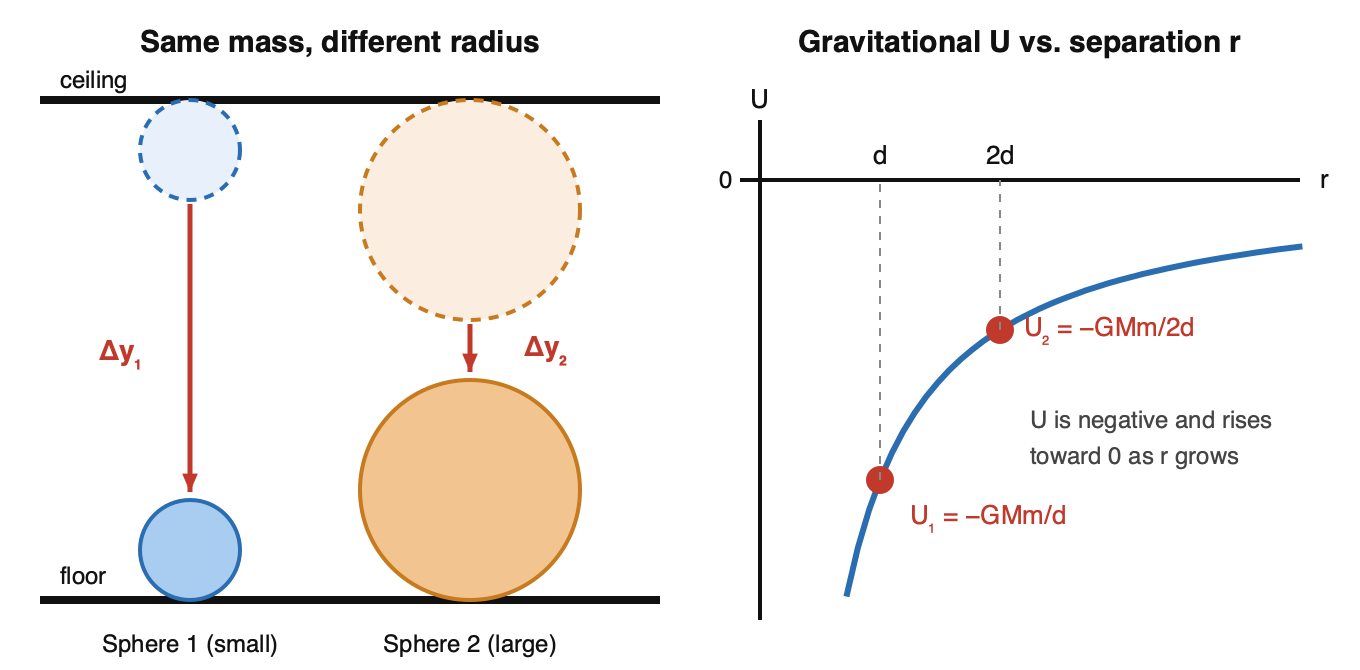 Left: the smaller sphere's center of mass falls farther, so it loses more gravitational potential energy. Right: for two masses, $U=-GMm/r$ is negative and rises toward zero as they move apart.
A Trap: Terminal Velocity
An object falling through air speeds up, then reaches a constant terminal speed. Its kinetic energy stops changing — but its gravitational potential energy does not. $\Delta U_g = mg\Delta y$ depends only on how far it has dropped, and it's still dropping. $U_g$ tracks height, not speed.
The Universal Form for Two Masses
For satellites, moons, and planets, gravity changes with distance, so we need
$$U_g = -\frac{Gm_1 m_2}{r}$$
with $r$ the center-to-center distance. It's negative always, because we set $U=0$ at infinite separation. Moving apart makes $U$ larger (less negative, rising toward zero); moving closer makes it more negative. So a satellite moving to a bigger orbit gains gravitational potential energy. And because $G$ never changes, you rarely need its value — write $U$ for each situation and let the constants cancel in ratios, remembering to account for both the mass factor and the distance factor.
Try It: Hill Roller
Change the zero line and watch the gravitational potential energy change while the change in energy stays the same. Energy Empire: Hill Roller
Videos
- Introduction to Gravitational Potential Energy with Zero Line Examples — Flipping Physics
- Universal Gravitational Potential Energy Introduction — Flipping Physics (extension: the $-Gm_1m_2/r$ form)
Practice Problems
-
A $0.50\text{ kg}$ book is lifted $2.0\text{ m}$ from the floor to a shelf. Find $\Delta U_g$ of the book–Earth system.
-
The same book sits on a shelf $2.0\text{ m}$ above the floor. A table is $0.75\text{ m}$ above the floor. (a) Find $U_g$ of the book on the shelf with the zero line at the floor. (b) Find $U_g$ with the zero line at the table top. (c) The book is moved from the shelf to the table top. Find $\Delta U_g$ using each zero line, and comment.
-
Two $2.0\text{ kg}$ spheres touch a ceiling $3.0\text{ m}$ above the floor. Sphere 1 has radius $0.10\text{ m}$, Sphere 2 has radius $0.40\text{ m}$. Each is lowered to the floor. Find $|\Delta U_g|$ for each, and state which is larger and why.
-
At time $t_1$ a moon of mass $m$ is a distance $d$ from a planet's center (planet mass $M$). At $t_2$ it is $2d$ away. Find the ratio $U_{t_1}:U_{t_2}$. Did the system's potential energy increase or decrease from $t_1$ to $t_2$?
-
Planet A (mass $m_0$) orbits a star of mass $M$ at radius $r_0$. Planet B (mass $4m_0$) orbits it at radius $2r_0$. Find $U_A:U_B$.
-
A satellite of mass $m$ is a distance $D$ from an asteroid of mass $M$. It moves to $2D$ and its mass becomes $\tfrac{m}{2}$. Find $\Delta U_g$ of the system.
-
A probe of mass $m$ is a distance $R$ from the center of a planet of mass $M$. It moves to a distance $3R$, and by then its mass has changed to $3m$ (assume nothing else changes). a) Find $U$ at $R$ and at $3R$ in terms of $G$, $M$, $m$, $R$. b) Find $\Delta U_g$. c) Explain, in one sentence, how mass and distance combined to give this result.
-
A satellite in circular orbit is moved to a slightly larger orbit radius. a) Does the gravitational potential energy of the satellite–Earth system increase or decrease? Justify using $U=-Gm_1m_2/r$. b) Sketch $U$ vs. $r$ (r on the horizontal axis) and mark the two orbits on it.
-
An object is released from rest near Earth's surface and speeds up, then reaches terminal velocity before landing. Air resistance acts on it. Which claim about the gravitational potential energy of the object–Earth system is true? (A) It stays constant while accelerating, then decreases at terminal velocity. (B) It decreases while accelerating, then stays constant at terminal velocity. (C) It stays constant the whole time. (D) It decreases while accelerating and continues to decrease at terminal velocity.
-
A student says, "The boulder at the top of the cliff has $5000\text{ J}$ of gravitational potential energy, and that number belongs to the boulder." Explain two things wrong or incomplete with this statement.
-
A satellite of mass $m$ orbits Earth (mass $M$) at radius $R$. It is moved to $3R$. (a) Find $\Delta U_g$. (b) A student says the satellite "lost" potential energy because the distance got larger. Identify the mistake in the student's reasoning.