Topic 3.3: Spring Potential Energy — The Man Who Named Energy
The word "energy" came from a Greek term meaning something like "activity," and for two thousand years it wasn't a measurable physics quantity. The first person to use it in the modern sense was the English polymath Thomas Young, in 1807. Young worked on the wave theory of light, helped decipher the Rosetta Stone, and practiced medicine — and his name is on Young's modulus, the number that measures how stiff a material is. That's the same idea as a spring constant $k$. So it's fitting that the man who named energy was also fascinated by how much energy you store by deforming something.
The Spring Energy Formula
The potential energy stored in a spring is
$$U_s = \tfrac{1}{2}k(\Delta x)^2$$
where $\Delta x$ is the stretch or compression from the spring's relaxed length. That is the reference: $U_s = 0$ there and only there. Because $\Delta x$ is squared, stretching and compressing by the same amount store the same energy, and doubling the displacement gives four times the energy.
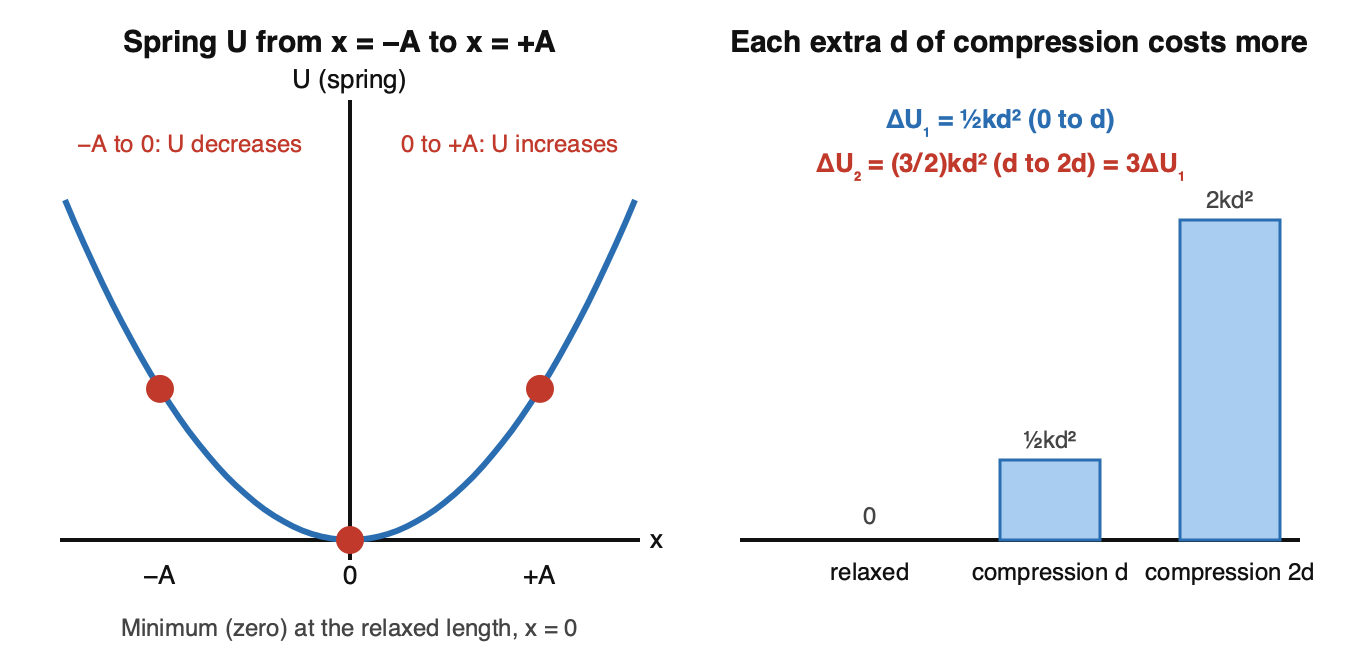 Left: $U_s$ vs. $x$ is a parabola with its minimum at the relaxed length. Right: each additional $d$ of compression stores more energy than the one before.
Picture a block on a horizontal spring, held at $x=-A$ with the spring compressed, then moved slowly to $x=+A$. On the way, the spring's energy decreases to zero at $x=0$ and then increases again. Not "up the whole way." That's the shape of a parabola.
Equal Steps, Unequal Energy
Compress a spring by $d$ (energy change $\Delta U_1$), then by an additional $d$ ($\Delta U_2$). The steps are the same size — but $\Delta U_2$ is bigger. From zero: the first $d$ stores $\tfrac12kd^2$, the second takes the total to $2kd^2$, so it stores $\tfrac32kd^2$ — three times as much. And you don't even need to know where you started: for any initial compression $x_0$, $\Delta U_2 - \Delta U_1 = kd^2$, always positive.
Where the Formula Comes From
The force needed to stretch a spring is $F = kx$, a straight line through the origin on a force-vs-position graph. The work is the area under it: a triangle of base $x$ and height $kx$, so $\tfrac12(x)(kx)=\tfrac12kx^2$. That's exactly the energy stored — the same "area under the graph" tool from Topic 3.2.
Springs and Gravity Together
On a vertical spring, lower an object slowly onto it and two potential energies change: the Earth–object gravitational energy decreases, and the spring's energy increases. At equilibrium the spring force balances weight, so $kx=mg$ and $x=mg/k$. The spring gains only half of what gravity loses — the hand holding the object back did negative work during the lowering.
Try It: Spring Launcher Game
Pull back the spring, predict the peak height, and launch: Energy Empire: Spring Launcher. Five levels plus a sandbox, with a live energy bar showing where every joule goes.
Videos
- Introduction to Elastic Potential Energy with Examples — Flipping Physics
- Hooke's Law Introduction — Force of a Spring — Flipping Physics (review of $F=kx$)
Practice Problems
-
A spring with $k=400\text{ N/m}$ is compressed $0.050\text{ m}$. Find its potential energy.
-
A spring stores $2.0\text{ J}$ when stretched $0.10\text{ m}$. How much does it store when stretched $0.30\text{ m}$?
-
The same spring is (a) stretched $0.10\text{ m}$ and (b) compressed $0.10\text{ m}$. Compare the stored energies and explain.
-
A spring ($k=100\text{ N/m}$) is compressed $0.10\text{ m}$, then compressed an additional $0.10\text{ m}$. Find $\Delta U_1$ and $\Delta U_2$, and compare them.
-
A block on a horizontal spring ($k=80\text{ N/m}$) is held at $x=-0.30\text{ m}$, then moved slowly at constant speed to $x=+0.30\text{ m}$. Find $U_s$ at $-0.30\text{ m}$, $0$, and $+0.30\text{ m}$, and describe how $U_s$ changes.
-
A $0.20\text{ kg}$ egg is placed on a vertical spring ($k=40\text{ N/m}$) at its relaxed length and lowered slowly to equilibrium. Find the compression, $\Delta U_g$, and $\Delta U_s$.
-
A spring ($k=50\text{ N/m}$) is stretched from $x=0$ to $x=0.40\text{ m}$. (a) Sketch the $F$-vs-$x$ graph and find the area under it. (b) Confirm the area matches $\tfrac12kx^2$. (c) Find the work needed to stretch it from $x=0.20\text{ m}$ to $x=0.40\text{ m}$ using the area of the region between those positions.
-
A spring is already compressed by $x_0$. It is compressed a further $d$ (change $\Delta U_1$), then another $d$ (change $\Delta U_2$). a) Write $\Delta U_1$ and $\Delta U_2$ in terms of $k$, $x_0$, and $d$. b) Show that $\Delta U_2-\Delta U_1=kd^2$. c) A student argues, "The changes can't be compared without knowing the original compression $x_0$." Use part (b) to explain why the student is wrong.
-
A person compresses a spring slowly at constant speed. Kinetic energy doesn't change, so net work on the block is zero. Explain how that's consistent with the person doing positive work and the spring storing energy.
-
A block is attached to a compressed horizontal spring and held at $x=-A$. A person slowly moves the block at constant speed through $x=0$ (spring relaxed) to $x=+A$. How does the potential energy of the spring–block system change? (A) It decreases throughout the motion. (B) It increases throughout the motion. (C) It decreases, then increases. (D) It increases, then decreases.
-
An egg is placed gently on a vertical spring at its unstretched length, then slowly lowered until it rests in equilibrium. Which correctly gives the signs of $\Delta U_g$ (Earth–egg) and $\Delta U_s$ (spring)? (A) $\Delta U_g>0$, $\Delta U_s>0$ (B) $\Delta U_g>0$, $\Delta U_s<0$ (C) $\Delta U_g<0$, $\Delta U_s>0$ (D) $\Delta U_g<0$, $\Delta U_s<0$