Topic 3.4: Conservation of Mechanical Energy — Choosing the System
In the 1720s the Dutch scientist Willem 's Gravesande dropped brass balls into soft clay from different heights and measured the dents. Drop a ball from twice the height and it strikes about $\sqrt2$ times faster — but the dent is twice as deep, not $\sqrt2$ times. Dent depth scaled with drop height, which means with $v^2$. That was exactly the evidence the vis viva side of the Leibniz–Descartes argument needed, and it was Émilie du Châtelet, in her 1740s physics textbook Institutions de Physique, who defended the $mv^2$ view with experiments like it. (She also translated Newton's Principia into French.) Her bigger insight: the height a ball has, the speed it gains, and the dent it makes aren't separate facts. Energy changes form, and the books balance.
Mechanical Energy and When It Is Conserved
The total mechanical energy of a system is
$$E = K + U$$
where $U$ includes every potential energy in that system — gravitational if Earth is in the system, spring if a spring is. It is conserved, so $K_i + U_i = K_f + U_f$, only when two things hold together: no external force does work on the system, and no energy is converted to internal energy.
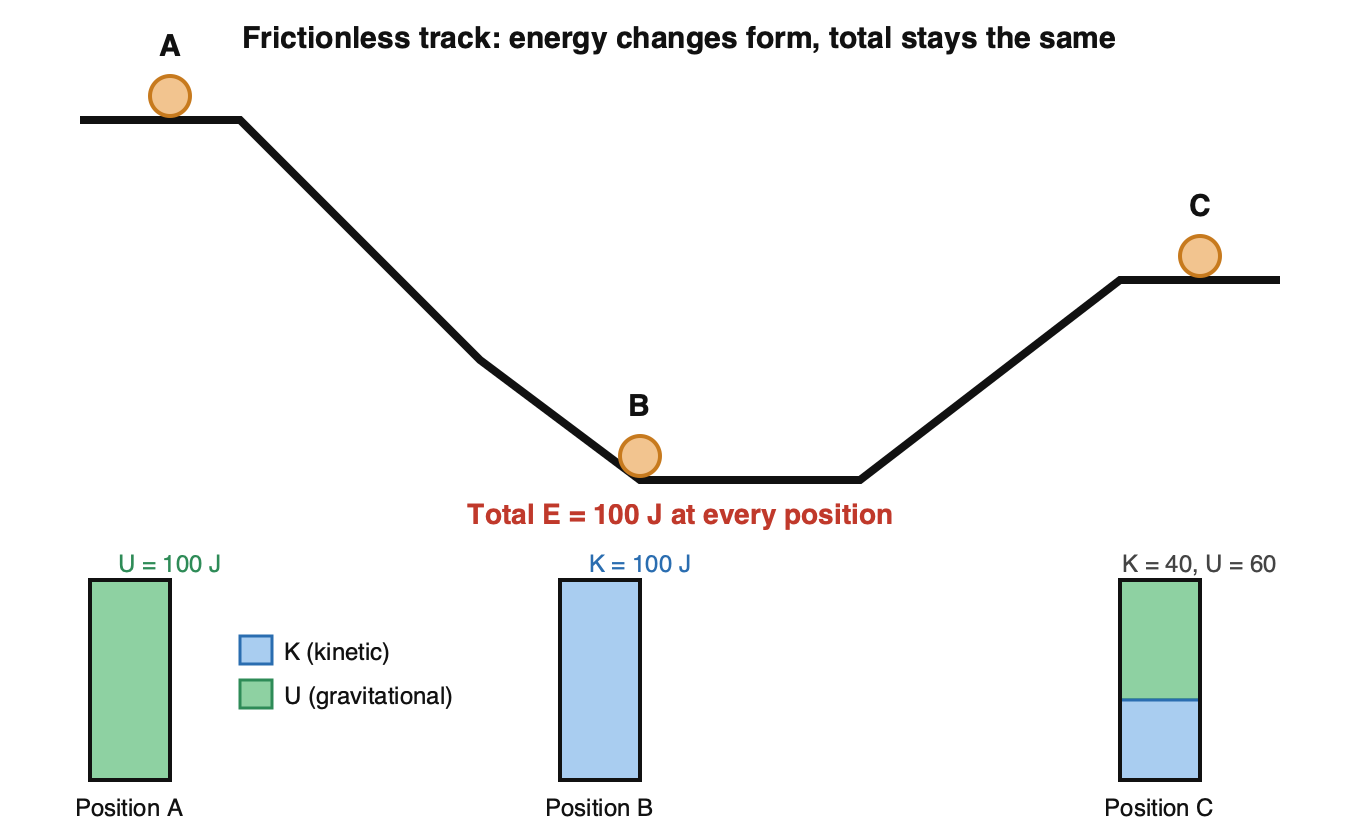 On a frictionless track, energy only changes form. The total stays at 100 J — the bars change color, not height.
The Hard Part Is Choosing the System
Whether a force is internal or external depends on what you call the system. Block on a frictionless ramp: if the system is block plus Earth, gravity is internal, its energy is the gravitational potential energy $U_g$ on your list, no external force does work, and $E$ is conserved. If the system is the block alone, gravity is an external force that does work, there is no $U_g$ on your list, and $\Delta K = W_{gravity}$.
A favorite AP question: a block rests at equilibrium on a vertical spring. The block–spring–Earth system has gravitational and spring potential energy. The block–spring system has only spring potential energy, because Earth isn't part of it.
Solving With Conservation
Once the system is set, $K_i + U_i = K_f + U_f$ does the work. Two powerful features: the mass usually cancels, and the path's shape never appears — only start and end heights and speeds matter. A sled at speed $v_i$ climbing a frictionless hill of height $h$ has $v_f = \sqrt{v_i^2 - 2gh}$ (minus, because it gains height and slows). A spring launch converts $\tfrac12 kx^2$ into $\tfrac12 mv^2$. And an asteroid approaching a planet has $\Delta E_{tot}=0$, $\Delta U_g<0$, so $\Delta K>0$ — it speeds up.
Try It: Spring Launcher Game
With no friction, the spring's stored energy turns entirely into height. Predict the peak, then launch: Energy Empire: Spring Launcher (Levels 1–3), with a live energy bar showing where every joule goes.
Try It: Hill Roller
Watch kinetic and gravitational energy trade places, and switch the system between cart-plus-Earth and cart alone. Energy Empire: Hill Roller
Videos
- Introduction to Conservation of Mechanical Energy with Demonstrations — Flipping Physics
- Introductory Conservation of Mechanical Energy Problem using a Trebuchet — Flipping Physics
- Energy Systems Clarified — Flipping Physics (the system-choice idea)
Practice Problems
-
A ball is dropped from rest from $20\text{ m}$ above the ground. Find its speed just before landing, using energy.
-
A frictionless ramp has height $h$. A block slides down from rest. (a) Write its speed at the bottom in terms of $g$ and $h$. (b) Does the answer depend on the block's mass? On the ramp's angle?
-
A sled slides on flat ice at $6.0\text{ m/s}$ and climbs a frictionless hill to a flat top $1.0\text{ m}$ higher. Find its speed at the top.
-
A $0.20\text{ kg}$ block is pressed against a spring ($k=100\text{ N/m}$), compressing it $0.20\text{ m}$, then released on a frictionless horizontal surface. Find the block's speed when the spring reaches its relaxed length.
-
A $0.40\text{ kg}$ block is launched by a spring ($k=400\text{ N/m}$, compressed $0.10\text{ m}$) up a frictionless incline. Assuming all the spring's energy becomes gravitational potential energy at the highest point, find the maximum height the block reaches above its starting position.
-
A $2.0\text{ kg}$ ball is released from rest at Position A, $5.0\text{ m}$ above the bottom of a frictionless track (Position B). Position C is $3.0\text{ m}$ above B. Find the ball's total mechanical energy, its kinetic energy at C, and its speeds at B and C.
-
A block is at rest on a vertical spring, in equilibrium. a) List the types of energy in the block–spring–Earth system. b) List the types of energy in the block–spring system. c) Explain why the two lists differ, using the definition of "system."
-
An asteroid moves directly toward a planet (the planet's velocity change is negligible). a) For the asteroid–planet system, state whether $\Delta E_{tot}$ is positive, negative, or zero, and justify. b) State the sign of $\Delta K$ for the asteroid and $\Delta U_g$ for the system, and explain how they're connected.
-
A student says: "If I double the sled's mass, the sled's final speed at the top of the frictionless hill will be smaller, because there's more mass to lift." Evaluate the claim using the energy equation.
-
A sled is traveling with speed $v_i$ along flat, frictionless ground and reaches a hill. It moves up to a flat section at height $h$ with speed $v_f$. What is $v_f$? (A) $\sqrt{2gh}$ (B) $\sqrt{v_i^2-2gh}$ (C) $\sqrt{v_i^2+2gh}$ (D) $\sqrt{2gh-v_i^2}$
-
At time $t_0$ a block is held at rest against a compressed horizontal spring at the top of a frictionless track. The total mechanical energy of the block–spring–Earth system is $E_0$. The block is released, slides down the track, and at $t_1$ is on a flat section. Friction is negligible. Which is true of $E_1$ and $E_0$? (A) $E_1<E_0$ (B) $E_1=E_0$ (C) $E_1>E_0$ with $E_0=0$ (D) $E_1>E_0>0$