Topic 3.4: Nonconservative Forces — Where Did the Energy Go?
Rub your hands together and they get warm. In the early 1800s many scientists believed heat was an indestructible fluid called caloric. Then, in the 1840s, a brewer's son from Manchester named James Prescott Joule built a device in which falling weights turned a paddle wheel inside an insulated container of water. The weights lost gravitational potential energy he could calculate; the water warmed by an amount he could measure with extraordinarily sensitive thermometers. Every time, the same amount of lost mechanical energy produced the same amount of warming. Heat wasn't a fluid — it was energy. The mechanical energy the paddle wheel lost hadn't vanished; it had become internal energy of the water. We measure energy in joules in his honor.
Friction Converts Mechanical Energy Into Internal Energy
A block slides down a rough ramp. For the block–Earth system, friction is an external force that converts some mechanical energy into internal energy (the surfaces warm up):
$$E_f = E_i - E_{dis}, \qquad E_{dis} = f,d$$
for a constant friction force $f$ over a sliding distance $d$. The mechanical energy decreases and the internal energy increases by the same amount.
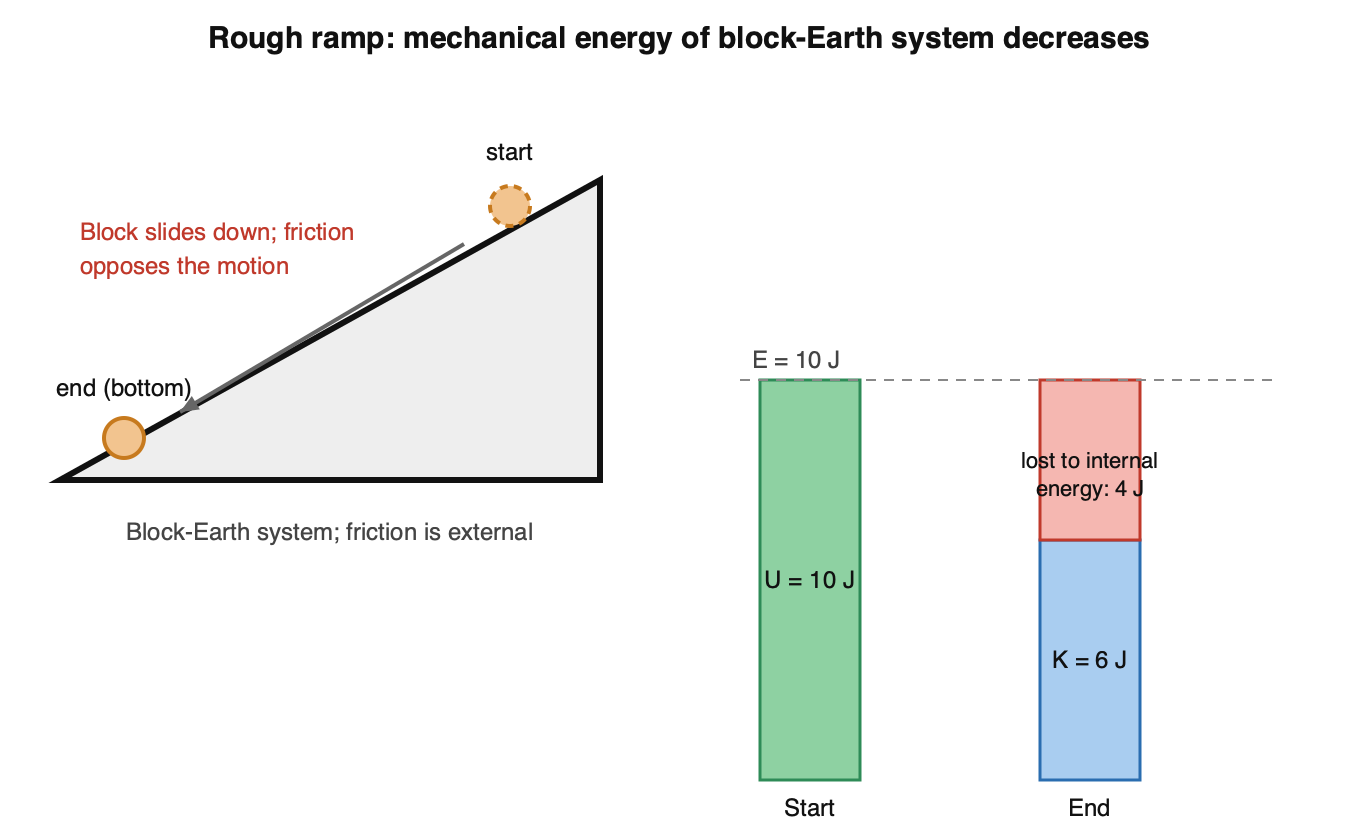 The block speeds up, but the mechanical energy of the block–Earth system still drops from 10 J to 6 J — 4 J became internal energy.
That's the trap on the AP quiz: the block is moving faster at the bottom, but its mechanical energy went down. Kinetic energy rose by 6 J while gravitational potential energy fell by 10 J. And if you expand the system to include the ramp and the air, the 4 J of internal energy is inside the system, so the total energy is conserved. Total energy is always conserved; mechanical energy is not.
External Work Transfers Energy
Energy also crosses the system boundary when an external force does work: $W_{ext} = \Delta E_{sys}$, including any change in internal energy. Lift a book slowly with system = book + Earth, and the person's work all goes into $U_g$. Take the system to be the book alone, and gravity is external, the net work is zero, and $\Delta K = 0$. Same event, different accounting.
The Conservation Checklist
For any "is mechanical energy conserved?" question, answer three things: (1) What is the system? (2) Does an external force do work on it? (3) Is energy being converted to internal energy? If both (2) and (3) are no, it's conserved. If not, it isn't — and "because energy is always conserved" is never a valid justification, because it mixes up total energy with mechanical energy. A skydiver at constant speed is the classic case: $K$ is constant, $U_g$ decreases, so mechanical energy decreases, because air drag turns it into internal energy.
Try It: Spring Launcher Game
See friction take its cut of the energy: Energy Empire: Spring Launcher (Levels 4–5) adds friction and a steep ramp, and the energy bar shows how much becomes internal energy.
Try It: Hill Roller
Turn on friction and see mechanical energy become internal energy on the way down and up. Energy Empire: Hill Roller
Videos
- Introduction to Mechanical Energy with Friction — Flipping Physics
- Introductory Work due to Friction equals Change in Mechanical Energy Problem — Flipping Physics
- Energy Transferred Into and Out of a System — Flipping Physics
Practice Problems
-
A $2.0\text{ kg}$ box is released from rest $1.5\text{ m}$ above the bottom of a rough ramp and reaches the bottom at $4.0\text{ m/s}$. Find its initial mechanical energy, its final kinetic energy, and the energy dissipated.
-
The ramp in Problem 1 is $3.0\text{ m}$ long. Find the average friction force.
-
A $0.20\text{ kg}$ rock slides up a rough ramp starting at $5.0\text{ m/s}$ and stops after sliding $1.5\text{ m}$ along the ramp, at a vertical height of $0.50\text{ m}$. Find the energy dissipated and the friction force.
-
A person pushes a $20\text{ kg}$ crate $5.0\text{ m}$ across a rough floor at constant speed with a horizontal $40\text{ N}$ force. Find the work done by the person, $\Delta K$ of the crate, and where the energy goes.
-
An $80\text{ kg}$ skydiver with an open parachute falls $50\text{ m}$ at constant speed. Find $\Delta K$, $\Delta U_g$, and the change in mechanical energy of the skydiver–Earth system.
-
A $3.0\text{ kg}$ block is lifted at constant speed $2.0\text{ m}$. (a) System = block–Earth: find $W_{person}$, $\Delta U_g$, $\Delta K$. (b) System = block alone: find the net work.
-
A rock of mass $m$ slides up a rough ramp starting at speed $v_0$ and stops after sliding a distance $d$ along the ramp, at vertical height $h$. a) Write $E_f=E_i-E_{dis}$ for the rock–Earth system. b) Show that the friction force is $f=\dfrac{m(v_0^2-2gh)}{2d}$. c) Evaluate $f$ for $m=0.30\text{ kg}$, $v_0=4.0\text{ m/s}$, $h=0.40\text{ m}$, $d=1.0\text{ m}$.
-
A block is released from rest on a rough ramp and slides down, speeding up. Take the system to be block–Earth. a) Is mechanical energy conserved? Answer the three checklist questions. b) Now take the system to be block–Earth–ramp. Is the total energy conserved? Explain.
-
A skydiver with an open parachute falls at constant speed. Sketch (or describe) how $K$, $U_g$, and $E_{mech}$ of the skydiver–Earth system change with time, and identify the force that changes $E_{mech}$.
-
A block is released from rest at the top of a rough ramp. There's significant friction, but the block's speed still increases as it slides down. Which correctly states whether the total mechanical energy of the block–Earth system decreases or stays the same, with a valid justification? (A) Decreases, because a force external to the system is dissipating energy. (B) Decreases, because the gravitational potential energy of the system decreases. (C) Stays the same, because energy is always conserved. (D) Stays the same, because gravitational potential energy is converted into kinetic energy.
-
A skydiver with an open parachute falls at constant speed. Is the mechanical energy of the skydiver–Earth system constant? Why or why not? (A) Yes, because the kinetic energy remains constant. (B) Yes, because the net force on the skydiver–Earth system is zero. (C) No, because the potential energy decreases while the kinetic energy remains constant. (D) No, because the kinetic energy increases while the potential energy remains constant.